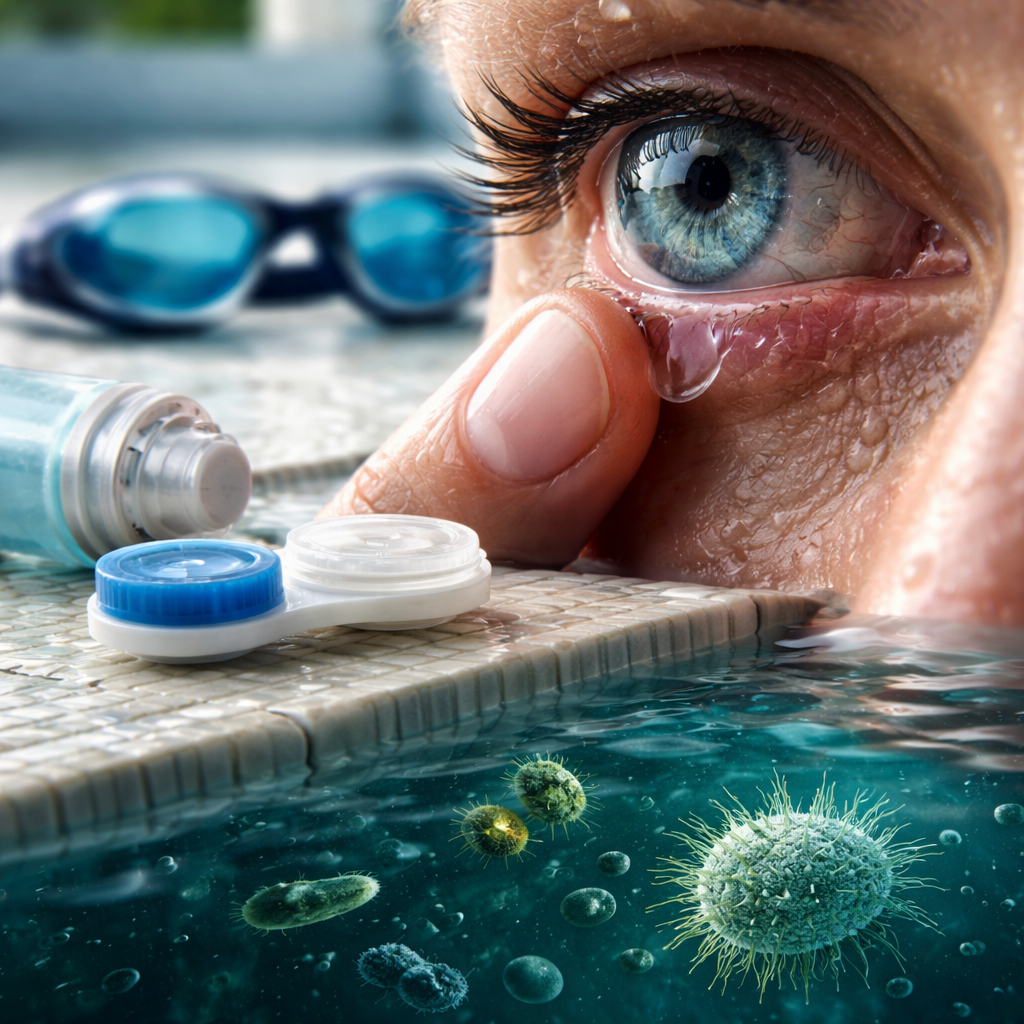
Most eye doctors will give you a pretty clear answer when asked: is it safe to wear contact lenses in a pool — and that answer is no. But understanding why helps you make smarter decisions, not just follow rules blindly.
What actually happens when contacts meet pool water
Pool water is not sterile, even when it looks clean and smells like chlorine. It contains a mix of microorganisms, chemical byproducts, and organic matter that can interact with contact lenses in ways most swimmers never consider.
Soft contact lenses are made from porous hydrogel or silicone hydrogel materials. When submerged, they absorb surrounding water — including whatever is dissolved in it. Chlorine alone does not eliminate all pathogens. Bacteria like Pseudomonas aeruginosa and a microorganism called Acanthamoeba are known to survive in treated pool water and can become trapped between the lens and your cornea.
The Acanthamoeba risk is not something to dismiss
Acanthamoeba keratitis is a rare but serious eye infection that can lead to permanent vision loss. It is most commonly associated with contact lens wear and exposure to water — including pools, hot tubs, lakes, and even tap water used for lens rinsing.
According to the Centers for Disease Control and Prevention (CDC), contact lens wearers are at significantly higher risk of Acanthamoeba keratitis, and water exposure is one of the primary contributing factors.
The infection is difficult to diagnose early because its symptoms — eye redness, pain, blurred vision, and light sensitivity — closely resemble other common eye conditions. Treatment is lengthy and not always fully effective, which is why prevention is so strongly emphasized.
Other real risks beyond infection
Infection is the most serious concern, but it is not the only one. Here is what else can go wrong when you swim with contacts:
- Lens displacement or loss — water movement and pressure can shift lenses off-center or wash them out entirely
- Corneal irritation — pool chemicals can cause temporary but uncomfortable inflammation of the eye surface
- Dry eye symptoms — contact lenses already reduce oxygen flow to the cornea, and pool exposure can worsen lens dehydration
- Chemical absorption — lenses can absorb chlorine and other pool chemicals, prolonging their contact with the eye even after you exit the water
These issues apply to both daily disposable lenses and extended-wear varieties. No type of soft contact lens offers protection in aquatic environments.
What about rigid gas-permeable lenses?
Rigid or hard contact lenses are less porous than soft lenses, which means they absorb less water. However, they are even more likely to be dislodged by water, and the infection risk from microorganism exposure still applies. Eye care professionals do not recommend them for swimming either.
Practical alternatives worth knowing about
If you need vision correction in the water, there are options that do not compromise your eye health.
| Option | How it works | Best for |
|---|---|---|
| Prescription swim goggles | Custom-made or available in standard powers | Regular swimmers who need clear underwater vision |
| Corrective goggles with inserts | Prescription lens inserts fit inside standard goggles | People with astigmatism or complex prescriptions |
| LASIK or laser eye correction | Permanent vision correction procedure | Those who want a long-term solution |
| Wearing glasses up until entering the water | Simply remove before entering the pool | Casual swimmers who do not need underwater vision |
Prescription swim goggles are the most practical solution for frequent swimmers. They are widely available online and through optical retailers, and a standard eye exam is all you need to get the right power.
If you already swam with contacts on
It happens. Maybe you forgot, maybe it was a spontaneous swim. Here is what eye care professionals typically recommend in that situation:
- Remove the lenses immediately after leaving the water — do not wait until you get home
- Do not reuse the lenses — discard them even if they feel fine
- Rinse your eyes with sterile saline solution if available
- Monitor your eyes for any redness, discomfort, or changes in vision over the following days
- Contact an eye doctor if any symptoms appear — early treatment of infections is critical
Your eyes are worth the extra step
The convenience of keeping contacts in during a swim does not outweigh the potential consequences. Vision loss from Acanthamoeba keratitis, while rare, is a documented and preventable outcome. The infections that contacts facilitate in aquatic settings can be aggressive and slow to respond to treatment.
Prescription goggles are inexpensive relative to the cost of treating a serious eye infection — financially and otherwise. Building the habit of removing lenses before any water activity, whether a pool, ocean, or even a shower, is one of the simplest protective steps a contact lens wearer can take.
Talk to your optometrist if you are unsure about the right approach for your specific prescription and lifestyle. They can help you find a solution that keeps both your vision and your eye health intact — in and out of the water.
