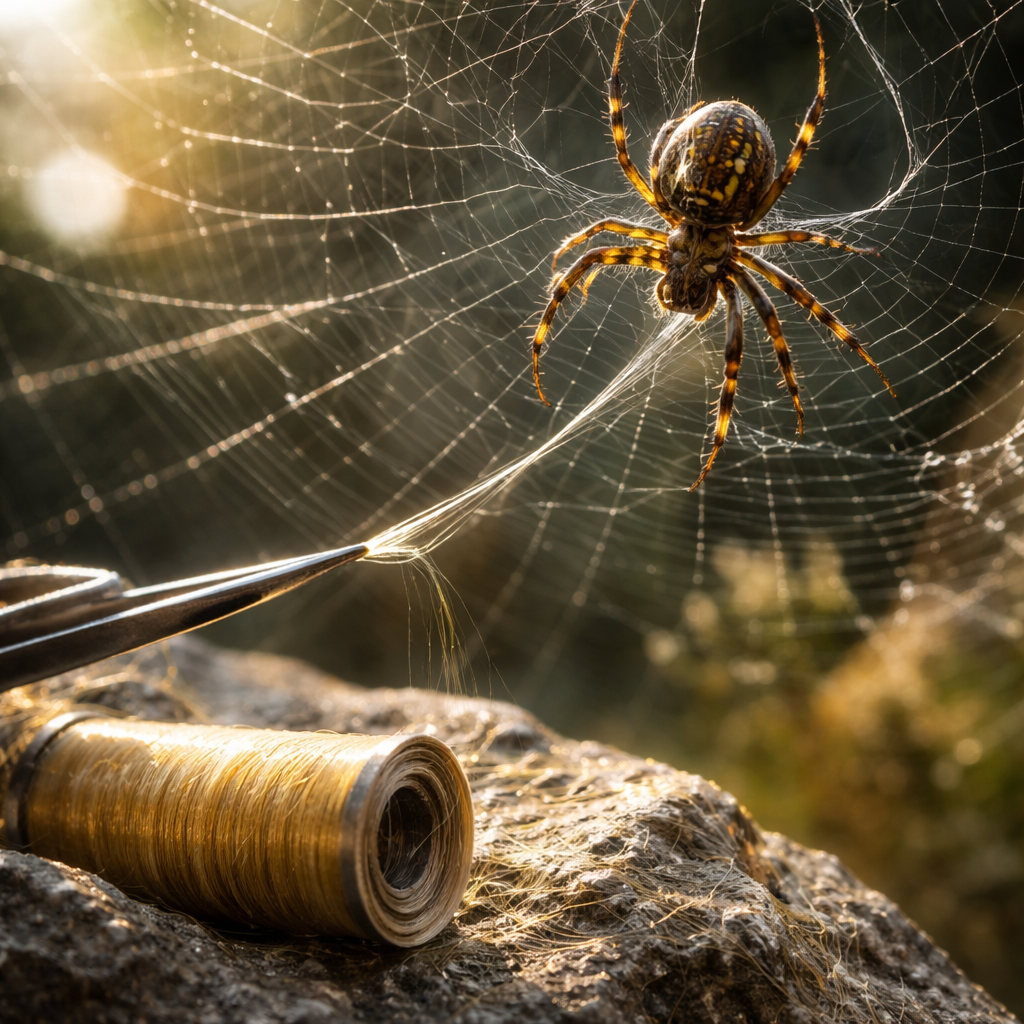
Spider silk is one of the most extraordinary biological materials ever studied — stronger than steel by weight, more elastic than nylon, and produced by an animal that fits in the palm of your hand. The facts about spiders and silk reveal a world of engineering precision that humans are still trying to fully understand and replicate.
A thread stronger than you think
When scientists compare spider silk to other known materials, the results are consistently surprising. A strand of dragline silk — the type spiders use for the outer frame of their webs — has a tensile strength comparable to high-grade steel, yet it weighs roughly six times less. What makes this even more remarkable is its elasticity: silk can stretch up to 40% of its original length before breaking, which steel simply cannot do.
This combination of strength and flexibility is what engineers call “toughness” — and spider silk outperforms almost every synthetic material currently in production when measured by this standard.
Not one silk, but many
Most people imagine spiders producing a single type of thread. In reality, a single spider can produce up to seven distinct types of silk, each with a different structure and function. This variety is part of what makes arachnid biology so fascinating to researchers.
- Dragline silk — used for the web’s structural frame and as a safety line when the spider drops
- Capture spiral silk — the sticky threads that trap insects, stretchy and coated with adhesive droplets
- Tubuliform silk — produced by females to wrap egg sacs and protect developing eggs
- Aciniform silk — used to wrap and immobilize prey after capture
- Piriform silk — a cement-like silk used to attach threads to surfaces
- Minor ampullate silk — a secondary structural thread, less studied but structurally distinct
- Flagelliform silk — the ultra-elastic core of capture spirals
Each type is produced by a different gland, and the spider controls which gland it uses depending on what task it’s performing at any given moment. This biological multitasking has no real parallel in the animal kingdom.
How silk is actually made
Silk begins as a liquid protein solution stored inside the spider’s silk glands. As the spider pulls the thread through tiny nozzles called spinnerets — located at the rear of the abdomen — the proteins undergo a rapid structural change. Through a combination of mechanical drawing and chemical shifts in pH and ion concentration, the liquid solidifies into a solid fiber almost instantly.
The process of silk formation happens in milliseconds, yet it produces a fiber whose molecular architecture rivals anything a modern laboratory can engineer from scratch.
The key proteins involved are called spidroins — large, repetitive molecules that fold in very specific ways to give silk its unique mechanical properties. Researchers have been working for decades to synthesize these proteins artificially, with partial but not yet complete success.
What the numbers actually say
| Material | Tensile Strength (GPa) | Elasticity | Weight |
|---|---|---|---|
| Dragline spider silk | 1.1–1.4 | Up to 40% | Very light |
| High-tensile steel | 1.0–1.5 | Less than 1% | Heavy |
| Kevlar | 3.6 | Less than 4% | Light |
| Nylon | 0.9 | Up to 20% | Very light |
As the table shows, spider silk doesn’t necessarily win on raw tensile strength alone — Kevlar beats it in that category. But when toughness (the combination of strength and elasticity) is factored in, silk holds its own against any synthetic fiber currently manufactured at scale.
Why spiders don’t get stuck in their own webs
This is one of those questions that sounds simple but has a genuinely interesting answer. Spiders avoid their own sticky capture threads through a mix of behavioral and physical adaptations. They move primarily along the non-sticky structural threads — the radial lines — and their legs are coated with a special oily substance that reduces adhesion even when contact with sticky silk does occur.
Some species also have specialized claws and leg hairs that help them navigate the web without triggering the adhesive properties of the spiral threads. It’s a system built on precision, not luck.
Real-world applications that are already in development
The potential uses for spider silk-inspired materials span multiple industries, and research in biomaterials has been pushing these possibilities forward steadily.
- Medicine — silk-based sutures and scaffolds for tissue engineering are being tested due to silk’s biocompatibility and low toxicity in the human body
- Defense — lightweight body armor using silk-inspired fibers is an active research area, given silk’s ability to absorb impact energy
- Aerospace — ultra-light, high-strength tethers and materials for use in extreme temperature conditions
- Wearable technology — flexible electronics that need to bend and stretch without losing function
The main obstacle to large-scale use has always been production. Unlike silkworms, spiders are territorial and cannibalistic, making farming them impractical. This has pushed scientists toward biosynthetic approaches — using bacteria, yeast, and even goats genetically modified to produce silk proteins in their milk.
Spider diversity and silk variation across species
With over 45,000 known spider species on Earth, silk properties vary enormously depending on the species, habitat, and evolutionary history. Orb-weaving spiders — the classic garden web builders — tend to produce the most studied and mechanically impressive silks. But other families have developed their own remarkable variations.
The Darwin’s bark spider, found in Madagascar, produces what is currently considered the toughest biological material ever recorded — its dragline silk is more than twice as tough as any other spider silk studied to date. Meanwhile, spitting spiders fire a stream of venomous silk to immobilize prey from a distance, a completely different use of silk production that has little to do with web-building at all.
The more you look, the more complex it gets
Spider silk research keeps expanding because the more closely scientists examine it, the more layers of complexity they find. The nano-scale structure of silk fibers, the way silk proteins self-assemble, the role of water in altering silk properties — all of these are active areas of study. Wetted silk, for instance, can actually contract and pull with measurable force, a property that some researchers are exploring as a basis for artificial muscles.
What started as curiosity about a sticky web has grown into one of the most interdisciplinary research fields in modern biology — connecting materials science, biochemistry, evolutionary biology, and engineering in ways that few other natural phenomena can.
