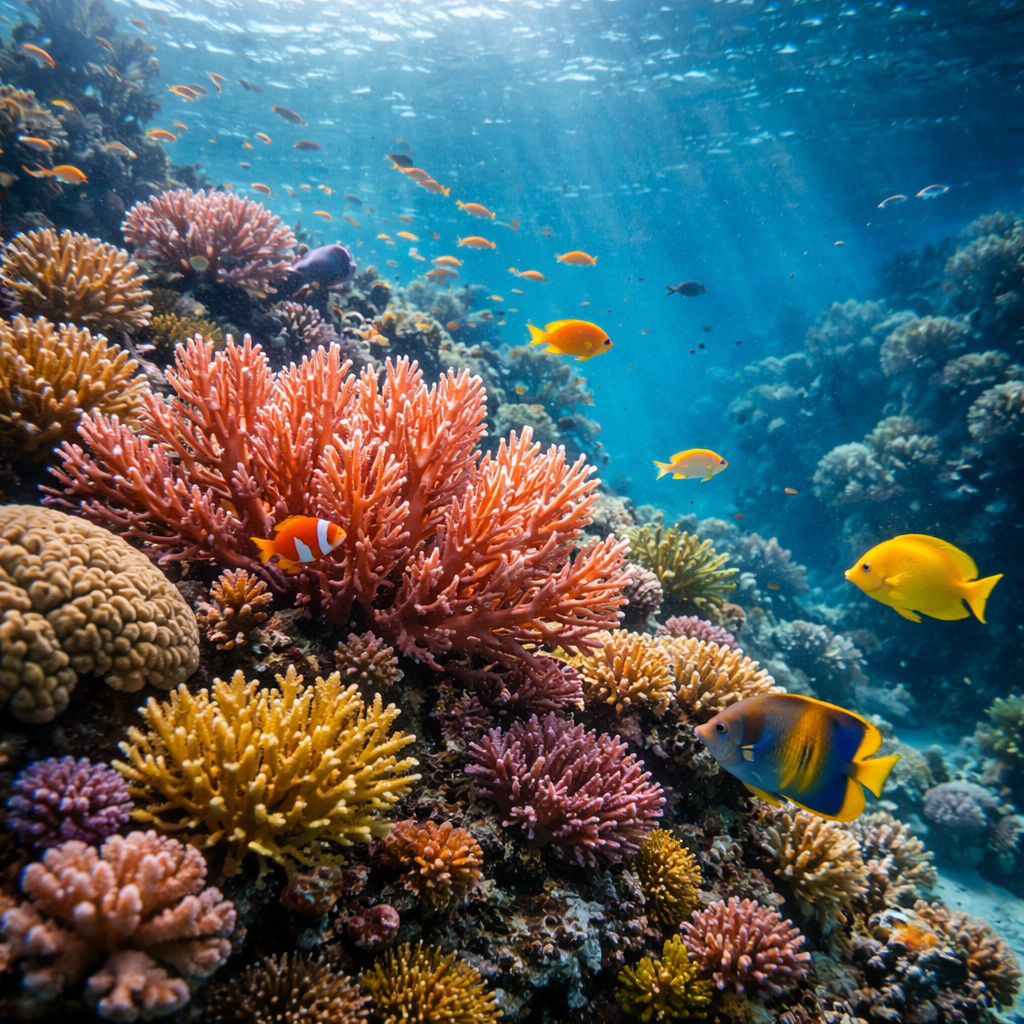
Most people know coral reefs as colorful underwater landscapes, but the facts about coral reefs go far deeper than their visual appeal. These ecosystems cover less than one percent of the ocean floor yet support roughly a quarter of all known marine species — a proportion that still puzzles researchers and highlights just how extraordinary these structures really are.
Coral is not a plant — and not quite an animal either
One of the most common misconceptions is that coral is a type of underwater plant. In reality, coral is an animal — or more precisely, a colony of tiny animals called polyps. Each polyp is a soft-bodied organism that secretes a hard calcium carbonate skeleton around itself. Over time, as generations of polyps live and die, those skeletons accumulate and form the physical structure we recognize as a reef.
What makes coral biology even more fascinating is its relationship with algae. Inside coral tissue lives a microscopic algae called zooxanthellae, which performs photosynthesis and provides the coral with up to 90% of its energy needs. In return, the coral offers the algae shelter and access to sunlight. This symbiotic partnership is the engine behind reef productivity — and it’s also the reason coral bleaching is so destructive. When water temperatures rise, coral expels its algae, turning white and losing its primary food source.
Scale, age, and geography — numbers that reframe everything
Coral reefs are ancient. The oldest reef systems on Earth are estimated to be around 50 million years old, though individual coral colonies can live for hundreds of years. The Great Barrier Reef, often cited as the world’s largest coral reef system, stretches over 2,300 kilometers along the northeastern coast of Australia and is large enough to be visible from space.
| Reef system | Location | Approximate size |
|---|---|---|
| Great Barrier Reef | Australia | 344,400 km² |
| Mesoamerican Reef | Caribbean Sea | ~1,000 km in length |
| Coral Triangle | Southeast Asia / Pacific | 6 million km² |
| Florida Reef Tract | United States | ~580 km in length |
The Coral Triangle, spanning waters across Indonesia, Malaysia, Papua New Guinea, the Philippines, Solomon Islands, and Timor-Leste, is considered the global center of marine biodiversity. It hosts over 600 coral species and more than 2,000 fish species — making it the tropical rainforest equivalent of the ocean world.
What reefs actually do for humans
The ecological role of coral reefs is well documented, but their economic and social significance is often underestimated. Healthy reef systems provide tangible, measurable benefits to human communities around the world.
- Coastal protection: Reefs act as natural barriers that absorb wave energy and reduce erosion, protecting shorelines and the communities that depend on them.
- Food security: Hundreds of millions of people, particularly in coastal and island regions, rely on reef-associated fisheries as a primary protein source.
- Medicine: Compounds derived from coral reef organisms have contributed to the development of treatments for cancer, HIV, and cardiovascular conditions.
- Tourism and livelihoods: Reef-based tourism generates billions of dollars annually and supports employment in dozens of countries.
- Scientific research: Coral skeletons act as natural climate archives, storing chemical records of ocean temperature and chemistry going back centuries.
Coral reefs have been described by marine biologists as the “cities of the sea” — not just because of their density and complexity, but because of the sheer number of interdependent relationships that make them function.
Threats that are reshaping reef ecosystems right now
Ocean warming is the most urgent and widespread threat facing coral reefs globally. Rising sea surface temperatures trigger mass bleaching events, which can kill large reef sections if the stress is prolonged. But temperature is not the only pressure these ecosystems face.
Ocean acidification — caused by the absorption of atmospheric carbon dioxide — reduces the availability of carbonate ions that corals need to build their skeletons. As oceans become more acidic, reef growth slows and existing structures become more fragile. Alongside these global stressors, local threats such as overfishing, runoff from agriculture, coastal development, and destructive fishing practices continue to degrade reef health in many regions.
Restoration science is advancing — and it’s genuinely promising
Over the past two decades, coral reef restoration has evolved from small-scale experimental projects into a recognized scientific field. Coral gardening — growing coral fragments on underwater nursery trees before transplanting them onto degraded reefs — is now practiced across the Caribbean, Pacific, and Indo-Pacific regions. Some programs have achieved transplant survival rates above 70%, which represents a meaningful improvement over earlier methods.
Researchers are also exploring selective breeding programs to develop coral strains with greater heat tolerance, as well as assisted gene flow techniques that introduce genetic material from more resilient populations into vulnerable reefs. While none of these approaches can replace the need to address the root causes of reef decline, they offer practical tools for buying time and preserving genetic diversity while broader changes take effect.
Another area gaining traction is the use of underwater acoustics. Studies have shown that playing recordings of healthy reef sounds in degraded areas attracts fish larvae, which accelerates natural recovery. It sounds unusual, but the ecological logic is sound: fish follow acoustic cues when selecting habitat, and a reef that sounds alive is more likely to become one.
Why the details change how we see the whole picture
Understanding coral reefs through their specifics — the biology of a single polyp, the chemistry of seawater, the acoustics of a recovering reef — shifts the way we think about ocean conservation. These are not abstract ecosystems that exist at a comfortable distance from everyday life. They are structured, dynamic, and deeply connected to human well-being in ways that continue to surprise even experienced marine scientists.
The more precisely we understand how reefs work, what they provide, and what they need to survive, the better equipped we are to make informed decisions — whether that means supporting conservation initiatives, making thoughtful choices about seafood, or simply recognizing the full weight of what is at stake when a reef system degrades. Curiosity, in this case, is one of the most useful tools available.
