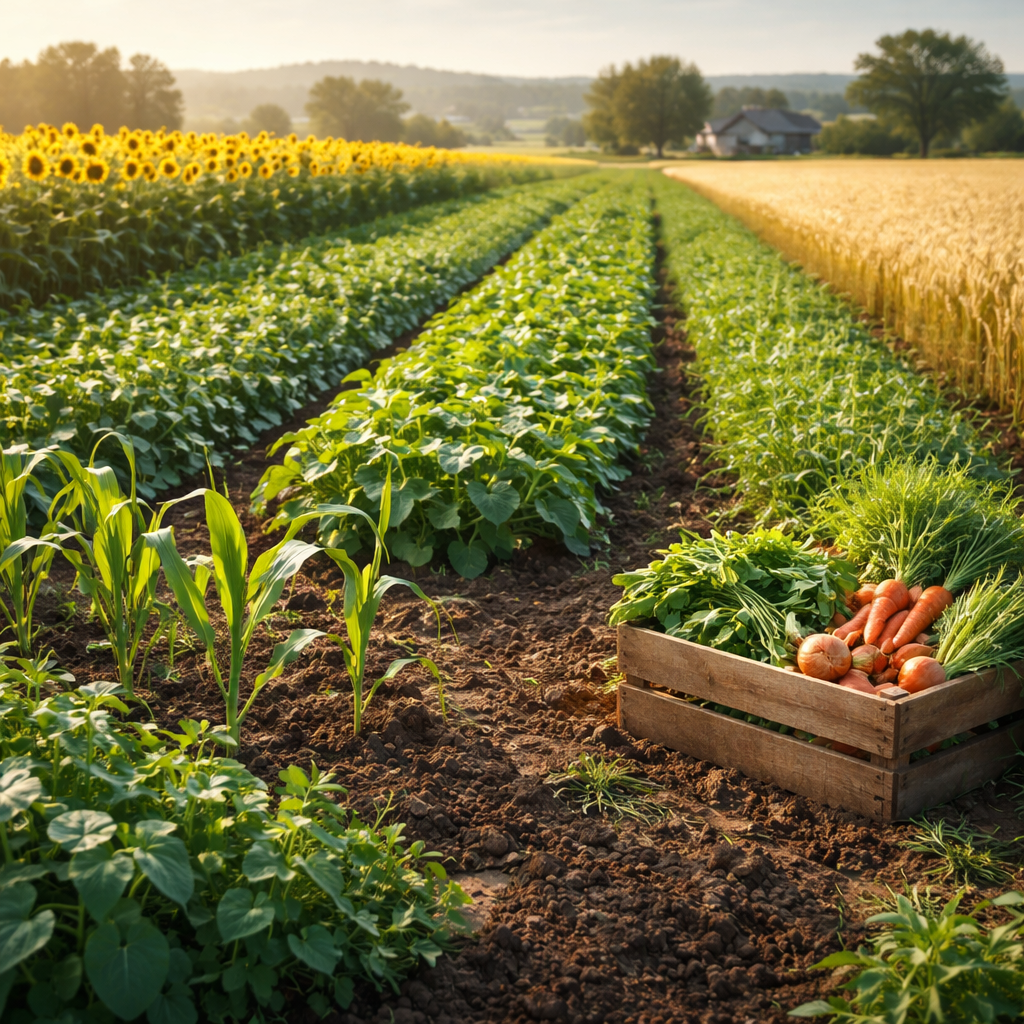
Soil exhaustion is one of the oldest problems in farming — and the advantages of crop rotation in agriculture have been helping growers tackle it for thousands of years. Yet despite its long history, rotation is anything but outdated. Modern agronomists, small-scale farmers, and even home gardeners keep returning to it because it delivers results that expensive inputs often cannot replicate on their own.
Why the order of crops matters more than most people think
Every plant species interacts with the soil in its own way. Some pull heavy amounts of nitrogen out of the ground; others actually fix atmospheric nitrogen through their root systems. Certain crops leave behind dense root structures that improve drainage, while others attract specific groups of pests and pathogens that can linger in the soil for seasons if the same host plant keeps returning. When a farmer plants the same crop year after year in the same field, these imbalances compound. Nutrient profiles shift. Pest populations build up. Soil structure weakens. Rotation interrupts this cycle at multiple levels simultaneously.
The core benefits broken down
There is no single reason why rotation works so well. Its strength lies in the combination of effects it produces across the growing season and from one season to the next.
- Soil fertility management: Legumes such as clover, peas, and soybeans host nitrogen-fixing bacteria in their root nodules. When these crops follow nitrogen-hungry cereals like wheat or corn, they help replenish what was taken — reducing dependence on synthetic fertilizers.
- Pest and disease suppression: Many soil-borne pathogens and insect pests are highly host-specific. Rotating to a non-host crop starves them out before populations reach damaging levels, cutting pesticide use significantly.
- Weed control: Different crops are grown using different cultivation techniques and planting densities. Alternating these disrupts the germination cycles of persistent weed species that thrive under monoculture conditions.
- Improved soil structure: Deep-rooted crops like sunflowers or turnips break up compacted layers that shallow-rooted species cannot reach, improving aeration and water retention for subsequent crops.
- Yield stability: Research consistently shows that fields under planned rotation produce more stable yields over time compared to continuously cropped land, even when input levels are held constant.
A well-designed rotation plan does not just protect this year’s harvest — it actively builds the productive capacity of the land for the seasons ahead.
Rotation and soil health: what happens underground
One of the most compelling arguments for rotation comes from soil biology. Healthy soil is not just a growing medium — it is a living ecosystem populated by bacteria, fungi, earthworms, and countless other organisms. Monoculture suppresses microbial diversity because it creates a uniform chemical environment that favors narrow groups of microbes. Rotation, by contrast, introduces variety: different root exudates, different organic matter inputs, different pH influences. This diversity supports a richer microbial community, which in turn drives better nutrient cycling and stronger natural disease suppression.
Mycorrhizal fungi are a good example. These organisms form symbiotic relationships with plant roots and dramatically extend the plant’s ability to absorb phosphorus and water. Their populations are sensitive to soil disturbance and chemical inputs, but they thrive in diverse cropping systems where their host range is not artificially narrowed.
A practical example: the classic four-field rotation
The four-field system developed in early modern Europe remains one of the most referenced examples of structured rotation, and its logic still holds in adapted forms today.
| Year | Crop | Primary benefit |
|---|---|---|
| Year 1 | Winter wheat | High-value grain; draws on residual fertility |
| Year 2 | Root vegetables (turnips) | Deep tillage effect; weed suppression |
| Year 3 | Spring barley | Disease break from wheat; different pest profile |
| Year 4 | Clover or legume mix | Nitrogen fixation; soil organic matter boost |
Modern adaptations of this model incorporate cover crops between main crops, green manures, and intercropping strategies that push the benefits even further. The core principle, however, remains unchanged: deliberate variety over time.
Rotation in the context of sustainable and organic farming
For organic producers, crop rotation is not optional — it is foundational. Without synthetic pesticides and soluble fertilizers as a fallback, the biological services that rotation supports become the primary tools for maintaining productivity. Organic certification standards across most countries explicitly require documented rotation plans for this reason.
But rotation is equally relevant for conventional farms trying to reduce input costs or meet tightening environmental regulations. Integrated pest management programs, soil carbon sequestration initiatives, and water quality improvement schemes all point toward diversified cropping systems as a core strategy.
Reducing chemical dependency is not about abandoning productivity — it is about building systems that do more of the work naturally.
Common misconceptions worth addressing
Some growers hesitate to implement rotation because of perceived complexity or short-term economic pressure. A few widespread assumptions deserve a closer look.
- Rotation is only for large farms: Smaller operations and even garden plots benefit proportionally as much as large fields. The scale of implementation changes, but the biological principles do not.
- You need to rotate every single year: While annual rotation is ideal, even rotating every two to three years provides meaningful benefits over continuous cropping of the same species.
- It always reduces income: Short-term revenue from a lower-value break crop may seem like a loss, but the reduction in input costs and yield losses from pests and disease typically offsets this over a full rotation cycle.
Getting started: practical guidance for planning a rotation
Designing a rotation does not require advanced agronomy expertise — it requires knowing your soil, your market, and your most persistent problems. A few starting points:
- Identify your problem crops: Which species do you grow most often and where do you see repeated issues with pests, disease, or yield decline? These are the candidates that most need a break.
- Group crops by family: Plants in the same botanical family often share pests and diseases. Rotating within the same family provides limited protection — aim to move between unrelated families.
- Include at least one legume: Even a simple two-year rotation that alternates a cereal or vegetable with a nitrogen-fixing legume provides a measurable soil fertility benefit.
- Keep records: The benefits of rotation accumulate over years. Tracking what was grown where helps you recognize patterns and refine your plan based on real outcomes.
Local agricultural extension services, university research stations, and experienced neighboring farmers are all valuable sources of region-specific guidance. What works in a humid temperate climate may need adjustment for arid or subtropical conditions, but the underlying biology remains consistent.
What the land gives back when you work with it
Farming is ultimately a long-term relationship with a piece of land. Rotation is one of the clearest expressions of that long view — a willingness to invest in cycles that pay off not just this season, but across decades of cultivation. Fields that have been managed with thoughtful rotation for many years tend to show measurably better organic matter content, more stable yields under stress conditions, and lower baseline inputs needed to sustain productivity. These are not abstract environmental goals. They translate directly into operational resilience and economic sustainability for the people who farm the land.
Whether you manage thousands of acres or a backyard kitchen garden, the logic is the same: give the soil variety, give it time to recover, and it will work harder for you in return.
