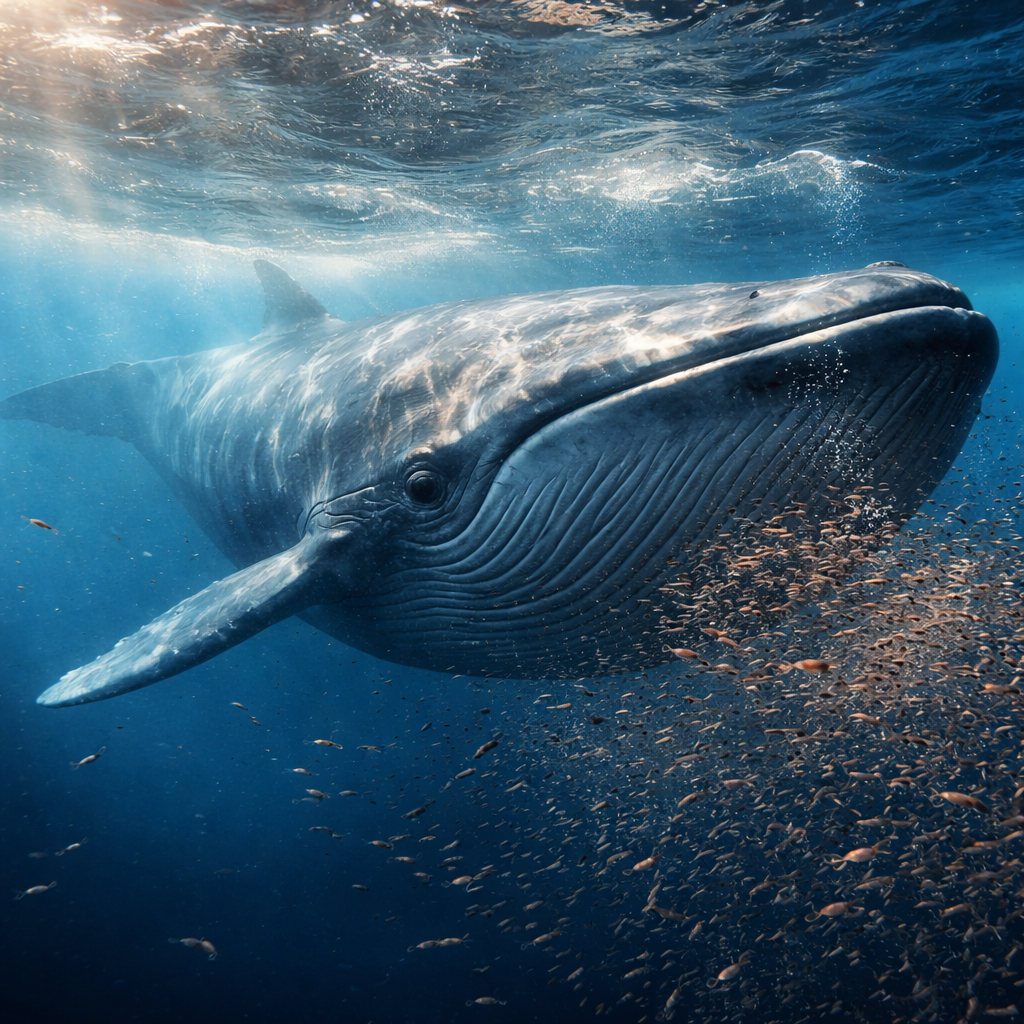
The ocean’s largest inhabitant tips the scales at up to 200 tons and stretches longer than two school buses end to end — and yet it survives on some of the tiniest creatures in the sea. The facts about blue whales tend to stop people in their tracks, not because they’re obscure, but because the sheer scale of this animal challenges what we think we know about life on Earth. Let’s dig into what makes this species genuinely extraordinary, layer by layer.
A body built beyond imagination
Blue whales (Balaenoptera musculus) are the largest animals known to have ever existed on this planet — not just today, but in the entire fossil record. Adults typically reach between 24 and 30 meters in length, with females generally growing larger than males. Their hearts alone can weigh as much as a small car, roughly 180 kilograms, and beat so slowly — around 4 to 8 times per minute when diving — that it’s barely detectable from the surface.
What’s perhaps even more striking is their tongue. It weighs approximately 2.7 tons, which is comparable to a full-grown Asian elephant. Yet this enormous tongue doesn’t help them chew — blue whales have no teeth. Instead, they use hundreds of baleen plates made of keratin to filter food from seawater.
| Body feature | Approximate size or weight |
|---|---|
| Total body length | 24–30 meters |
| Body weight | Up to 200 metric tons |
| Heart weight | ~180 kg |
| Tongue weight | ~2.7 metric tons |
| Newborn calf length | ~7–8 meters |
| Newborn calf weight | ~2.7 metric tons |
Feeding on the smallest prey in the ocean
There’s a certain irony in the fact that the largest animal alive depends almost entirely on krill — tiny shrimp-like crustaceans that measure just a few centimeters. During feeding season, a single adult blue whale consumes an estimated 3 to 4 tons of krill every single day. To put that in perspective, that’s roughly 40 million individual krill in a 24-hour period.
Blue whales are lunge feeders. They accelerate toward dense patches of krill, open their enormous mouths, and engulf thousands of liters of water at once. The water is then pushed through the baleen plates, trapping the krill inside. This feeding strategy is energy-intensive but highly efficient when prey density is high enough — which is why blue whales tend to follow krill blooms with seasonal precision.
Blue whales don’t just eat a lot — they have evolved one of the most energy-optimized feeding mechanisms in the animal kingdom, capable of capturing thousands of calories in a single lunge lasting just a few seconds.
How blue whales communicate across ocean basins
One of the most fascinating aspects of blue whale biology is their voice. Blue whales produce some of the loudest sounds of any animal on Earth, with calls reaching up to 188 decibels — louder than a jet engine at close range. These low-frequency vocalizations can travel thousands of kilometers through deep ocean channels, potentially allowing individuals to communicate across entire ocean basins.
Researchers have identified distinct vocal patterns in different populations around the world. Blue whales in the North Atlantic, for instance, produce calls that differ noticeably from those in the Indian Ocean or the Northeast Pacific. Scientists believe these regional “dialects” can help track population movements and identify separate groups — a tool that’s become essential for conservation monitoring.
Migration, lifespan, and reproduction
Blue whales are highly migratory. They generally spend summers in cold, polar-rich feeding grounds — areas like the waters around Antarctica or the North Atlantic — and migrate toward warmer tropical or subtropical regions in winter for breeding. However, some populations, such as those in the Eastern North Pacific, appear to follow less predictable routes tied to ocean temperature and prey availability.
In terms of lifespan, blue whales are estimated to live between 70 and 90 years under natural conditions. This estimate comes largely from earwax plug analysis — a layered structure that scientists can read like tree rings. Females give birth roughly every two to three years after a gestation period of about 10 to 12 months. Calves are nursed for around 7 months and gain weight at an extraordinary pace — up to 90 kilograms per day during nursing.
Conservation status and what actually threatens blue whales
Despite their immense size, blue whales are classified as Endangered on the IUCN Red List. Their global population was devastated during the era of industrial whaling in the 20th century, when an estimated 360,000 blue whales were killed in the Southern Ocean alone. Commercial whaling of blue whales was finally banned internationally in 1966, but recovery has been painfully slow.
Today, the primary threats facing the species are quite different from historical hunting:
- Ship strikes — blue whales surface slowly and are vulnerable to collisions with large vessels, particularly in busy shipping lanes
- Ocean noise pollution — human-generated underwater noise interferes with their long-range communication and navigation
- Climate change — warming oceans shift krill distribution, disrupting feeding patterns and migration timing
- Entanglement in fishing gear — less common than for other whale species but still documented
Current global estimates place the total blue whale population at somewhere between 10,000 and 25,000 individuals, depending on the methodology used. Some subpopulations, such as the Antarctic blue whale, remain critically low despite decades of protection.
Where blue whales actually live — and where to see them
Blue whales are found in every major ocean — the Atlantic, Pacific, Indian, and Southern Ocean — though their distribution is anything but uniform. Certain locations have become well-known hotspots for whale watching, particularly during feeding season when individuals aggregate around rich upwelling zones.
Some of the most reliable places where blue whales are regularly observed include the waters off Sri Lanka (particularly in the Gulf of Mannar), the coast of California near Monterey Bay, the St. Lawrence Estuary in Canada, and the waters around the Azores. These locations combine deep water with strong krill productivity, which consistently attracts the whales.
The science still catching up with the animal
For all their size, blue whales remain surprisingly difficult to study. They spend most of their lives in deep, open ocean — often far from shore — and their dive depths can reach 500 meters or more. Tagging technology has improved dramatically in recent decades, with satellite-linked tags and acoustic recording devices revealing migration routes and behavioral patterns that were completely unknown a generation ago.
Researchers are also exploring biopsy darts to sample skin and blubber for genetic and hormonal analysis, giving insight into reproductive cycles, stress levels, and population structure without capturing the animals. Every new dataset shifts our understanding in some direction — reinforcing just how much of this species’ life still unfolds beyond our direct observation. Blue whales have inhabited Earth’s oceans for millions of years, and in many ways, they still move through a world we’re only beginning to understand.
