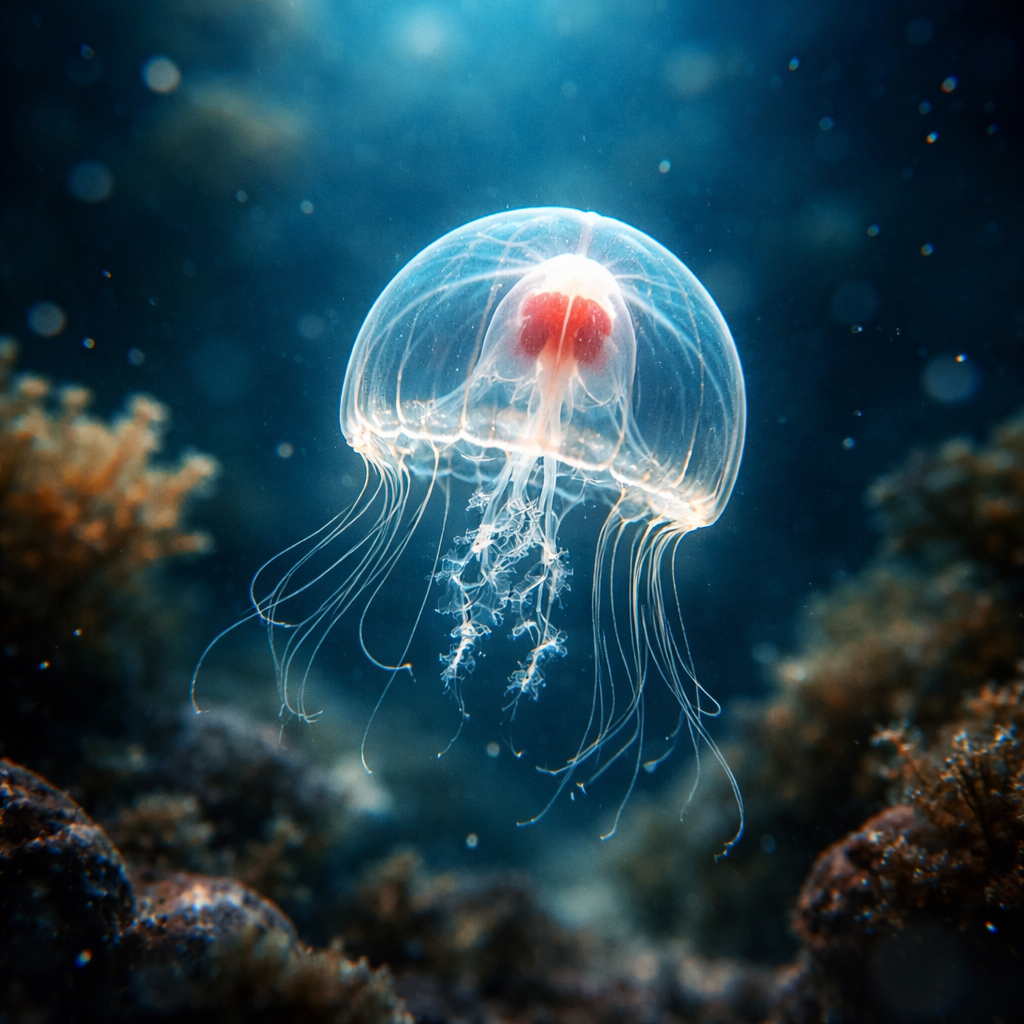
Most living organisms age and die — that’s a biological given. Yet the facts about jellyfish immortality challenge this assumption in a way that few scientific discoveries ever have. One tiny marine creature, Turritopsis dohrnii, has demonstrated a genuinely documented ability to reverse its own aging process, returning from an adult stage back to its juvenile form. This isn’t mythology or exaggeration — it’s a well-studied biological phenomenon that has reshaped how scientists think about aging, cellular reprogramming, and the limits of what life can do.
The creature behind the science
Turritopsis dohrnii is a small jellyfish — typically no larger than a fingernail — native to the Mediterranean Sea but now found in oceans worldwide, largely due to ballast water from cargo ships. It belongs to the class Hydrozoa and has a life cycle that, under stress or physical damage, can run in reverse.
Under normal conditions, this jellyfish follows a standard path: from larva to polyp, then from polyp to medusa (the swimming, bell-shaped adult). What makes it extraordinary is what happens next. When the adult medusa is injured, starving, or simply aging, it can revert back to the polyp stage through a process called transdifferentiation — where mature, specialized cells transform into a completely different cell type. From there, the organism can grow into a new adult all over again.
What transdifferentiation actually means
This term sounds technical, but the concept is striking in its simplicity. Normally, a differentiated cell — say, a muscle cell or a nerve cell — stays what it is for the life of the organism. Transdifferentiation breaks that rule. The cell “forgets” its identity and adopts a new one.
“It’s as if a butterfly could revert back to a caterpillar, and then become a butterfly again.” — a commonly used analogy among biologists studying Turritopsis dohrnii
In practice, the process involves cells in the jellyfish’s body undergoing wide-scale reprogramming — shifting gene expression, restructuring tissue, and rebuilding the entire organism from a biologically younger state. This is not the same as regeneration (regrowing a lost limb), nor is it reproduction. It is a genuine biological reversal of the life cycle.
Key facts that matter most
There’s a lot of noise around this topic online, so it helps to separate what is confirmed from what is speculation.
| Claim | Status |
|---|---|
| Turritopsis dohrnii can revert to polyp stage | Scientifically confirmed |
| The process can repeat indefinitely in lab conditions | Observed, though difficult to study long-term |
| The jellyfish is physically immortal in the wild | Not confirmed — predation and disease still apply |
| Humans could use the same mechanism to stop aging | Highly speculative, no current evidence |
| Other jellyfish species show similar behavior | Some relatives show partial reversal, less documented |
The distinction between biological potential immortality and actual immortality in the wild is important. In a natural ocean environment, these jellyfish are eaten, infected by parasites, and exposed to pollution. The cellular mechanism doesn’t protect them from the physical world — it only gives them a tool to reset their biology when internal conditions deteriorate.
Why researchers find this so valuable
The excitement in the scientific community isn’t really about living forever. It’s about understanding how cellular identity is established and whether it can be changed safely. Age-related diseases like cancer, neurodegeneration, and heart failure all involve cells that have lost normal function — either becoming locked into a damaged state or behaving in ways they shouldn’t.
If the mechanisms behind Turritopsis dohrnii’s cellular reversal can be mapped and understood, it opens theoretical doors to questions like: Can human cells be reprogrammed without becoming cancerous? Can damaged tissue in aging organs be encouraged to reset? These are long-horizon questions, but the jellyfish provides a natural model that no laboratory has yet been able to engineer.
Research into this area also connects to broader work on stem cells, epigenetic reprogramming, and longevity biology — fields that have gained significant traction in recent years. The jellyfish doesn’t hold all the answers, but it offers a proof of concept that biology itself has found a way to sidestep cellular aging.
Common misconceptions worth clearing up
- The jellyfish does not live forever without ever dying. Predators, environmental damage, and disease mean wild populations do not achieve perpetual survival.
- The reversion process is not instantaneous. It takes time, and not every individual successfully completes the cycle — especially outside of controlled conditions.
- Turritopsis dohrnii is not the only organism with unusual aging biology. Naked mole rats, certain species of lobster, and some turtles show remarkable resistance to age-related decline — though none have the same reversal mechanism.
- This is not a newly discovered species. It was first described in the late 19th century, but its life-cycle reversal wasn’t documented scientifically until the 1990s.
A perspective worth sitting with
What makes this topic genuinely fascinating isn’t just the biology — it’s what it implies about our assumptions. For a long time, aging was treated as inevitable and linear, a one-way street written into every living thing. Turritopsis dohrnii demonstrates that this isn’t universally true. Biology, under the right conditions, has found a workaround.
That doesn’t mean immortality is around the corner for humans. The gap between a 4-millimeter jellyfish and a complex mammal is enormous. But science rarely makes sudden leaps — it builds slowly on unexpected discoveries, and this one is as unexpected as they come. Understanding how a small, nearly transparent animal resets its own biological clock may end up being one of the more significant threads that researchers pull on in the study of aging and cellular biology for a long time to come.
