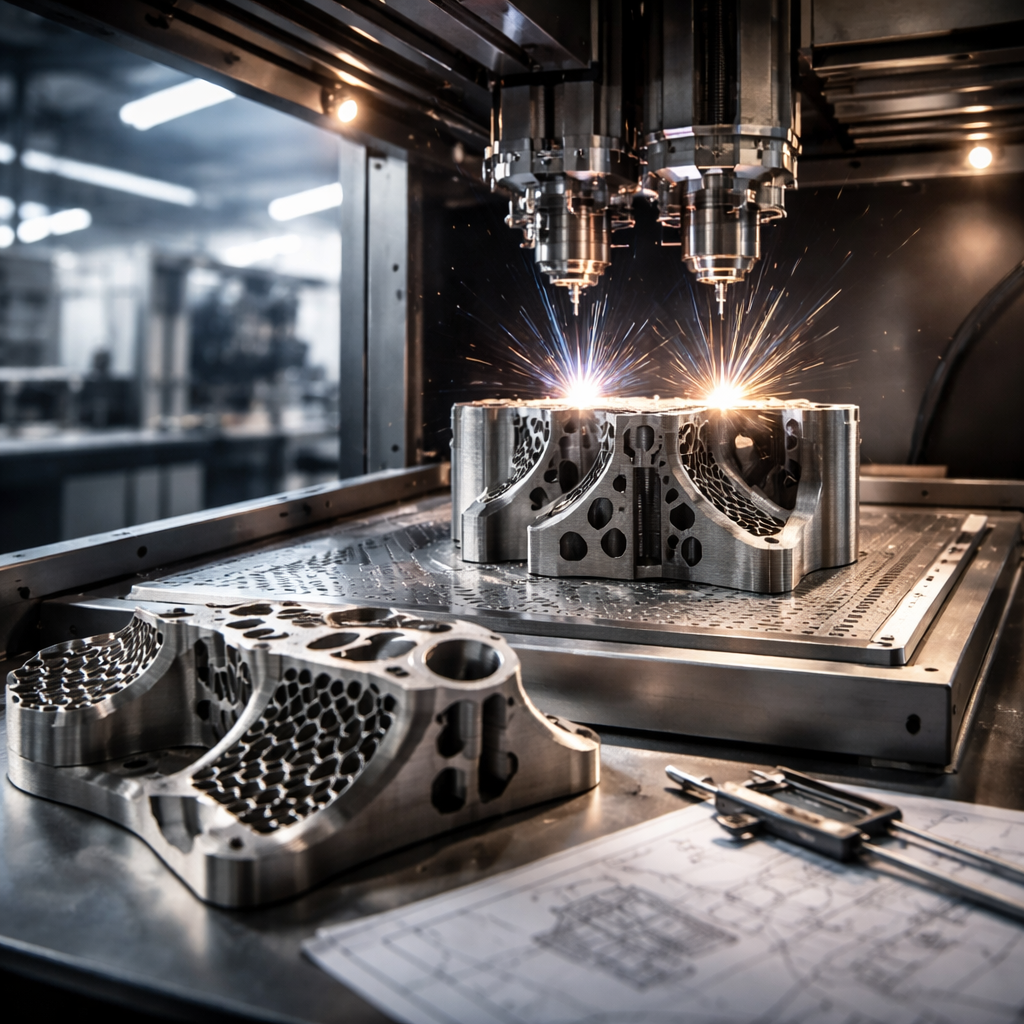
When a spare part breaks on an assembly line and the replacement won’t arrive for three weeks, the real cost isn’t the part — it’s the downtime. That single scenario captures why the advantages of 3D printing in manufacturing have moved from a niche conversation to a boardroom priority across automotive, aerospace, medical devices, and consumer goods industries worldwide.
From prototype to production floor: how additive manufacturing changed the game
For decades, traditional subtractive manufacturing — cutting, drilling, milling raw material down to shape — defined how factories operated. The process works well at scale, but it carries hidden costs: expensive tooling, long setup times, and enormous material waste. Additive manufacturing flips that logic entirely by building objects layer by layer, using only the material the design actually needs.
This shift isn’t purely about efficiency. It fundamentally changes what is possible to manufacture. Lattice structures that are lighter than solid metal yet equally strong, internal cooling channels that snake through a component in ways no drill bit could follow, geometries that were once confined to a designer’s imagination — all of these become manufacturable realities with additive processes.
The practical benefits manufacturers are actually seeing
It’s worth separating marketing language from operational reality here. The benefits that consistently appear in engineering case studies and industry research fall into a few clear categories.
- Rapid prototyping: Design teams can iterate physical prototypes in hours rather than weeks, compressing product development cycles significantly.
- Tooling and jig production: Factories use 3D printing to produce custom fixtures, clamps, and assembly aids on demand, eliminating lengthy procurement lead times.
- On-demand spare parts: Digital inventory replaces physical warehousing. A file is stored; a part is printed when needed.
- Design freedom: Complex geometries, internal channels, and consolidated assemblies that replace multiple machined components with a single printed one.
- Reduced material waste: Powder-bed fusion and similar processes use only what the geometry requires, unlike CNC machining where up to 90% of raw material can become scrap.
- Customization at no extra cost: Personalised medical implants, patient-specific surgical guides, and bespoke consumer products can be produced without retooling.
These aren’t theoretical possibilities — they are documented applications running in production environments at companies including GE Aviation, Airbus, Stryker, and Adidas, among many others.
Where traditional manufacturing still holds the edge
A balanced view matters here. Additive manufacturing is not a universal replacement for injection moulding, casting, or CNC machining. For very high-volume production of simple geometry parts, traditional methods remain faster and cheaper per unit. The economics shift decisively in favour of 3D printing when volumes are low, geometry is complex, or customisation is required.
| Factor | 3D Printing | Traditional Manufacturing |
|---|---|---|
| Tooling cost | None required | High upfront investment |
| Cost per unit at high volume | Higher | Lower |
| Geometric complexity | Virtually unlimited | Constrained by toolpath access |
| Lead time for new designs | Hours to days | Weeks to months |
| Material waste | Low | Can be very high |
| Customisation cost | Minimal | Significant retooling required |
Understanding this comparison is essential for any manufacturer evaluating where additive technology fits into their production strategy. The most successful implementations tend to be hybrid — using 3D printing for specific components or stages while retaining conventional processes where they make economic sense.
Supply chain resilience and the digital inventory model
One consequence of global supply chain disruptions in recent years has been a surge of interest in distributed manufacturing — the idea that parts can be produced locally, on demand, rather than shipped from centralised facilities overseas. 3D printing sits at the core of this model.
Instead of storing thousands of spare parts in a warehouse that may become obsolete, companies can maintain a digital library of validated files and print what they need, where they need it, when they need it.
This approach reduces carrying costs, eliminates the risk of obsolete stock, and shortens the distance between demand and fulfilment. For industries like defence, maritime, and rail — where spare parts for legacy equipment can be nearly impossible to source — this capability isn’t a convenience, it’s a strategic necessity.
Material innovation is expanding what’s printable
Early industrial 3D printing was largely limited to plastics. The range of printable materials has expanded dramatically: high-performance polymers, titanium, stainless steel, aluminium alloys, cobalt-chrome, ceramics, and even continuous carbon fibre composites are now processed using various additive techniques including selective laser sintering, direct energy deposition, and binder jetting.
This expansion of the material palette has been decisive for adoption in demanding sectors. Aerospace components must withstand extreme temperatures and mechanical loads. Medical implants require biocompatibility and precise surface finishes. Tooling inserts need hardness and thermal conductivity. Each of these requirements is now addressable through additive manufacturing with the right material and process combination.
Start with tooling, jigs, and fixtures rather than end-use parts. The business case is easier to prove, regulatory hurdles are lower, and your team builds familiarity with design-for-additive principles before committing to higher-stakes applications.
Sustainability considerations that don’t get enough attention
The environmental dimension of additive manufacturing deserves more nuanced treatment than it typically receives. On one hand, the reduction in material waste compared to subtractive processes is a genuine advantage, particularly when working with expensive or resource-intensive metals like titanium. Localised production also reduces transportation emissions associated with global supply chains.
On the other hand, metal powder production is energy-intensive, some polymer powders have limited recyclability after repeated use, and the machines themselves consume significant electricity. A complete lifecycle assessment — from raw material to end-of-life part — is necessary to make honest sustainability claims. The picture is positive in many scenarios, but not uniformly so, and responsible manufacturers conduct that analysis before drawing conclusions.
What actually determines whether 3D printing works for your operation
Technology is only part of the equation. The manufacturers that get sustained value from additive manufacturing share a few common characteristics beyond simply purchasing equipment.
- They invest in training engineers to design specifically for additive processes, not just convert existing CAD files.
- They establish clear qualification and quality assurance processes for printed parts, especially in regulated industries.
- They identify the right applications — high-complexity, low-to-medium volume, high customisation — rather than trying to print everything.
- They integrate additive into a broader manufacturing strategy rather than treating it as a standalone technology.
The technology rewards thoughtful implementation. Companies that approach it as a solution looking for a problem tend to be disappointed. Those that start with a specific operational challenge — a bottleneck, a supply vulnerability, a design limitation — and evaluate whether additive manufacturing addresses it consistently find value worth building on.
The conversation around additive manufacturing has matured significantly. It is no longer about whether 3D printing belongs in industry — that question has been answered across thousands of production environments. The more interesting question now is how deeply it integrates into manufacturing strategy, and which capabilities it unlocks that weren’t economically or physically possible before.
