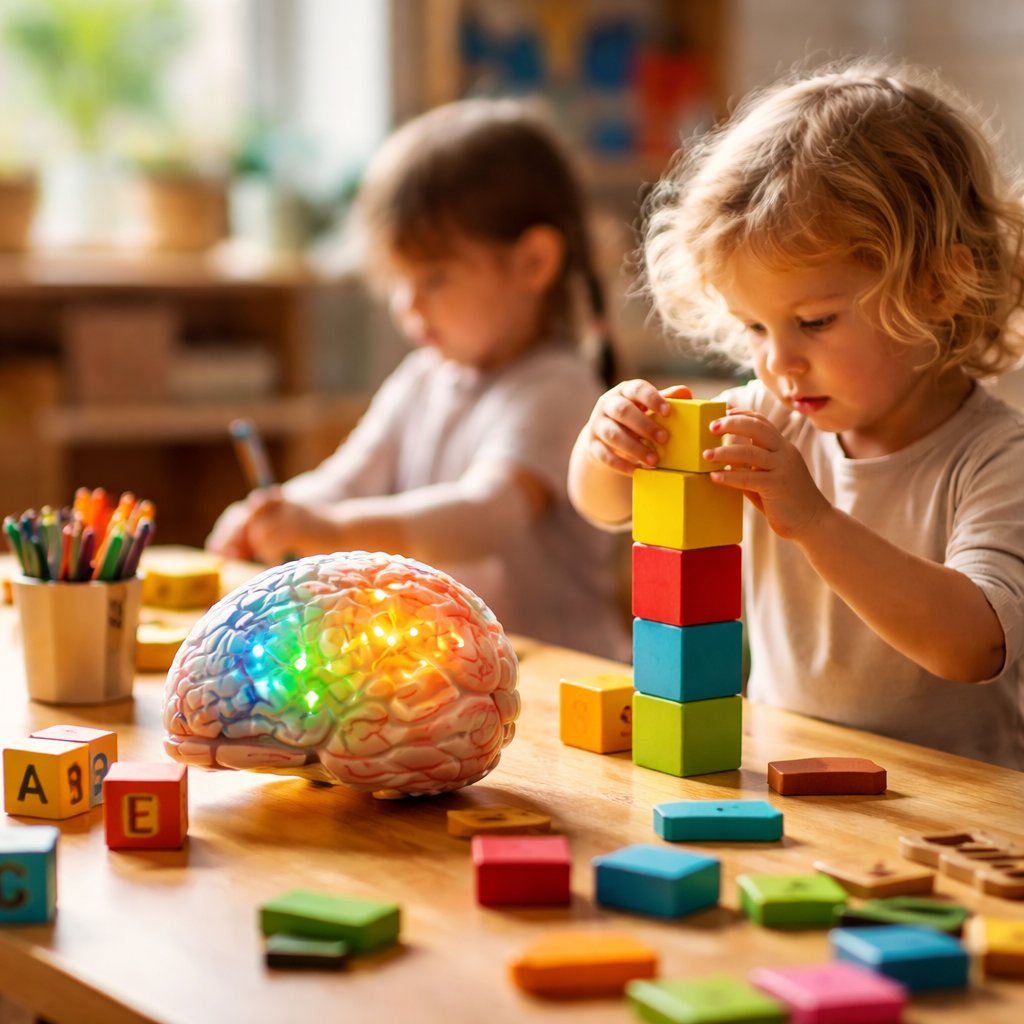
Most people assume that real learning begins in first grade — but research tells a very different story. The advantages of early childhood education go far beyond learning the alphabet or counting to ten. The first years of a child’s life represent a period of extraordinary brain development, and what happens during that time leaves lasting marks on cognition, social skills, emotional resilience, and even long-term health.
What actually happens in the developing brain before age six
Neuroscientists have documented that approximately 90% of a child’s brain development occurs before the age of five. During this window, neural connections form at a pace that will never be replicated later in life. Sensory experiences, language exposure, social interaction, and structured play all directly shape the architecture of the brain — literally wiring it for future thinking and learning.
This does not mean that children who miss formal early education are permanently disadvantaged. But it does mean that high-quality early learning environments can give children a meaningful head start — not by pushing academic content too early, but by nurturing curiosity, communication, and self-regulation in age-appropriate ways.
Social and emotional development: the foundation nobody talks about enough
Ask any kindergarten teacher what separates children who thrive from those who struggle, and the answer is rarely academic readiness. More often, it comes down to emotional regulation — the ability to manage frustration, wait for a turn, and recover from disappointment without shutting down.
Early childhood programs provide children with repeated, structured opportunities to practice exactly these skills. Through collaborative play, conflict resolution with peers, and relationships with caring educators, young children develop the emotional vocabulary and coping strategies they will rely on for the rest of their lives.
“Children who develop strong social-emotional skills in early childhood are more likely to form positive relationships, perform better academically, and demonstrate greater mental well-being throughout adolescence and adulthood.”
— Harvard Center on the Developing Child
Language, literacy, and the power of conversation-rich environments
One of the clearest benefits of quality early education is accelerated language development. Children in rich verbal environments — where adults ask open-ended questions, read aloud regularly, and respond meaningfully to children’s observations — build significantly larger vocabularies before entering primary school.
This matters more than many parents realize. Vocabulary size at kindergarten entry is one of the strongest predictors of reading comprehension in later grades. Children who arrive at school already comfortable with books, storytelling, and verbal expression have a measurable advantage that tends to compound over time.
| Skill Area | Without Early Education | With Quality Early Education |
|---|---|---|
| Vocabulary at age 5 | Varies widely, often limited | Typically broader and more diverse |
| Emotional regulation | Dependent primarily on home environment | Reinforced through structured peer interaction |
| School readiness | Lower average scores in early assessments | Higher readiness across multiple domains |
| Long-term academic outcomes | Greater risk of falling behind | Associated with higher graduation rates |
Cognitive skills that early learning quietly builds
Beyond language and emotion, early childhood education develops a cluster of cognitive abilities that researchers refer to as executive function — the mental toolkit that includes working memory, cognitive flexibility, and the ability to focus on a task while ignoring distractions.
These skills are not taught through worksheets. They are built through imaginative play, structured routines, problem-solving games, and creative challenges. A child building a block tower and figuring out why it keeps falling is, in a very real sense, practicing scientific reasoning and persistence.
- Working memory: holding information in mind while completing a task
- Inhibitory control: pausing before acting impulsively
- Cognitive flexibility: shifting between different tasks or perspectives
- Attention span: sustaining focus in structured and unstructured settings
- Problem-solving: experimenting and drawing conclusions from experience
Children who develop strong executive function in early childhood consistently show better academic outcomes — not just in reading and math, but across virtually every subject that requires sustained effort and self-direction.
The role of play — and why it should never be underestimated
There is a persistent misconception that play-based learning is somehow less rigorous than instruction-based learning. Early childhood researchers have consistently found the opposite to be true. When children engage in guided play — activities that are child-directed but shaped by a thoughtful educator — they learn in ways that are deeply meaningful and far more likely to be retained.
Role-playing scenarios build narrative thinking. Sensory play develops fine motor skills and scientific curiosity. Group games introduce concepts of fairness, rules, and cooperation. The best early childhood programs understand this and design environments where play and learning are inseparable.
Long-term outcomes that reach well beyond the classroom
The impact of quality early education does not stop at school readiness. Longitudinal studies — most notably the Perry Preschool Project and the Abecedarian Project — followed participants for decades and found that children who received high-quality early education were more likely to complete secondary school, more likely to maintain stable employment, and had lower rates of involvement with the criminal justice system.
These findings are not about any one specific curriculum. They point to something more fundamental: when children feel safe, stimulated, and genuinely seen during their earliest years, the effects ripple outward in ways that benefit not just individuals but entire communities.
Choosing the right early learning environment
Not all early education programs are created equal. The quality of teacher-child interaction is consistently identified as the single most important factor in whether an early learning program produces meaningful benefits. Look for programs where educators respond warmly and promptly to children, ask open-ended questions, and treat children’s ideas with genuine respect.
- Low child-to-teacher ratios that allow for individual attention
- A mix of structured activities and free exploratory play
- Educators with training in early childhood development
- A physically safe and emotionally predictable environment
- Regular, transparent communication with families
It is also worth remembering that early education does not have to mean formal preschool. High-quality parenting, community playgroups, and home-based learning can all provide many of the same developmental benefits — provided they are responsive, stimulating, and emotionally supportive.
What the evidence keeps pointing us toward
Decades of research across multiple disciplines — neuroscience, developmental psychology, economics, and education — consistently arrive at the same conclusion: investing in the earliest years of a child’s life yields some of the greatest returns of any educational intervention. The window is real, the benefits are well-documented, and the mechanisms behind them are better understood today than ever before.
For parents, educators, and anyone who cares about how children grow into capable, compassionate adults — understanding what happens in these foundational years is not just academically interesting. It is genuinely useful. Because the goal was never about creating academic high-achievers at age four. It was always about helping children feel confident, connected, and ready to face whatever comes next.
