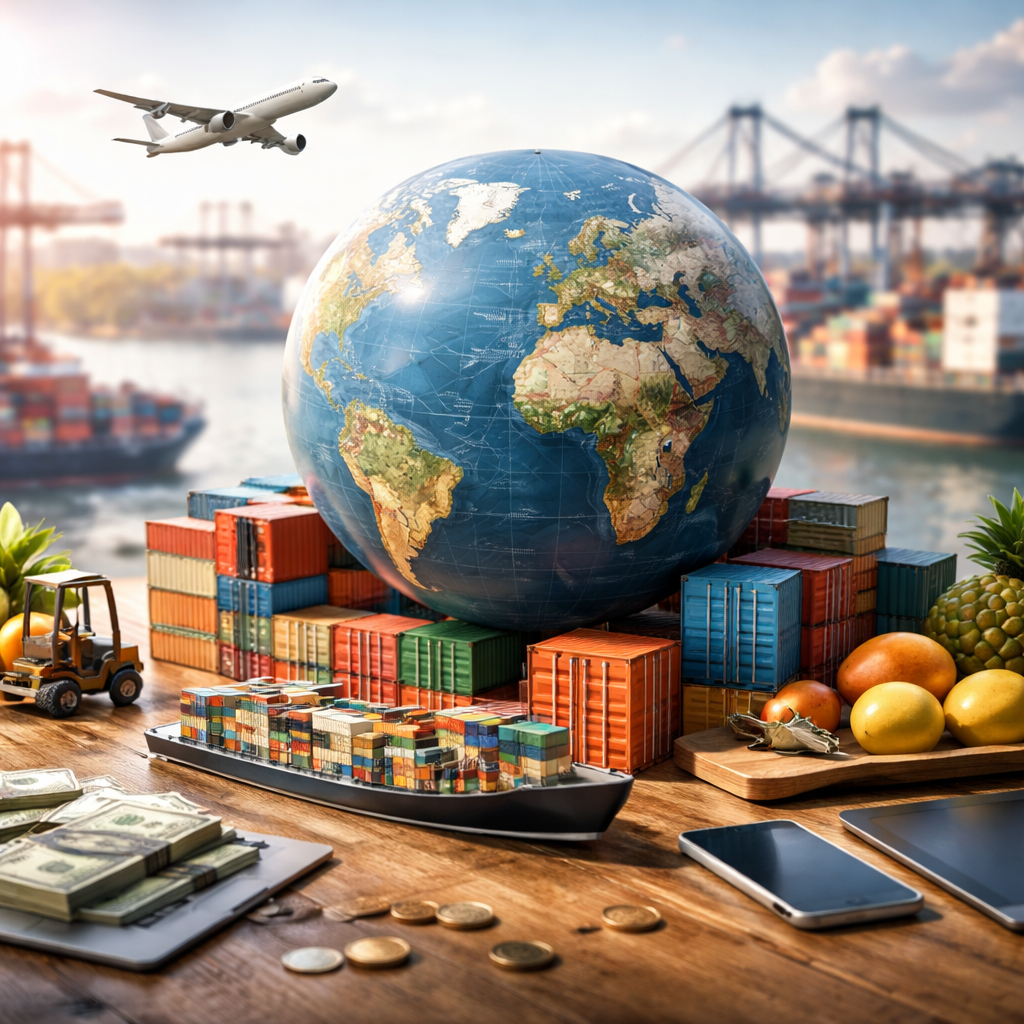
When a single country tries to produce everything its population needs, it almost always ends up doing most things poorly. The advantages of international trade become obvious the moment you compare living standards in open economies versus closed ones — the gap is rarely subtle. Cross-border commerce shapes not only what goods appear on store shelves, but also how competitive industries become, how many jobs exist, and ultimately how much purchasing power ordinary people hold in their hands.
Why specialization is the engine behind global commerce
One of the clearest economic arguments for trading across borders goes back to the principle of comparative advantage. A country doesn’t need to be the absolute best at producing something to benefit from selling it internationally — it simply needs to produce it at a lower opportunity cost than its trading partners. This insight, developed by economist David Ricardo in the early 19th century, still holds up remarkably well when you look at how modern supply chains are structured.
Vietnam dominates global textile exports not because its workers are uniquely skilled, but because labor costs and infrastructure align in a way that makes clothing production economically sensible. Meanwhile, Germany exports precision machinery because its industrial ecosystem — engineering talent, technical education, manufacturing culture — creates conditions that are hard to replicate elsewhere. Neither country is trying to do everything. Both are doing what they do best, and trading for the rest.
Economic growth that wouldn’t happen in isolation
Access to larger markets dramatically changes the math for businesses. A manufacturer selling only to domestic customers is limited by local demand. The same manufacturer with export access can scale production, lower per-unit costs, and reinvest profits into innovation. This dynamic creates a compounding effect: more exports fund more research, which leads to better products, which attract more foreign buyers.
Foreign direct investment flows through the same channels. When trade relationships are stable and predictable, companies are far more willing to build facilities, hire local workers, and transfer technology across borders. Countries that have embraced open trade policies consistently attract more of this investment than those that erect barriers.
“Trade is not a zero-sum game. When two countries exchange goods based on their respective strengths, both end up with more than they started with.”
What consumers actually gain
The benefits of international trade aren’t abstract — they show up in very concrete ways for everyday shoppers. Greater product variety is the most visible: without global trade, consumers in northern climates would never see tropical fruits, electronics would be far more expensive, and clothing choices would shrink dramatically.
But variety is only part of the picture. Competition from foreign producers forces domestic companies to keep prices in check. When local manufacturers know that cheaper or better alternatives are available from abroad, they have a real incentive to improve efficiency rather than pass costs on to buyers. This competitive pressure is one of the primary mechanisms through which trade reduces inflation and raises real wages over time.
| Benefit area | How it works | Who gains most |
|---|---|---|
| Lower consumer prices | Import competition reduces monopoly pricing | Households with moderate incomes |
| Product diversity | Access to goods not produced domestically | All consumers |
| Job creation | Export industries expand and hire | Workers in trade-exposed sectors |
| Technology transfer | Foreign investment brings know-how | Developing economies |
| Economic resilience | Diversified supply reduces local shocks | National economies broadly |
Employment, skills, and the broader labor market
Trade skeptics often point to job losses in industries that face foreign competition, and those concerns aren’t imaginary — displacement is real and can be painful for specific communities. But the fuller picture shows that export-oriented industries typically create more jobs than import competition eliminates, and those jobs tend to pay higher wages on average.
Beyond raw numbers, international trade shapes the skills a workforce develops. Companies that compete globally invest more in training, adopt newer technologies faster, and demand higher productivity — which translates into better-paid, more resilient employment over the long run. Workers in internationally active firms tend to have stronger career trajectories than those in purely domestic industries.
Geopolitics, diplomacy, and the peace argument
Economists and political scientists have long observed that countries deeply integrated through trade are far less likely to enter into military conflict with each other. This isn’t idealism — it’s incentive structure. When two countries are each other’s major trading partners, the economic cost of disrupting that relationship through conflict becomes enormous for both sides.
The European Union is perhaps the most-cited example. Western European nations that fought devastating wars throughout the first half of the 20th century built a framework of economic interdependence after World War II, and military conflict between member states has since become essentially unthinkable. Trade didn’t cause peace on its own, but it created powerful structural reasons to maintain it.
Innovation accelerates when ideas cross borders
Open trade doesn’t just move physical goods — it moves knowledge. When companies operate across multiple markets, they encounter different consumer preferences, regulatory standards, and competitive environments. That exposure forces adaptation and fuels innovation in ways that purely domestic operations rarely do.
Technology diffusion is closely linked to trade flows. Countries that are more open to imports of capital goods — machinery, electronics, industrial equipment — tend to adopt productivity-enhancing technologies faster. This effect is particularly significant for developing economies, where access to foreign technology can compress decades of industrial development into a much shorter timeframe.
- Exposure to foreign competition drives domestic companies to innovate or lose market share
- Multinational firms bring management practices and technical knowledge into host countries
- International research collaboration grows stronger when trade ties exist
- Consumer demand for global products pushes local producers to meet international quality standards
Trade isn’t painless — but the alternative is worse
No honest account of global commerce should pretend there are no downsides. Trade liberalization has disrupted industries, contributed to regional inequality in some countries, and created complex dependencies in global supply chains that became visible during recent disruptions. These are legitimate concerns that deserve serious policy attention.
But the answer to those problems has rarely been successful protectionism. Countries that shut their borders to protect inefficient industries typically end up with higher prices, lower innovation, reduced investment, and weaker long-term growth. The more productive path has generally been policies that help workers transition between industries while maintaining the economic openness that drives overall prosperity.
“The question was never whether trade creates disruption. It does. The real question is whether the gains — spread across millions of consumers and workers — outweigh the concentrated losses. Historically, they do.”
The bigger picture every economy eventually faces
As global supply chains grow more sophisticated and digital trade expands into services, software, and intellectual property, the nature of international commerce keeps evolving. But the underlying logic remains unchanged: no economy, regardless of size or resource endowment, is fully self-sufficient in a way that maximizes human welfare. Openness, with all its complexity, consistently produces better outcomes than isolation.
For individuals navigating career choices, business owners thinking about expansion, or simply curious people trying to understand why the world is organized the way it is — understanding how cross-border trade actually works, and why it matters, is genuinely useful knowledge. The global economy isn’t a distant abstraction. It’s the reason your coffee comes from Ethiopia, your phone was assembled in Asia, and the software you use was written by a team spread across five time zones.
