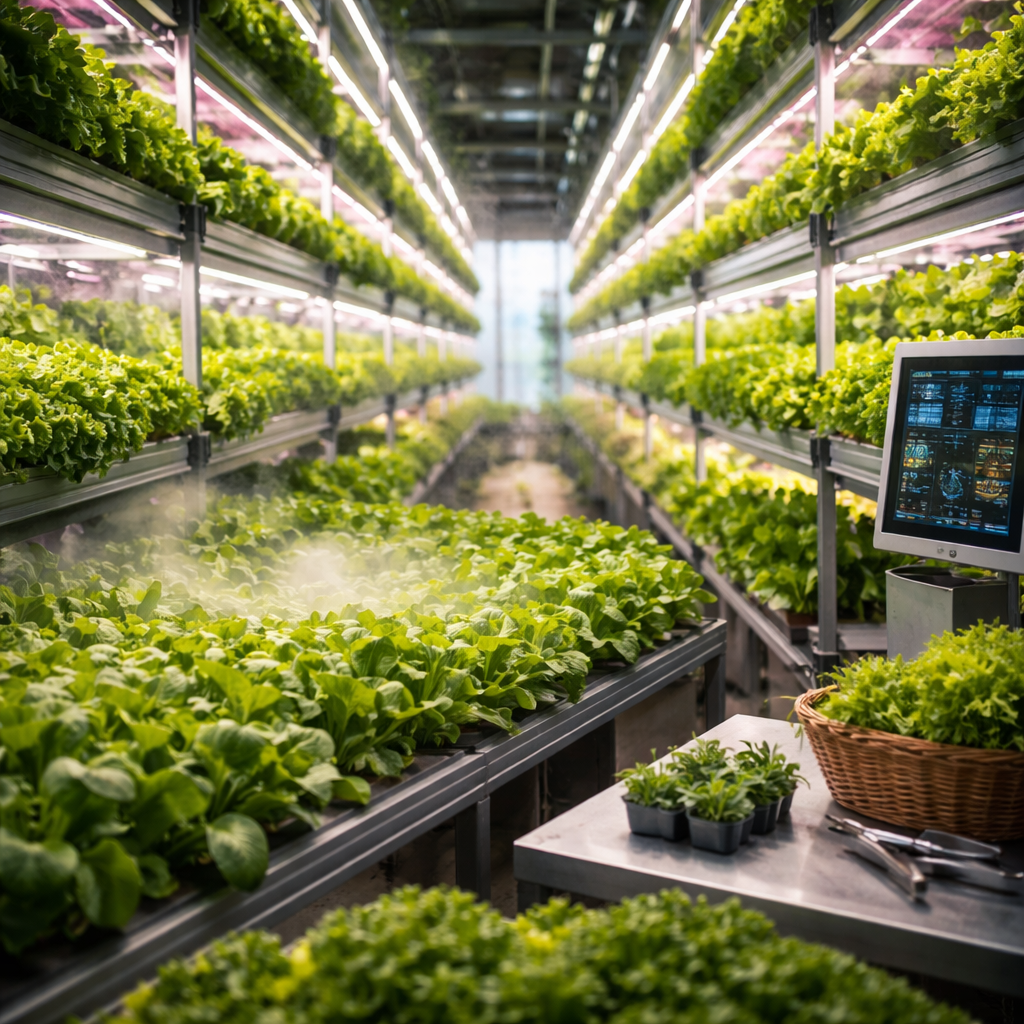
What if cities could grow their own food year-round, regardless of drought, frost, or shrinking farmland? That question is no longer hypothetical — it’s the driving force behind one of the fastest-growing sectors in modern agriculture. The advantages of vertical farming go far beyond novelty: they represent a measurable, practical shift in how we produce, distribute, and think about food systems.
Why traditional farming is running out of room
Agricultural land is under pressure from multiple directions — urban sprawl, soil degradation, and increasingly unpredictable weather patterns. Conventional outdoor farming relies heavily on geography, seasonal cycles, and large water inputs. Vertical farming was developed, in part, as a direct response to these constraints. Instead of spreading crops across flat land, vertical farms stack growing layers in controlled indoor environments, using significantly less physical space to produce comparable or greater yields.
This doesn’t mean vertical farming replaces all traditional agriculture overnight. But for specific crops — leafy greens, herbs, microgreens, strawberries — it offers a compelling alternative that’s already being scaled commercially.
Resource efficiency that actually holds up to scrutiny
One of the most frequently cited strengths of indoor farming is its water efficiency. Hydroponic and aeroponic systems, which are commonly used in vertical setups, recirculate water rather than allowing it to drain into the soil. Studies from multiple research institutions confirm that vertical farms can use up to 95% less water than conventional field farming for the same crops.
Beyond water, vertical farming eliminates the need for pesticides in most cases. Because the growing environment is sealed and controlled, there’s no exposure to outdoor insects or airborne pathogens. This reduces both chemical costs and the health risks associated with pesticide residue on produce.
| Resource | Conventional Farming | Vertical Farming |
|---|---|---|
| Water usage | High (rain + irrigation) | Up to 95% less |
| Land required | Large areas | Minimal footprint |
| Pesticide use | Frequent | Rarely needed |
| Seasonal dependency | Strong | None |
| Proximity to consumers | Often distant | Can be urban/local |
Controlled environment agriculture and crop consistency
In a vertical farm, variables like temperature, humidity, CO₂ levels, and light spectrum are dialed in with precision. This is what’s known as controlled environment agriculture (CEA). The result is a growing cycle that delivers consistent produce quality regardless of what’s happening outside — a heatwave, a cold snap, or a supply chain disruption.
For food retailers and restaurant buyers, this consistency is a genuine advantage. A vertical farm in the middle of a city can supply fresh basil or baby spinach every week of the year without the variability that comes with seasonal outdoor harvests.
“The ability to decouple food production from climate and geography is not a futuristic concept — it’s happening right now in urban warehouses, repurposed factories, and purpose-built facilities across multiple continents.”
Shorter supply chains and fresher produce on the shelf
One often underappreciated benefit of vertical farming is where it can be located. Because these systems don’t require soil or sunlight from the sky, they can be built inside cities — in warehouses, basement levels, or converted commercial buildings. This dramatically shortens the distance food travels from farm to table.
Shorter transport means less time in transit, which directly impacts freshness and nutritional content. Leafy greens, in particular, begin losing vitamins almost immediately after harvest. A local vertical farm can get produce to grocery shelves within hours rather than days.
- Reduced transportation emissions from shorter logistics routes
- Less food spoilage during transit
- Higher nutrient retention in fresh produce
- Ability to respond quickly to local demand fluctuations
- Potential for hyperlocal sourcing by restaurants and retailers
The land use argument — and why it matters more than it sounds
A single acre of vertical farming can produce the equivalent yield of multiple outdoor acres, depending on the crop. This isn’t a marketing claim — it’s a function of stacking growing layers vertically and running lights on optimized schedules. For a world where arable land is genuinely finite, this productivity-per-square-meter ratio has real long-term significance.
It also means that vertical farming can operate in places where conventional agriculture simply can’t — desert regions, Arctic climates, dense urban cores, or post-industrial zones with contaminated soil. This geographic flexibility opens up food production possibilities that were previously off the table.
Challenges worth acknowledging honestly
No fair assessment of vertical farming skips its limitations. Energy consumption is a legitimate concern — LED grow lights run continuously, and climate control systems require consistent power. This makes the carbon footprint of a vertical farm heavily dependent on the energy source powering it. Facilities running on renewable energy perform very differently in sustainability terms compared to those on coal-heavy grids.
Startup costs are also significant. Building and equipping a commercial vertical farm requires substantial capital investment, which is one reason the sector has leaned heavily on venture funding and why smaller-scale operations sometimes struggle to reach profitability.
These challenges don’t cancel out the benefits — but they do shape where and how vertical farming makes the most sense to implement.
Where the real value shows up — and who it’s for
Vertical farming isn’t trying to replace wheat fields or cattle pastures. Its strongest case is in high-value, fast-growing crops that are consumed fresh and close to where they’re grown. Think salad greens, culinary herbs, edible flowers, microgreens, and certain fruits like strawberries.
For urban consumers, the appeal is straightforward: fresher food, fewer chemicals, and a shorter chain between the farm and the plate. For policymakers and city planners, vertical farming represents a tool for improving urban food security — particularly in regions vulnerable to supply chain disruptions or climate-related agricultural losses.
And for anyone who’s simply curious about where the food system is heading, vertical farming is one of the clearest examples of how technology, sustainability, and practical need are converging in real time — not in a lab, but in operational facilities already supplying supermarkets and restaurants today.
