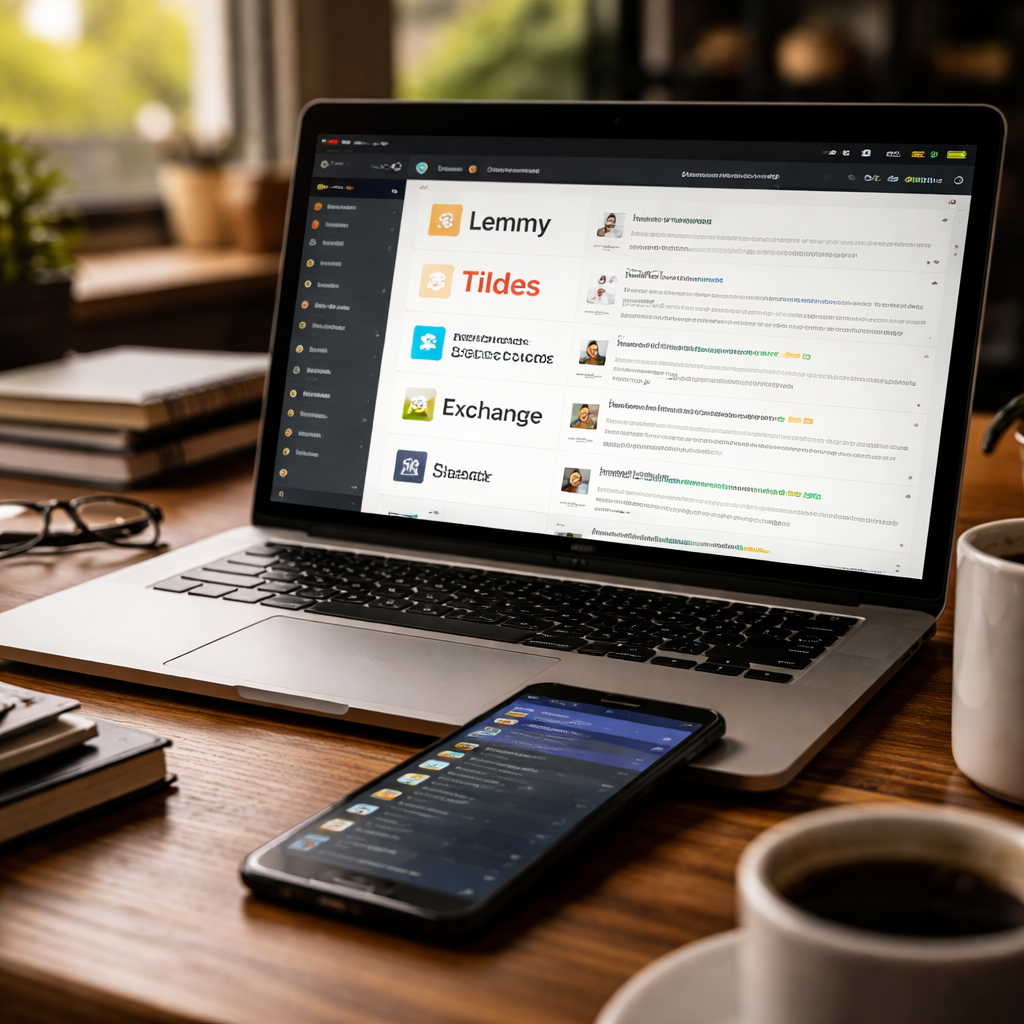
Most people who go looking for an alternative to Reddit are not trying to escape online communities — they just want something that fits better. Less noise, more niche depth, or simply a different culture around how conversations happen. The good news is that the landscape of discussion platforms has grown significantly, and there are real options worth knowing about.
Why people start looking elsewhere
Reddit has built one of the most expansive community ecosystems on the internet. But size comes with trade-offs. Many users report that popular subreddits have become harder to engage with — heavy moderation, frequent reposts, and an upvote system that tends to surface predictable content rather than genuinely interesting discussions.
Others are concerned about privacy, data usage, or the platform’s shifting API and third-party app policies. And some simply want a space that feels less chaotic — somewhere conversations stay on topic and new voices are not immediately buried under thousands of existing comments.
Platforms built around focused communities
One of the strongest alternatives in terms of community structure is Lemmy. It is an open-source, federated platform — meaning there is no single company controlling it. Instead, independent instances run by different communities connect through the ActivityPub protocol, the same standard behind Mastodon. You can join an instance that aligns with your interests and still interact with people across the entire network.
Tildes is another option that takes a deliberately different approach. It was built as a non-profit with a focus on thoughtful discussion. There are no upvote counts displayed publicly in a way designed to chase engagement, and the community actively discourages low-effort content. It is smaller, but that is partly the point.
The best online communities are not always the biggest ones. Often it is the smaller, well-moderated spaces that produce the most useful and honest conversations.
Interest-specific forums that go deeper
If the goal is depth on a specific subject rather than a general community platform, dedicated forums often outperform Reddit significantly. Platforms like Stack Exchange cover technical and knowledge-based topics with a structure designed for answers rather than discussion threads. For creative writing, fiction, and worldbuilding communities, Sufficient Velocity and SpaceBattles have active and well-organized user bases.
Gaming communities frequently find that Discord servers, while not forum-based, serve as far more responsive and topic-specific spaces than any subreddit. The real-time nature of chat combined with organized channels creates a different but often more engaging dynamic for hobbyist groups.
A quick look at the main options
| Platform | Best for | Key feature |
|---|---|---|
| Lemmy | General discussion, tech, news | Federated, open-source, no corporate ownership |
| Tildes | Thoughtful long-form discussion | Non-profit, invite-based, quality-focused |
| Hacker News | Tech, startups, science | Minimalist, high signal-to-noise ratio |
| Stack Exchange | Q&A on specific knowledge areas | Structured answers, expert community |
| Discord (servers) | Hobbyist and niche groups | Real-time, organized by topic channels |
Hacker News deserves a separate mention
Hacker News, run by Y Combinator, sits in a unique spot. It is not trying to replace Reddit across all topics — it is specifically focused on technology, science, and entrepreneurship. But within those areas, the quality of discussion is consistently high. Comments tend to be substantive, and the community has a strong norm against low-effort responses.
If your main Reddit usage was following tech or startup news, Hacker News is likely the clearest direct replacement. The interface is bare-bones by design, which also means it loads fast and stays distraction-free.
Things worth considering before switching
- No single platform replicates Reddit’s full breadth — most alternatives are stronger in specific niches
- Smaller communities mean less content volume but often higher quality interactions
- Federated platforms like Lemmy require a bit of setup to find the right instance for your interests
- Some communities exist simultaneously on multiple platforms, so you do not always have to choose
- Lurking before posting helps you understand the tone and unwritten rules of any new community
It is also worth noting that many people end up using more than one platform at the same time — Reddit for broad topic discovery, a dedicated forum for deeper engagement on specific interests, and something like Hacker News for professional or tech-oriented reading. There is no rule that says you need one single community hub.
The format matters as much as the platform
One thing that often gets overlooked is that the format of a platform shapes how conversations unfold. Reddit’s threading model encourages branching debates. Tildes encourages single-thread depth. Discord encourages fast back-and-forth. Hacker News almost discourages long arguments by convention.
Thinking about what kind of interaction you actually want — not just what topics you want to discuss — makes it much easier to find the right fit. Someone looking for long, researched responses on a niche hobby will have a very different experience on a focused forum than on a general-purpose voting-based platform.
Where to start if you have never explored beyond Reddit
The easiest entry point is usually Lemmy, particularly if you already know which topics matter most to you. Finding the right instance — whether that is one focused on technology, science, media, or local communities — takes maybe fifteen minutes of browsing, and the experience from that point forward is familiar enough that the learning curve is minimal.
For anyone drawn to quality over quantity, Tildes is worth the patience its smaller size requires. Conversations there tend to stay constructive longer than on most large platforms, and the lack of gamified metrics changes how participation feels in ways that are difficult to appreciate until you experience it directly.
The common thread across all these platforms is that the community — not the interface — determines the experience. Spending time where the people are genuinely interested and knowledgeable about what you care about will always matter more than which platform technically hosts the conversation.
