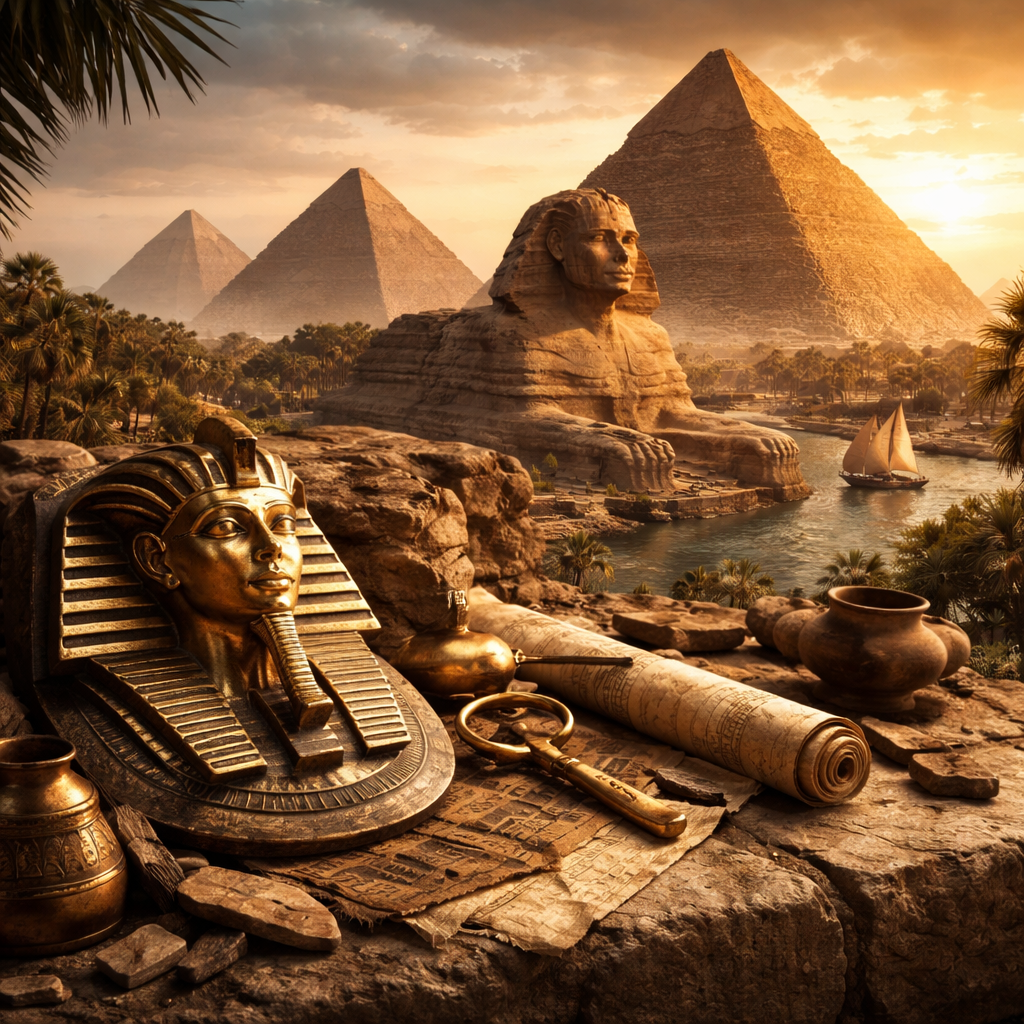
The ancient Egyptians built structures so precisely aligned with celestial bodies that modern engineers still struggle to replicate their methods — and that’s just one of the many remarkable facts about ancient Egypt that continue to reshape how we understand early human civilization. This culture didn’t simply exist; it engineered a way of life that lasted longer than any empire before or since.
A civilization measured in millennia, not centuries
Most people think of ancient Egypt as a single, unified era. In reality, Egyptian civilization spanned over three thousand years — longer than the time separating us from the fall of Rome. Historians divide this period into kingdoms and intermediate phases, each with its own political dynamics, artistic styles, and religious shifts. The Old Kingdom gave us the pyramids. The Middle Kingdom refined literature and trade. The New Kingdom produced military expansion and some of the most iconic pharaohs in history, including Ramesses II and Hatshepsut.
What makes this continuity even more astonishing is how deliberately Egyptians preserved it. Scribes trained for years to copy texts accurately. Priests maintained rituals with extraordinary consistency. The culture wasn’t static — it adapted — but it always anchored itself to the same core identity rooted in the Nile, the gods, and the concept of Ma’at, or cosmic order.
Engineering and astronomy woven into stone
The Great Pyramid of Giza was the tallest man-made structure on Earth for nearly four thousand years. Its four base sides are aligned to the cardinal directions with an accuracy of less than one-tenth of a degree. The internal chambers are positioned to align with specific stars during certain times of the year. This wasn’t decoration — it was intentional, ritualistic, and deeply connected to Egyptian beliefs about the afterlife and stellar navigation of the soul.
“The precision of Egyptian construction wasn’t a coincidence or a lucky guess. It reflects a sophisticated understanding of geometry, astronomy, and labor organization that took generations to develop.”
Beyond the pyramids, Egyptians developed a calendar based on the heliacal rising of Sirius — the star they associated with the goddess Isis. This astronomical event signaled the annual flooding of the Nile, which deposited rich silt and made Egypt’s agriculture possible. Their ability to predict and plan around natural cycles was central to the stability of the entire civilization.
Daily life looked very different from the monuments
Pharaohs and temples dominate modern imagination, but the majority of ancient Egyptians were farmers, craftspeople, and traders living in mud-brick homes along the Nile. Their daily existence was structured, communal, and surprisingly documented. Thanks to papyri, ostraca (inscribed pottery shards), and tomb paintings, historians know a great deal about what ordinary people ate, how they organized labor disputes, and even what games their children played.
- Workers who built the royal tombs received wages in the form of grain, fish, vegetables, and occasionally beer
- Medical papyri show that Egyptian physicians diagnosed conditions and prescribed treatments with a rational, observational approach
- Women in ancient Egypt could own property, initiate divorce, and conduct legal business — rights that many cultures didn’t grant until the modern era
- Board games like Senet were played by people across all social classes, not just elites
- Cats were not only valued but legally protected; harming one was considered a serious offense
These details shift the perspective considerably. Ancient Egypt wasn’t just a backdrop for royal drama — it was a functioning society with labor laws, medical knowledge, and social mobility built into its structure.
Religion as the operating system of Egyptian society
The Egyptian pantheon included over two thousand deities, but the religious system wasn’t chaotic. Different gods governed specific domains — Thoth oversaw wisdom and writing, Anubis guided the dead, Sekhmet represented war and healing. Temples weren’t just places of worship; they functioned as economic centers, hospitals, libraries, and administrative hubs. The priesthood held enormous political power, sometimes rivaling that of the pharaoh.
| Deity | Domain | Associated symbol |
|---|---|---|
| Ra | Sun, creation | Solar disk |
| Osiris | Death, resurrection | Crook and flail |
| Isis | Magic, motherhood | Throne headdress |
| Horus | Sky, kingship | Falcon |
| Anubis | Embalming, afterlife | Jackal |
The concept of the afterlife drove enormous portions of Egyptian culture and economy. Mummification was not merely a ritual — it was a sophisticated preservation process involving the removal of organs, treatment with natron salt, and wrapping in linen over many weeks. Wealthy individuals commissioned elaborate tombs stocked with food, tools, jewelry, and shabtis (small figurines meant to serve the deceased in the next world). Even the poorest burials showed evidence of care and intention.
Writing that changed the world
Hieroglyphics are among the most recognizable writing systems in history, but they were only one of several scripts used in Egypt. Hieratic, a cursive form, was used by scribes for administrative and religious documents. Demotic emerged later for everyday communication. The decipherment of hieroglyphics through the Rosetta Stone in the early nineteenth century unlocked millennia of recorded history that had been inaccessible for centuries.
The Egyptians also produced some of the earliest known literary texts. The Tale of Sinuhe, written during the Middle Kingdom, is considered one of the finest pieces of ancient literature and contains themes of exile, identity, and longing that feel entirely relatable today. Medical, mathematical, and astronomical texts also survive — including the Rhind Mathematical Papyrus, which demonstrates an advanced understanding of geometry and arithmetic.
What the Nile actually made possible
It’s impossible to separate ancient Egyptian civilization from the Nile River. The annual inundation cycle created one of the most fertile agricultural strips in the ancient world. This predictable abundance allowed the population to grow, specialize labor, and invest resources in monumental construction and artistic production. Without the Nile’s flood-and-retreat rhythm, the pyramids almost certainly wouldn’t exist.
The river also served as the country’s main highway. Heavy stone blocks, trade goods, and armies all moved by water. Egypt’s geographic isolation — desert to the east and west, sea to the north, cataracts to the south — made it naturally defensible and allowed internal culture to develop with relative consistency over centuries.
Ancient Egypt keeps revealing new layers
Archaeological discoveries continue to rewrite what we know. Recent excavations have uncovered workers’ villages near Giza that show pyramid builders were not enslaved — they were organized labor forces who received medical care, were buried with honor, and sometimes petitioned authorities over rations. Ground-penetrating radar and satellite imaging have revealed hidden chambers, unexcavated tombs, and entire buried cities that haven’t been touched in thousands of years.
Ancient Egyptian history is not a closed book — it’s a document still being read, one excavation at a time. The more researchers dig, the more this civilization proves to be far more nuanced, human, and sophisticated than the old image of pyramid-obsessed god-kings ever captured. That’s exactly what makes it so endlessly worth exploring.
