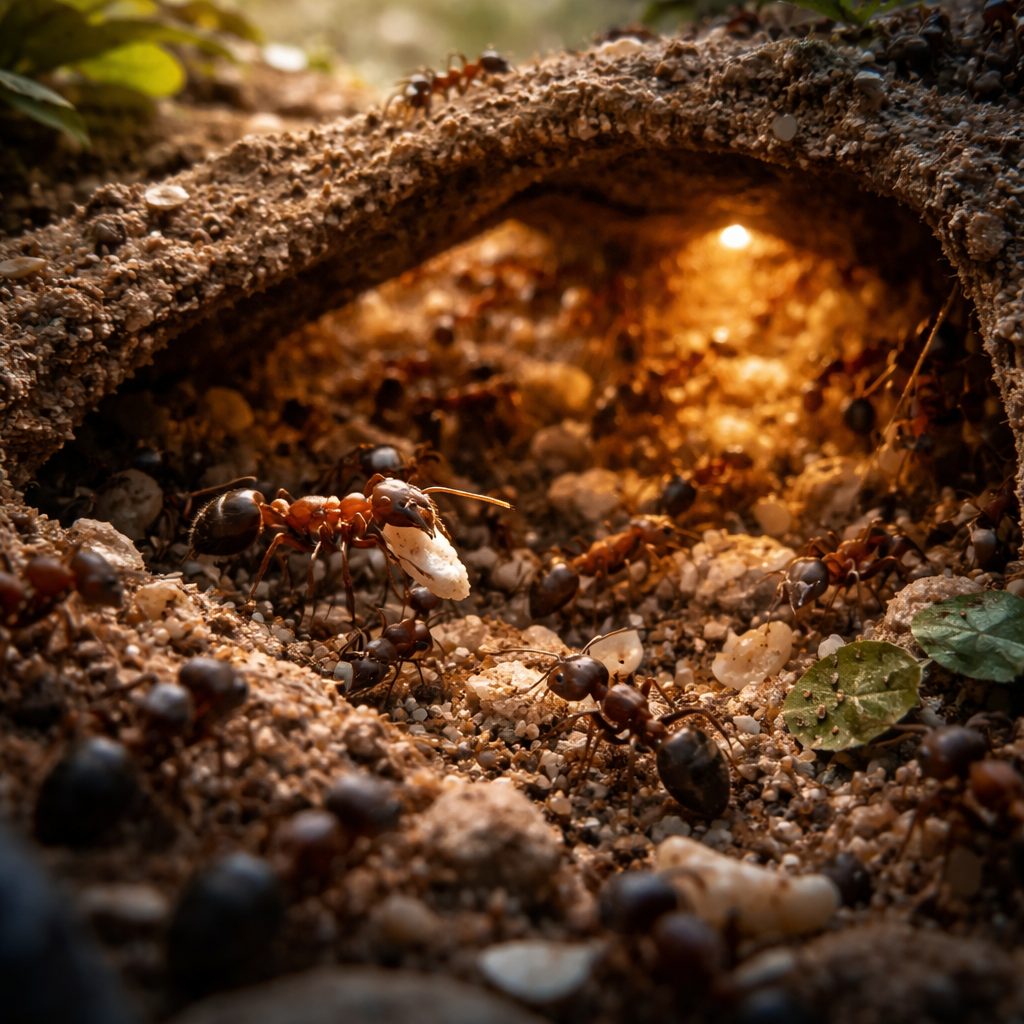
Most people walk past an anthill without a second thought — yet beneath that small mound lies a civilization more organized than many human cities. The facts about ants and their colonies reveal a world of chemical communication, architectural precision, and biological roles so specialized they would make any engineer envious. Once you start looking closely, it’s almost impossible not to be fascinated.
A colony is not just a group — it’s a living system
An ant colony functions less like a gathering of individuals and more like a single organism. Each member plays a defined role, and the colony as a whole responds to threats, resources, and environmental changes in a coordinated way that no single ant could manage alone. This concept, known as superorganism behavior, is one of the most studied phenomena in entomology.
The size of a colony varies dramatically depending on the species. Some colonies contain a few hundred individuals, while others — like those of driver ants in Africa — can reach 20 million members. What’s consistent across species is the division of labor that keeps everything running.
| Caste | Primary Role | Lifespan |
|---|---|---|
| Queen | Reproduction and colony founding | Up to 30 years |
| Worker | Foraging, nest maintenance, larval care | 1–3 years |
| Soldier | Colony defense | 1–5 years |
| Male (drone) | Mating with queen | A few weeks |
How ants actually talk to each other
Ants have no vocal cords and no ears in the traditional sense, yet they communicate with remarkable precision. Their primary language is chemical. Pheromones — chemical compounds secreted by glands across the ant’s body — carry messages about food sources, danger, colony identity, and reproductive status.
When a forager finds food, it lays a pheromone trail back to the nest. Other workers follow this trail, reinforcing it with their own chemicals if the food source is worth it. If the food runs out, no new pheromones are added, and the trail gradually evaporates. This self-correcting system means colonies don’t waste energy on exhausted resources.
Ants can also use vibrational signals — a process called stridulation — by rubbing body segments together to alert nestmates during cave-ins or attacks underground.
Beyond chemical and vibrational signals, some species use tactile communication — antennal touches that transfer information about food quality or trigger specific behaviors in nestmates. The complexity of this multi-channel communication system is part of what makes ant behavior so compelling to researchers.
Nest architecture that outperforms simple digging
Ant nests are not random tunnels. Colonies engineer their underground structures with specific zones for larvae, food storage, waste disposal, and the queen’s chamber. Leafcutter ants, for example, cultivate fungus gardens inside their nests and maintain precise humidity and temperature levels to keep the fungus healthy — effectively running underground farms.
Fire ants take structural engineering even further: during floods, they link their bodies together to form living rafts that can float for weeks. The colony stays alive while workers rotate positions so no individual stays submerged too long.
Ant species and the surprising range of their lifestyles
With over 20,000 described species of ants on Earth, the variety of colony behaviors is staggering. A few examples that stand out:
- Leafcutter ants harvest plant material not to eat directly, but to grow fungus — their actual food source. A mature colony can strip a tree bare overnight.
- Army ants don’t build permanent nests. They form temporary bivouacs using their own bodies, moving every few weeks as they exhaust local prey.
- Slave-making ants (like Polyergus species) raid neighboring colonies to steal pupae, which then hatch and work for the raiding colony.
- Honeypot ants have specialized workers called repletes, whose abdomens swell with stored liquid food to serve as living pantries during dry seasons.
- Carpenter ants don’t eat wood — they excavate it to build galleries, making them a common cause of structural damage in homes.
The queen’s role is more nuanced than most people think
A common misconception is that the queen “commands” the colony. In reality, she has no executive authority. Her biological role is reproduction — she can lay thousands of eggs per day in peak season and store sperm for years after a single mating flight. Colony decisions, such as where to forage or when to relocate, emerge from the collective behavior of workers, not from any single leader.
Some species can have multiple queens within one colony — a condition called polygyny. This typically results in larger, more resilient colonies, since the loss of one queen doesn’t collapse the entire reproductive system.
Physical strength and endurance that defy their size
Ants are routinely cited as one of the strongest animals relative to body weight. Most species can carry 10 to 50 times their own body weight, and some — like the leafcutter ant — can carry loads over 100 times their mass while climbing vertical surfaces. This is partly due to their exoskeleton structure and the mechanical efficiency of their muscles at small scales.
Their endurance is equally notable. Worker ants can travel distances equivalent to a human running several marathons daily, navigating terrain, avoiding predators, and returning to the nest with precision — often using solar positioning and polarized light as navigation tools.
What ant colonies reveal about collective intelligence
Researchers studying ant colonies have contributed directly to fields like robotics, computer science, and network optimization. Ant Colony Optimization (ACO) is a real algorithmic method — inspired by pheromone trail behavior — used to solve complex routing and logistics problems. Google Maps and logistics software have drawn on principles first observed in ant foraging behavior.
This cross-disciplinary relevance is part of why ant biology continues to attract serious scientific attention. A colony of ants, operating without any central control, consistently solves problems that would require significant computational power if modeled artificially.
Small creatures, but far from simple
Understanding how ant colonies work changes how you see the natural world. These insects have been refining their social systems for over 130 million years — long before humans appeared. Their colonies are not a curiosity; they are a blueprint for how distributed systems, resource management, and collective decision-making can function without hierarchy. Next time you notice a line of ants crossing a path, it’s worth pausing — what looks effortless is actually the result of a system that took millions of years to perfect.
