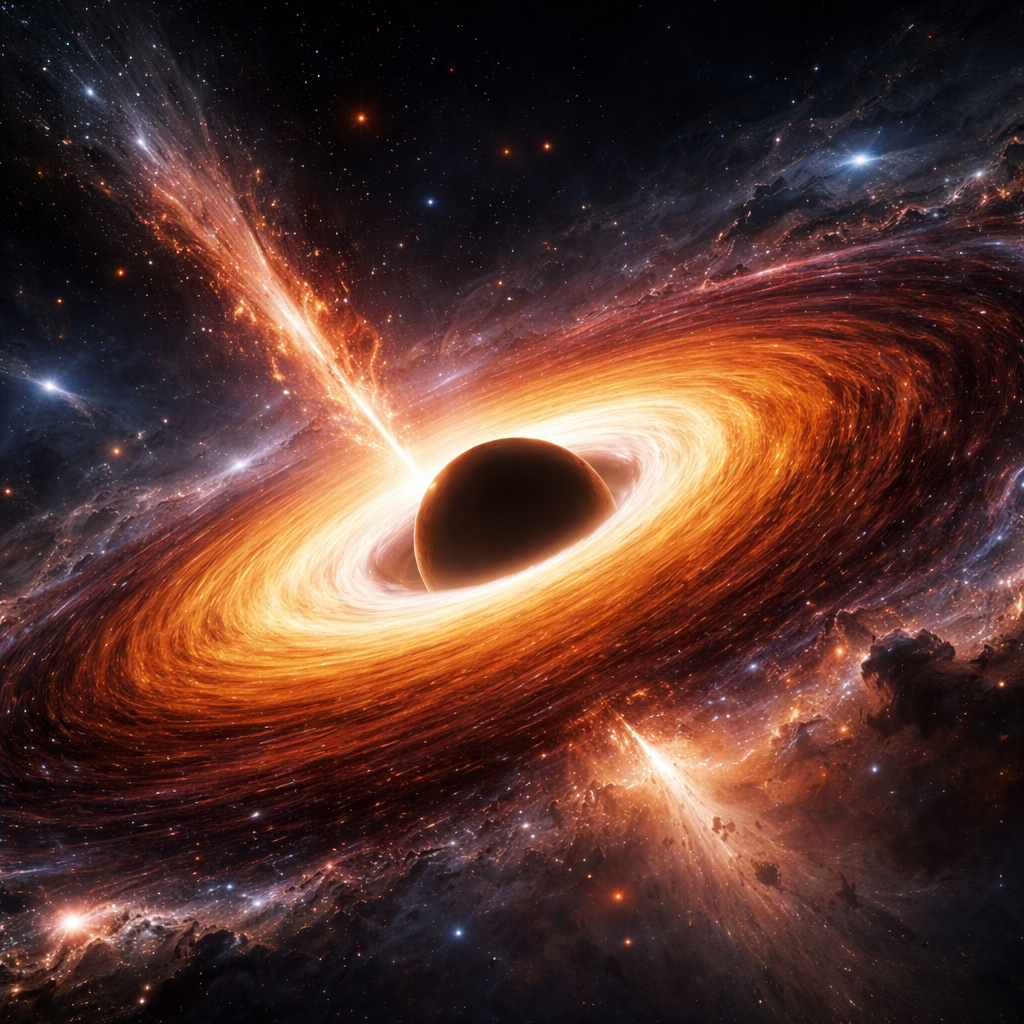
Every few years, a telescope captures something that stops physicists mid-sentence — and the facts about black holes are almost always at the center of that moment. These objects are not just dramatic backdrops for science fiction; they are real, measurable, and in many ways the most extreme environments the universe has ever produced. What makes them so compelling is not mystery for mystery’s sake, but the hard physics behind them.
What a black hole actually is — and what it is not
A black hole is a region of spacetime where gravity is so intense that nothing — not even light — can escape once it crosses a boundary called the event horizon. This is not a hole in the traditional sense, nor is it a vacuum cleaner pulling in everything nearby. Objects only fall into a black hole if they travel too close. Stars, planets, and gas clouds can orbit black holes safely for billions of years without being absorbed.
The event horizon is essentially a point of no return. Once crossed, escape is physically impossible — not because of a lack of speed or technology, but because of the geometry of spacetime itself. Beyond the event horizon lies the singularity, a region where known physics breaks down and density becomes theoretically infinite.
The four types you should know
Black holes are not a single category. Astrophysicists currently recognize four distinct types based on mass and origin:
| Type | Mass Range | Known Origin |
|---|---|---|
| Stellar black holes | 5–100 solar masses | Collapse of massive stars |
| Intermediate black holes | 100–100,000 solar masses | Uncertain; possibly star cluster mergers |
| Supermassive black holes | Millions to billions of solar masses | Found at galactic centers; origin debated |
| Primordial black holes | Varies widely | Theoretical; possibly formed after the Big Bang |
Sagittarius A*, the supermassive black hole at the center of the Milky Way, has a mass roughly four million times that of the Sun — yet it sits about 26,000 light-years away from Earth, posing no direct threat to our solar system.
Time, light, and gravity: the physics that bends reality
One of the most counterintuitive aspects of black holes involves time itself. According to general relativity, gravity slows time — a phenomenon called gravitational time dilation. The closer you are to a massive object, the slower time passes relative to someone farther away. Near the event horizon of a black hole, this effect becomes extreme.
An observer watching someone fall into a black hole would never actually see them cross the event horizon. The infalling person would appear to slow down, redden, and gradually fade — frozen in time from the outside observer’s perspective.
Meanwhile, from the perspective of the person falling in, the crossing of the event horizon might feel unremarkable — at least for a large enough black hole. This apparent contradiction between reference frames is one of the things that makes black hole physics so philosophically disorienting, even for experienced researchers.
Light itself bends around black holes through a process called gravitational lensing. This effect has practical value: astronomers use it to observe distant galaxies that would otherwise be hidden, using the black hole as a natural cosmic magnifier.
Hawking radiation and the slow death of black holes
In the mid-1970s, Stephen Hawking proposed that black holes are not entirely black — they emit a faint form of thermal radiation due to quantum effects near the event horizon. This radiation, now called Hawking radiation, means that black holes very slowly lose mass over time.
The process is extraordinarily slow. A stellar-mass black hole would take longer than the current age of the universe many times over to evaporate completely. However, the theoretical implication is significant: black holes can eventually disappear. This leads directly to the famous black hole information paradox — the question of what happens to all the information encoded in the matter that fell in. It remains one of the most active and unresolved problems in theoretical physics.
The first image and what it confirmed
For most of scientific history, black holes were inferred rather than seen. That changed when the Event Horizon Telescope collaboration released the first direct image of a black hole’s shadow — specifically, the supermassive black hole at the center of galaxy M87, located about 55 million light-years from Earth. The image showed a bright ring of superheated gas surrounding a dark central region, matching predictions from general relativity with remarkable precision.
A subsequent image of Sagittarius A* was released later, adding further confirmation. Both images required a planet-sized virtual telescope — a coordinated network of radio observatories spread across multiple continents — to achieve the necessary resolution. The result was one of the most technically demanding observations in the history of astronomy.
Gravitational waves: hearing black holes collide
Beyond imaging, physicists now have another way to study black holes: listening for them. When two black holes spiral toward each other and merge, they release an enormous burst of energy in the form of gravitational waves — ripples in the fabric of spacetime predicted by Einstein more than a century ago.
The LIGO and Virgo detectors have recorded dozens of such merger events. The first confirmed detection involved two black holes with masses of roughly 29 and 36 times the Sun’s mass. In the final fraction of a second before merger, the collision radiated more energy than all the stars in the observable universe combined — just in a different form, invisible to the eye but detectable as a subtle stretching and squeezing of space itself.
- Gravitational waves travel at the speed of light
- They pass through matter without being absorbed or scattered
- LIGO detectors are sensitive to movements smaller than one-thousandth the diameter of a proton
- Multi-messenger astronomy now combines gravitational wave data with light observations for a fuller picture
Black holes are not the end of the story
It would be easy to treat black holes as cosmic dead ends — regions where matter falls in and nothing comes back. But that framing misses something important. Black holes appear to play a central role in shaping galaxies. The supermassive black holes at galactic cores are thought to regulate star formation through jets of energy and matter that can extend for thousands of light-years, influencing the entire galaxy around them.
There is also the question of what lies beyond the singularity. Some theoretical frameworks — including certain approaches in loop quantum gravity — suggest that singularities may not actually be infinite density points, but regions where spacetime transitions into something new. A handful of researchers have even proposed that black holes might act as seeds for new universes, though this remains firmly in the realm of speculation rather than tested science.
What is clear is that black holes sit at the intersection of the two great pillars of modern physics: general relativity and quantum mechanics. They are the places where both theories are pushed hardest — and where their incompatibility becomes most obvious. Resolving that tension is not just a matter of academic curiosity. It may be the key to understanding the deepest structure of reality itself.
