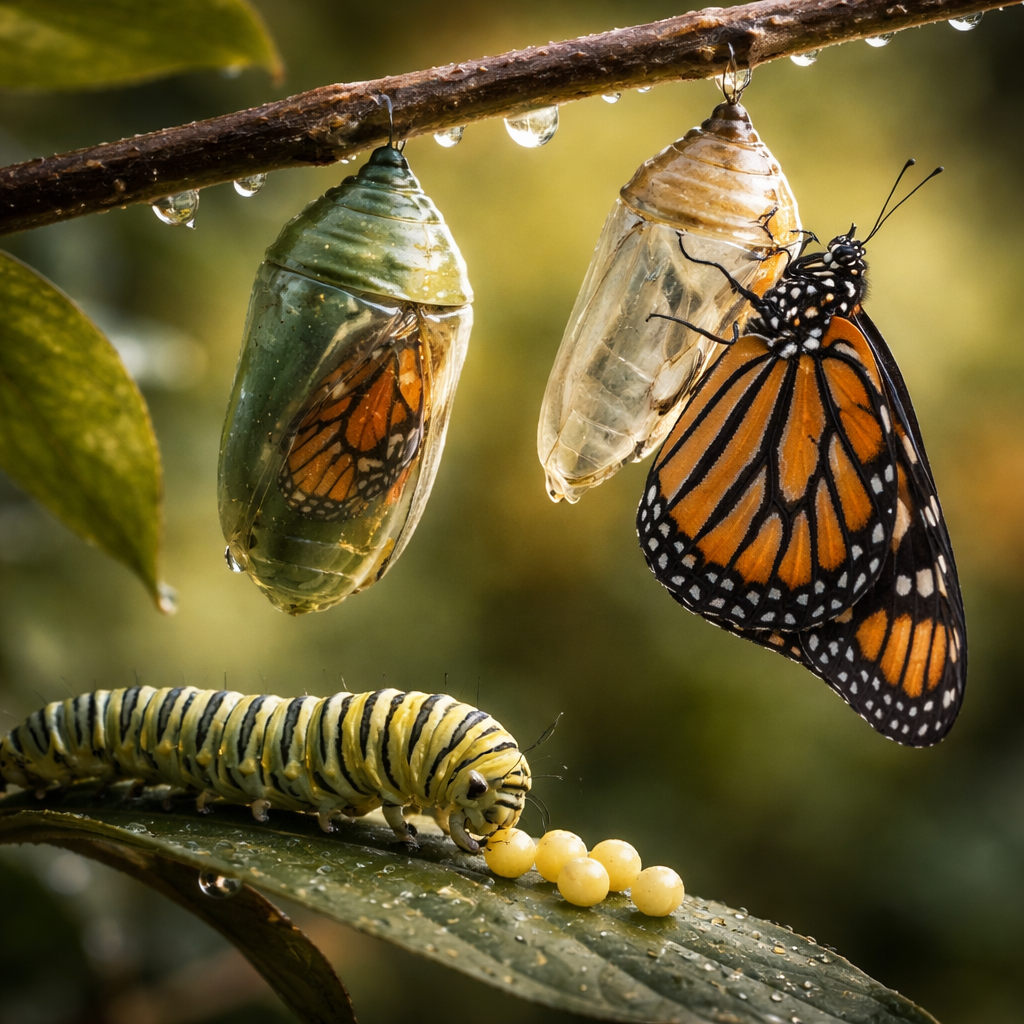
Most people have watched a butterfly drift past a window and never stopped to wonder what actually happens inside a chrysalis. The facts about butterflies and metamorphosis are genuinely stranger than most biology textbooks let on — and once you understand the full process, the way you look at these insects changes completely.
The four stages that define a butterfly’s life
A butterfly doesn’t simply grow larger over time the way a dog or a human does. Its entire body plan is rebuilt from scratch not once, but across four distinct stages: egg, larva, pupa, and adult. Scientists call this complete metamorphosis, or holometabolism, and it sets butterflies apart from insects like grasshoppers that go through only partial change.
Each stage serves a very specific biological purpose. The larva — what most of us call a caterpillar — exists almost entirely to eat and store energy. The adult butterfly, by contrast, is built primarily for reproduction and dispersal. These two phases have such different jobs that they essentially need different bodies, which is exactly why the transformation between them has to be so extreme.
What actually happens inside a chrysalis
Here is where the story gets genuinely surprising. When a caterpillar seals itself inside a chrysalis, it doesn’t just rearrange its existing parts. Much of its body breaks down into a kind of biological soup — a fluid rich in undifferentiated cells called imaginal discs. These discs were present in the caterpillar all along, quietly waiting, and they contain the genetic blueprint for every adult structure: wings, compound eyes, antennae, and legs.
Research published in peer-reviewed entomology journals has confirmed that some memories formed during the caterpillar stage can survive metamorphosis and persist into adulthood — meaning the butterfly is not entirely a “new” creature in a cognitive sense.
This finding overturned a long-held assumption that metamorphosis was essentially a complete reset. The nervous system, it turns out, is partly preserved even as the rest of the body is reconstructed. That continuity of memory hints at just how sophisticated the process really is.
Butterfly biology facts that tend to surprise people
Beyond metamorphosis itself, butterfly anatomy contains several details that are easy to overlook but fascinating once you encounter them.
- Butterflies taste with their feet. Chemoreceptors on their tarsi allow them to detect sugars and identify host plants the moment they land.
- Their wings are covered in tiny scales made of chitin — the same material as their exoskeleton — and the colors you see are often structural rather than pigment-based, produced by microscopic light-refracting structures.
- A butterfly’s proboscis starts as two separate tubes that zip together during the pupal stage. If they fail to connect properly, the adult cannot feed.
- Some species, like the Monarch, navigate using a time-compensated sun compass — an internal mechanism that adjusts direction based on the time of day.
- Butterfly wings beat far more slowly than those of bees or flies, yet their flight patterns are highly erratic, which is thought to be an anti-predator adaptation.
The caterpillar-to-butterfly timeline varies more than you might expect
One common misconception is that all butterflies spend roughly the same amount of time in each stage. In reality, the timeline differs dramatically between species and is heavily influenced by temperature, food availability, and day length.
| Species | Egg stage | Larval stage | Pupal stage |
|---|---|---|---|
| Monarch (Danaus plexippus) | 3–5 days | 10–14 days | 8–15 days |
| Painted Lady (Vanessa cardui) | 3–7 days | 12–18 days | 7–10 days |
| Swallowtail (Papilio species) | 4–10 days | 3–4 weeks | 10–20 days |
| Cabbage White (Pieris rapae) | 4–8 days | 2–3 weeks | 7–12 days |
Temperature plays a particularly strong role. In cooler conditions, the pupal stage can extend significantly — some species overwinter as pupae and complete development only when spring temperatures rise above a certain threshold. This pause is called diapause, and it functions as a kind of biological waiting room.
Why metamorphosis evolved in the first place
The evolutionary logic behind complete metamorphosis is compelling. By having larval and adult stages that look entirely different and eat entirely different things, a single species effectively eliminates direct competition between its young and its adults for the same food resources. A caterpillar munching on leaves is not competing with the adult butterfly that sips nectar. That division of ecological roles may have contributed significantly to the extraordinary diversity of holometabolous insects — a group that includes not just butterflies but also beetles, flies, and wasps, together accounting for the vast majority of all insect species on Earth.
Migration, lifespan, and the bigger picture
Adult butterflies typically live far shorter lives than the caterpillar stage might suggest. Many species survive as adults for only a few weeks, focused entirely on mating and laying eggs. The Monarch is a notable exception — the migratory generation that travels from North America to central Mexico can live up to eight months, a lifespan several times longer than summer generations of the same species.
That extended lifespan is directly tied to a shift in reproductive timing. Migratory Monarchs delay reproduction entirely until after their return journey in spring. Their bodies enter a state called reproductive diapause, suspending sexual maturity while channeling energy into flight and fat storage. It’s a striking example of how flexible insect physiology can be when evolutionary pressure demands it.
When knowing this actually changes something
Understanding butterfly metamorphosis isn’t just trivia for a nature quiz. It has direct implications for conservation, agriculture, and even biomimicry research. Engineers studying the structural coloration of butterfly wings have developed applications in anti-counterfeiting technology and display screens. Biologists studying imaginal disc development continue to gain insights relevant to regenerative medicine. And for anyone growing a garden, knowing which plants support caterpillar feeding versus adult nectaring can meaningfully improve local butterfly populations.
The process that looks like quiet stillness inside a chrysalis is actually one of the most complex transformation sequences in the animal kingdom. And it happens in backyards, on roadsides, and in forests around the world, largely unnoticed — which might be the most remarkable fact of all.
