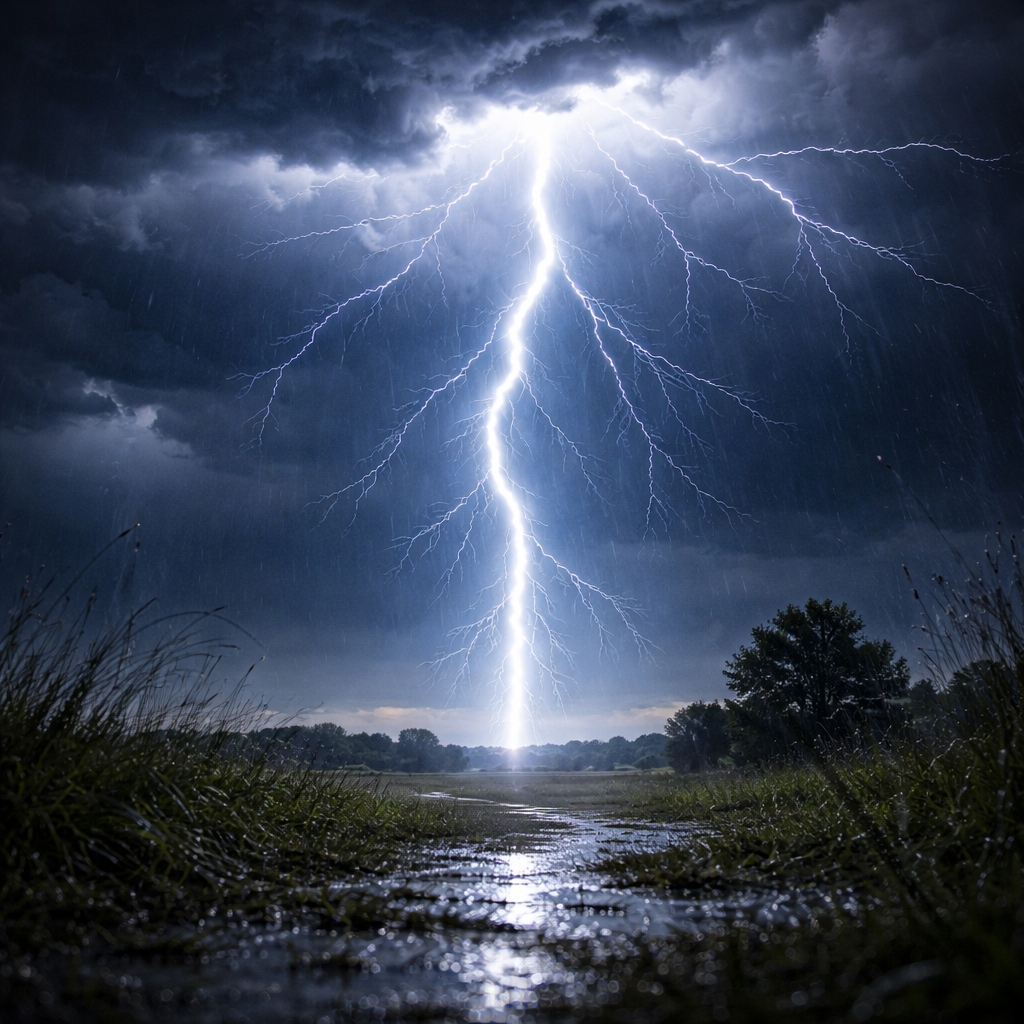
A bolt can reach temperatures five times hotter than the surface of the sun — and that’s just one of many facts about lightning and thunder that most people never learned in school. These phenomena happen thousands of times every minute across the globe, yet they remain genuinely misunderstood, feared, and underestimated all at once.
What actually happens between cloud and ground
Lightning is not simply electricity falling from the sky. It begins with charge separation inside a thunderstorm cloud, where ice crystals and water droplets collide and transfer electrical energy. Positively charged particles accumulate near the top of the cloud, while negative charges gather at the base. When the difference becomes large enough, a discharge occurs — either within the cloud itself, between clouds, or between the cloud and the ground.
What we see as a single dramatic flash is actually a rapid sequence of events. A faint stepped leader — invisible to the naked eye — moves downward from the cloud in jagged steps, ionizing the air as it goes. Simultaneously, streamers of positive charge rise from tall objects on the ground. When one of these upward streamers connects with the descending leader, the circuit closes and a return stroke shoots upward at roughly one-third the speed of light. That luminous channel is what we call lightning.
Thunder is not just noise — it carries information
Thunder is the direct acoustic result of lightning. The superheated air around a lightning channel expands explosively, creating a shockwave that we hear as a rumble or crack. The reason thunder sounds different depending on your distance is straightforward physics: the low-frequency rumbling travels farther than the sharp crack, which is why a distant storm sounds like rolling drums rather than a sharp bang.
Sound travels roughly 1 kilometer every 3 seconds (or 1 mile every 5 seconds). Counting the seconds between a flash and the thunder that follows gives you a reliable estimate of how far away the storm is.
This simple method — sometimes called the “flash-to-bang” rule — is not just a fun trick. It’s a genuinely useful safety tool that tells you whether a storm is approaching or moving away.
Numbers that are hard to believe but completely real
The scale of lightning activity on Earth is staggering. Some verified figures help put it into perspective:
| Fact | Value |
|---|---|
| Average lightning strikes per second globally | approximately 100 |
| Peak temperature of a lightning channel | around 30,000 K (about 5 times hotter than the sun’s surface) |
| Duration of a typical return stroke | 0.2 milliseconds |
| Voltage in a single bolt | 100 million to 1 billion volts |
| Energy released per strike | approximately 1–5 gigajoules (mostly as heat and light) |
Despite the enormous voltage, the total electrical energy in a single strike is relatively modest — roughly equivalent to powering a standard light bulb for a few months. The danger lies not in energy quantity but in intensity and unpredictability.
Types of lightning you might not have seen classified before
Most people think of lightning as the classic ground strike, but meteorologists and atmospheric scientists recognize several distinct types:
- Intracloud lightning — the most common type, occurring entirely within a single cloud and rarely visible from the ground.
- Cloud-to-cloud lightning — a discharge traveling between two separate storm cells.
- Cloud-to-ground lightning — the type responsible for most lightning-related injuries and structural damage.
- Ball lightning — a rare, poorly understood phenomenon reported as a glowing sphere that moves slowly and disappears suddenly. Its exact mechanism is still debated in the scientific community.
- Sprites and elves — large-scale electrical discharges above thunderstorm clouds, in the upper atmosphere, visible only from aircraft or high-altitude cameras.
Each type behaves differently and poses different risks, which is why understanding them matters beyond simple curiosity.
Common myths that keep circulating — and why they’re wrong
A surprising number of widely believed ideas about lightning are simply incorrect. Clearing them up is more than pedantry — some misconceptions can genuinely endanger people.
One persistent myth is that lightning never strikes the same place twice. In reality, tall structures like the Empire State Building are struck dozens of times per year. Lightning tends to follow paths of least resistance, and prominent conductive objects are natural targets precisely because of that.
Another widely repeated claim is that rubber-soled shoes protect you outdoors during a storm. They don’t — the voltages involved are so high that the thin layer of rubber offers no meaningful insulation whatsoever.
A third myth suggests that crouching in an open field with feet together makes you safe. The crouch position is actually recommended — not because it makes you safe, but because it reduces your profile while minimizing ground current risk. There is no truly safe outdoor location during an active lightning storm. Seeking solid shelter or a hard-top vehicle is the only reliable option.
Practical safety that actually holds up
Understanding the science makes safety advice much easier to follow, because you understand why each rule exists rather than memorizing arbitrary instructions.
- Go indoors or into a hard-top vehicle as soon as you hear thunder — if you can hear it, you are already within strike range.
- Avoid contact with plumbing, corded phones, and electrical appliances while indoors, as lightning can travel through conductive materials.
- Stay away from isolated tall trees, hilltops, open water, and metal fences outdoors.
- If caught in the open with no shelter available, avoid lying flat — instead crouch low with feet together and minimize contact with the ground.
- Wait at least 30 minutes after the last thunder before resuming outdoor activity.
These are not overcautious suggestions — they reflect patterns identified across decades of lightning injury and fatality data collected by meteorological agencies worldwide.
When the sky speaks, it’s worth listening
Lightning and thunder are among the most powerful and visually dramatic natural events that most of us will encounter in ordinary life. They are also genuinely well-studied — atmospheric scientists have accumulated deep knowledge about storm electrification, discharge physics, and injury mechanisms. That knowledge is accessible and useful to anyone willing to look past the myths.
Whether you’re caught in a summer storm, watching lightning from a safe window, or simply trying to make sense of what’s happening in the sky above — the science gives you something better than fear. It gives you context. And context, in this case, might genuinely keep you safer.
