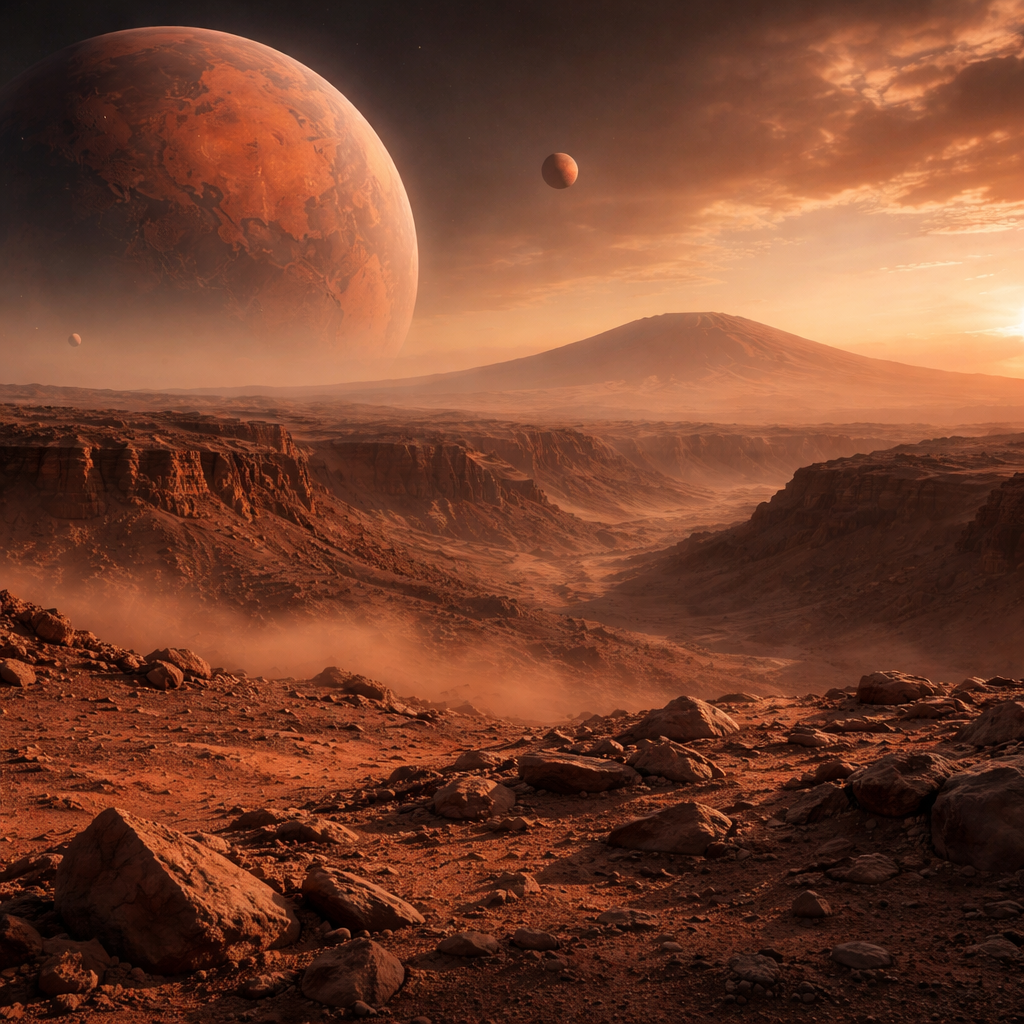
When you look at facts about Mars the red planet, one detail stands out immediately: this world is simultaneously the most Earth-like planet in our solar system and one of the most hostile environments imaginable. Average surface temperatures drop to around –60°C, dust storms can engulf the entire planet for months, and the atmosphere is so thin that liquid water cannot exist on the surface. Yet Mars keeps pulling scientists, engineers, and curious minds back toward it — and for very good reason.
Why Mars looks red — and what that color actually tells us
The reddish-orange hue of Mars is not just a visual curiosity. The planet’s surface is covered in iron oxide — essentially rust — mixed into the fine dust and soil. When ultraviolet radiation from the Sun interacts with iron-rich minerals over billions of years, oxidation occurs, painting the landscape in shades of orange, brown, and deep red. This same dust gets lifted into the thin Martian atmosphere during wind events, giving the sky a butterscotch tint rather than the blue we see on Earth.
The color is also a geological fingerprint. It suggests that Mars once had conditions — possibly including liquid water and a thicker atmosphere — that allowed widespread chemical reactions across its surface. In that sense, the red color is less an aesthetic feature and more a record of planetary history written in iron.
Core numbers worth knowing
Before going deeper, it helps to have a clear picture of Mars in terms of scale and position. The planet is smaller than Earth but larger than you might expect, and its orbit creates significant variations in distance from us depending on where both planets are in their respective paths around the Sun.
| Parameter | Mars | Earth (for comparison) |
|---|---|---|
| Diameter | 6,779 km | 12,742 km |
| Distance from the Sun | ~228 million km (average) | ~150 million km (average) |
| Length of a day | 24 hours 37 minutes | 24 hours |
| Length of a year | 687 Earth days | 365 days |
| Surface gravity | 3.72 m/s² | 9.81 m/s² |
| Number of moons | 2 (Phobos and Deimos) | 1 |
One thing that surprises many people is how similar a Martian day is to ours. At just 37 minutes longer than an Earth day, the daily cycle on Mars would feel almost familiar — assuming you could survive everything else about being there.
Olympus Mons and Valles Marineris: extremes that redefine “big”
Mars holds two of the most dramatic geological features in the entire solar system. Olympus Mons is a shield volcano that rises approximately 22 kilometers above the Martian surface — nearly three times the height of Mount Everest above sea level. Its base spans roughly 600 kilometers, meaning the entire volcanic structure would cover an area comparable to France. It formed over billions of years because Mars lacks tectonic plates, so the crust stayed in one position over a magma hotspot, allowing lava to accumulate into a single enormous structure.
Valles Marineris, the canyon system stretching along Mars’s equatorial region, is equally staggering. It runs for approximately 4,000 kilometers in length, reaches depths of up to 7 kilometers, and in some sections spans 200 kilometers in width. The Grand Canyon, by comparison, would fit inside a small portion of it. Scientists believe Valles Marineris formed primarily through tectonic stretching and rifting of the crust rather than through erosion by water, though water likely played a role in shaping some of its features over time.
“Mars is the only planet we know of inhabited solely by robots.” — a popular observation in the space exploration community that captures just how thoroughly we’ve sent machines ahead of us.
The question of water — past, present, and frozen
Evidence gathered by rovers, orbiters, and landers points strongly to the conclusion that Mars once had liquid water flowing across its surface. Ancient riverbeds, mineral deposits that only form in the presence of water, and layered sedimentary rock all support this picture. The leading hypothesis is that Mars had a warmer, wetter period billions of years ago before losing most of its atmosphere and its global magnetic field.
Today, water on Mars exists primarily in two forms. The polar ice caps contain a mixture of water ice and dry ice (frozen carbon dioxide), with the north polar cap holding a substantial reservoir of water ice beneath a seasonal layer of CO₂ frost. Additionally, radar data from orbiting spacecraft has detected what appear to be subsurface liquid water deposits beneath the southern polar region, though the exact nature and extent of these features is still actively studied.
Two tiny moons with unusual origins
Phobos and Deimos, the two moons of Mars, are among the smallest moons in the solar system and look nothing like our own Moon. Both are irregularly shaped, heavily cratered, and dark in color. Phobos orbits Mars at an altitude of only about 6,000 kilometers — closer to its planet than any other moon in the solar system — and completes an orbit in just under 8 hours. Because it orbits faster than Mars rotates, it actually rises in the west and sets in the east as seen from the Martian surface.
Their origin remains a topic of scientific debate. One theory suggests they are captured asteroids from the nearby asteroid belt, which would explain their irregular shapes and dark, carbon-rich composition. Another hypothesis proposes they formed from debris after a large impact on Mars early in the planet’s history. Future missions may help settle this question.
What robotic explorers have found on the surface
Decades of robotic exploration have dramatically changed our understanding of Martian geology, chemistry, and climate. Rovers have confirmed the presence of organic molecules in Martian rock, detected methane fluctuations in the atmosphere, and found evidence of ancient lake environments in Gale Crater and Jezero Crater. These findings don’t prove life existed on Mars, but they do confirm that the raw chemical ingredients and environmental conditions were once present.
- Curiosity rover has been operating in Gale Crater for over a decade, drilling rock samples and analyzing their chemical composition.
- Perseverance rover landed in Jezero Crater, a site chosen because it shows clear signs of an ancient river delta, and has been collecting rock core samples for potential future return to Earth.
- The Ingenuity helicopter, which arrived with Perseverance, demonstrated powered flight in the thin Martian atmosphere — a first for any aircraft on another planet.
- InSight lander recorded marsquakes, giving scientists their first seismic data from inside another planet.
Each of these missions has added a new layer of detail to our understanding, and collectively they have built a picture of Mars as a world that was geologically active, potentially water-rich, and at least chemically hospitable in its distant past.
Mars as a destination — closer than it seems, harder than it looks
Planning a crewed mission to Mars involves challenges that go far beyond rocket engineering. The psychological and physiological effects of spending six to nine months in transit each way, followed by a surface stay that could last over a year before the planets align for a return journey, put enormous demands on both technology and human endurance. Radiation exposure during the journey and on the surface, in the absence of Mars’s global magnetic field, is one of the most serious health concerns researchers are working to address.
At the same time, the resources available on Mars offer real possibilities. The carbon dioxide atmosphere can theoretically be converted into oxygen and fuel using in-situ resource utilization technology — a process already demonstrated in a small-scale experiment by the MOXIE instrument aboard Perseverance. Water ice, if accessible, could support both drinking water and rocket propellant production. Mars also has regolith that could potentially be used in construction of surface habitats.
The planet that keeps asking questions back
What makes Mars genuinely compelling isn’t just the scale of its mountains or the mystery of its missing atmosphere. It’s the fact that every answer uncovered by science seems to open two or three new questions. Did microbial life ever exist in those ancient lake beds? Where exactly did all the water go? Could the subsurface hold environments where life persists today? These aren’t idle speculations — they are active areas of scientific research backed by real data and ongoing missions.
Mars sits at an unusual intersection: it is close enough to study in detail, similar enough to Earth to be relatable, and different enough to constantly challenge assumptions. Whether you’re drawn to it out of scientific curiosity, interest in space exploration, or simply fascination with what lies beyond our own world, the red planet offers more substance than almost any other subject in planetary science. And the story is very much still being written.
