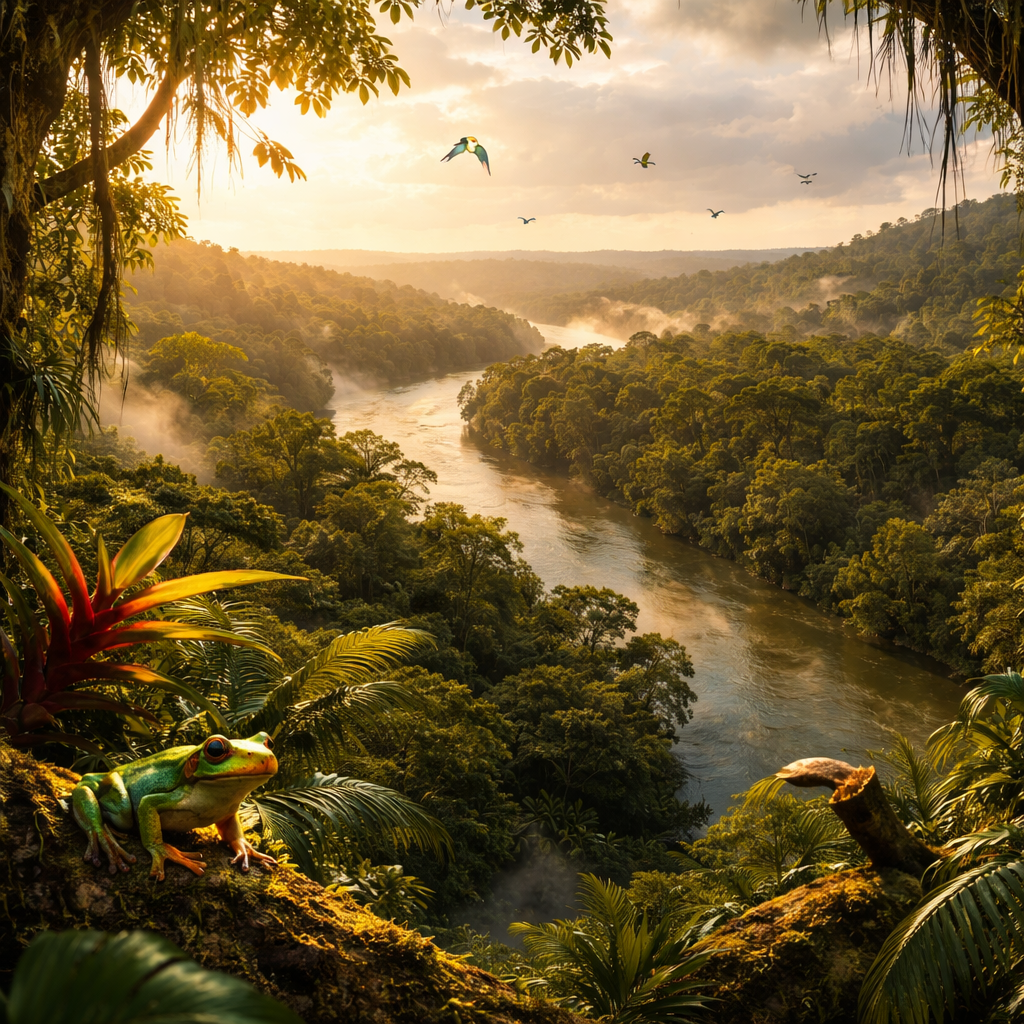
Half of the world’s rainforest species live within a single river basin — and that basin belongs to the Amazon. The facts about the Amazon rainforest reveal something far more complex than just a stretch of green trees: this ecosystem regulates rainfall patterns across an entire continent, stores hundreds of billions of tons of carbon, and shelters communities whose knowledge of the natural world remains largely undocumented by science.
A forest that breathes for the planet
The Amazon basin covers roughly 5.5 million square kilometers, sprawling across nine countries in South America. Brazil holds the largest share — approximately 60% of the total area — while Peru, Colombia, Venezuela, Ecuador, Bolivia, Guyana, Suriname, and French Guiana contain the rest. This is not simply a large forest. It functions as a self-sustaining system that generates its own rainfall through a phenomenon scientists call “flying rivers” — vast streams of water vapor released by tree transpiration that travel thousands of kilometers through the atmosphere before falling as rain.
The sheer biological richness of the Amazon is difficult to grasp from numbers alone, but numbers do help frame the picture. Researchers estimate the region hosts around 10% of all species on Earth, including more than 40,000 plant species, over 1,300 bird species, and approximately 3,000 types of freshwater fish — more than in any other river system on the planet.
What the numbers actually tell us
| Category | Estimated number |
|---|---|
| Plant species | ~40,000 |
| Bird species | ~1,300 |
| Freshwater fish species | ~3,000 |
| Mammal species | ~430 |
| Amphibian species | ~1,000+ |
| Indigenous groups | ~400 distinct peoples |
These figures are not fixed. New species are still being formally described by scientists every year, particularly among insects, fungi, and deep-canopy plants. The Amazon remains one of the least biologically surveyed regions on Earth despite being one of the most studied ecosystems in popular culture.
The Amazon River itself is in a category of its own
The river that runs through this forest is the world’s largest by discharge volume, releasing more freshwater into the ocean than the next seven largest rivers combined. During the wet season, the Amazon can stretch up to 48 kilometers in width in certain sections. The forest floor along its banks floods annually, creating what ecologists call várzea — seasonally flooded forests — where trees have adapted to survive months of submersion. Fish swim among the treetops. This is not a metaphor; it is documented behavior of dozens of species that feed on submerged fruits and seeds.
The Amazon River discharges about 20% of all freshwater that enters the world’s oceans. This single fact illustrates why the health of this one ecosystem has global consequences.
Threats that are measurable and ongoing
Deforestation in the Amazon is not a potential future risk — it is an active, quantified process. Satellite data consistently show large areas of forest being cleared each year for cattle ranching, soy agriculture, logging, and infrastructure development. When forest is removed, it does not simply disappear from a map. It triggers a cascade: soil erosion accelerates, local rainfall decreases, carbon stored over centuries re-enters the atmosphere, and species lose their habitat faster than they can adapt or relocate.
Scientists have introduced the concept of a “tipping point” — a threshold beyond which the Amazon could begin converting from a dense tropical forest into a drier savanna-like landscape. Some researchers suggest that losing around 20–25% of the original Amazon cover could trigger this transition in parts of the forest. Current deforestation rates make this a genuine concern for the coming decades.
Indigenous peoples and forest knowledge
Around 400 distinct indigenous groups call the Amazon home, speaking an estimated 300 different languages. Many of these communities have lived in the forest for thousands of years and possess detailed, practical knowledge of medicinal plants, sustainable agriculture techniques such as terra preta (biochar-enriched soil), and ecological relationships that Western science is only beginning to study formally.
Territories managed by indigenous communities consistently show lower deforestation rates than comparable unprotected areas. This is not coincidental — it reflects generations of land stewardship built around long-term sustainability rather than short-term extraction.
Terra preta: an ancient soil technology
One of the most remarkable discoveries linked to Amazonian indigenous cultures is terra preta, or “dark earth.” This is a type of highly fertile soil found across the Amazon basin, created by ancient inhabitants who mixed charcoal, bone, and organic waste into the naturally poor tropical soil. Unlike regular tropical soils that lose nutrients quickly, terra preta retains fertility for centuries. Modern researchers are actively studying it as a model for sustainable agriculture in nutrient-poor regions worldwide.
Practical reasons to care about a distant forest
For most people living outside South America, the Amazon can feel abstract — a place read about but never visited. But the connections are more direct than they appear. Many pharmaceuticals trace their origins to Amazonian plant compounds. The forest’s influence on atmospheric moisture affects weather patterns far beyond its borders. And as a carbon sink, its continued health is directly tied to the pace of global temperature change.
- Around 25% of modern medicines contain ingredients first discovered in tropical rainforests
- The Amazon produces approximately 20% of the oxygen recycled through photosynthesis in the terrestrial biosphere
- Amazonian cloud formation affects rainfall as far as the agricultural regions of Argentina and southern Brazil
- Freshwater fisheries in the basin support the food security of tens of millions of people
A note on the “lungs of the Earth” phrase
The popular description of the Amazon as the “lungs of the Earth” is scientifically imprecise but emotionally resonant. In reality, a mature forest consumes roughly as much oxygen as it produces through the respiration of its organisms. What the Amazon genuinely does — and does on an enormous scale — is absorb and store carbon dioxide, regulate water cycles, and maintain biodiversity that underpins ecosystem services globally. The real value is not in oxygen production alone, but in the stability the forest provides to planetary systems we depend on.
The forest does not need mythology — its reality is enough
The Amazon rainforest does not require exaggeration. The actual documented facts — the species counts, the hydrological data, the carbon storage figures, the cultural depth of its peoples — are more compelling than any simplified narrative. Understanding what this ecosystem genuinely does, what threatens it, and why those threats have consequences well beyond its borders is the kind of knowledge that stays useful regardless of where you live or what your background is. The Amazon is one of those places where the more precisely you look, the more extraordinary the picture becomes.
