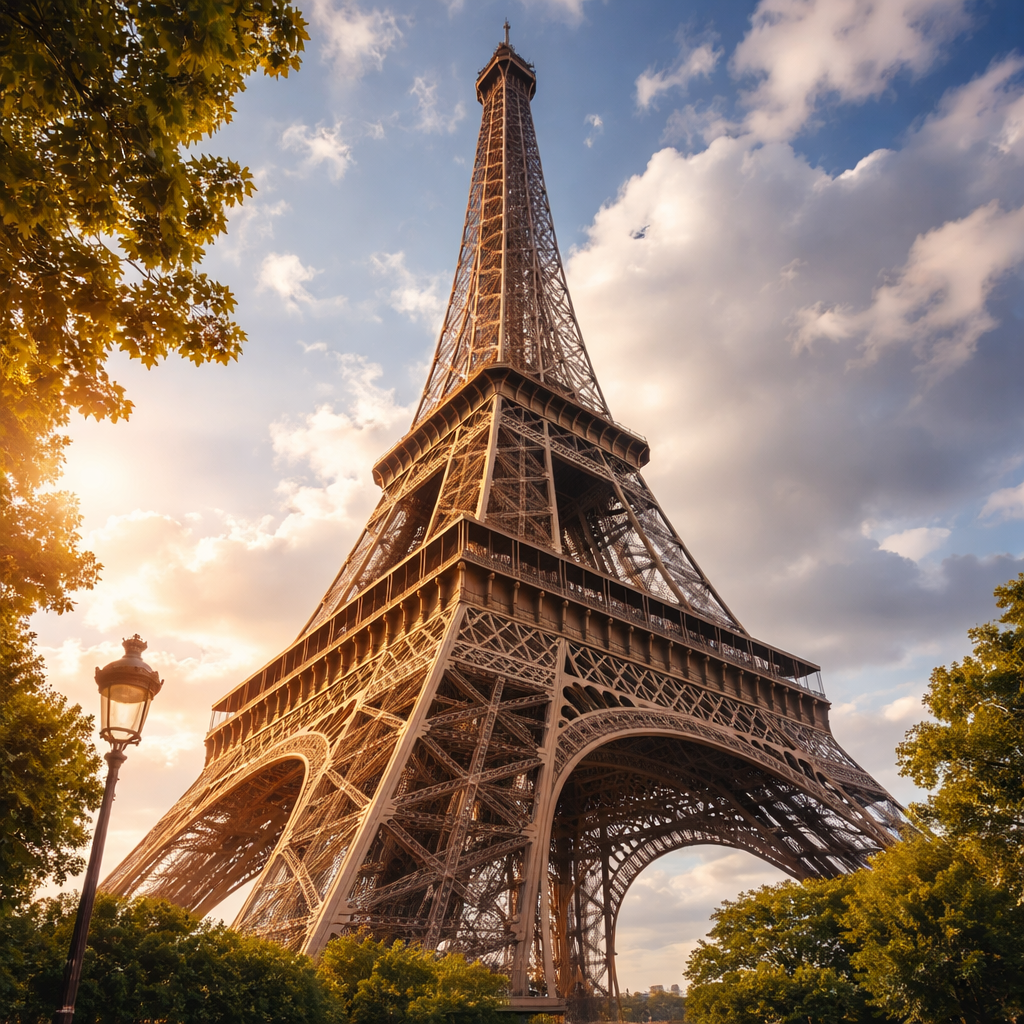
Most people know the Eiffel Tower as a romantic symbol of Paris — but the facts about the Eiffel Tower tell a far more surprising story than any postcard ever could. From engineering controversies to unexpected scientific functions, this iron structure has accumulated layers of history that most visitors walking beneath it never suspect.
It Was Never Meant to Stay
Gustave Eiffel designed and built the tower as a temporary exhibit for the 1889 World’s Fair in Paris, officially called the Exposition Universelle. The original plan called for its demolition after 20 years. What saved it? A radio antenna installed at the top, which made the structure militarily and scientifically valuable. The French government decided to keep it — and that practical decision changed the skyline of Europe forever.
The construction itself was a remarkable achievement for its era. Over 18,000 individual iron pieces were used, held together by approximately 2.5 million rivets. Around 300 workers assembled the tower over a period of roughly two years, two months, and five days — and despite the scale of the project, only one worker died during construction, which was considered extraordinarily low by the standards of the time.
Numbers That Actually Surprise People
The statistics behind the tower shift perspective in interesting ways. Here are some figures that tend to catch people off guard:
- The tower stands approximately 330 meters tall, including the broadcast antenna at the summit.
- It weighs around 10,100 tonnes in total structure weight.
- The iron framework itself weighs roughly 7,300 tonnes.
- On a hot summer day, the metal expands and the tower can grow up to 15 centimeters taller due to thermal expansion.
- The tower sways slightly — up to 7 centimeters — in strong winds, which is intentional and part of the structural design.
- It is repainted every seven years, requiring approximately 60 tonnes of paint each time to protect the iron from rust.
That last point about repainting is easy to overlook, but it represents a continuous and significant maintenance operation. The color used is not a standard shade — it is a custom brown gradient, slightly darker at the base and lighter toward the top, designed to make the tower look uniform against the Paris sky.
The Tower Has a Scientific Side Most Tourists Miss
Beyond its visual appeal, the Eiffel Tower has served real scientific and military purposes throughout its history. Gustave Eiffel himself used the tower for aerodynamic experiments, running objects down a wire from the top to study air resistance. He also installed a meteorological station and a laboratory on the third floor, which he used for personal research.
During World War I, the tower’s radio transmitter was used to jam German communications — a tactical role that directly contributed to the Allied war effort and arguably justified its continued existence more than any artistic argument ever had.
This dual identity — iconic monument and working infrastructure — is part of what makes the Eiffel Tower unusual among the world’s most visited landmarks. It was not built as a monument to anything symbolic. It was built as a demonstration of French industrial capability, and it went on to become functional in ways its critics never anticipated.
What Parisians Actually Thought of It
The initial public reaction in Paris was far from admiring. A group of prominent French artists and intellectuals signed a formal petition against the tower’s construction, calling it an eyesore and comparing it to a giant factory chimney. The writer Guy de Maupassant reportedly disliked it so intensely that he would lunch at the tower’s restaurant regularly — because it was the one place in Paris from which he could not see the structure.
That story may be slightly embellished by time, but it reflects a genuine cultural tension that surrounded the tower’s early decades. Public opinion reversed dramatically once the structure proved both useful and visually adaptable — especially as electric lights transformed its appearance after dark.
A Closer Look at the Structure
| Feature | Detail |
|---|---|
| Year of completion | 1889 |
| Total height (with antenna) | ~330 meters |
| Number of steps to the top | 1,665 |
| Number of iron components | Over 18,000 |
| Repainting frequency | Every 7 years |
| Annual visitors | Approximately 6–7 million |
| Floors open to the public | 3 (ground, second, summit) |
The tower’s three public levels each offer a different experience. The first floor now features a glass floor section that allows visitors to look straight down to the ground — something that was not part of the original design. The second floor is considered the most popular for photography, offering a mid-height panorama of Paris. The summit, when weather permits, provides views extending over 70 kilometers.
Details That Rarely Make It Into Travel Guides
Some of the most interesting aspects of the tower’s history are the ones that don’t fit neatly into tourism brochures. For instance, Gustave Eiffel had a private apartment built for himself at the very top of the tower. He used it to receive guests and conduct experiments, and he reportedly turned down substantial offers from wealthy Parisians who wanted to rent it.
The tower also has its own address and postal code, functions as a broadcast tower for French television and radio stations, and contains an ice rink on the first floor during winter months. These operational details are a reminder that the structure has never been purely decorative — it has always had a working life running parallel to its symbolic one.
Why the Tower Keeps Drawing People In
What keeps the Eiffel Tower genuinely interesting — even for people who have seen it dozens of times — is the contrast between what it looks like and what it actually is. Visually, it reads as romantic and timeless. Historically, it was a controversial industrial experiment built on a tight deadline by a pragmatic engineer who cared more about aerodynamics than aesthetics.
That gap between perception and reality is where the best travel knowledge lives. The tower is worth visiting not because it looks the way it does in photographs, but because standing beneath it — looking up through 300 meters of wrought iron lattice — makes the engineering feel real in a way that no image can fully convey.
And for anyone who prefers to explore from a distance, the history itself is rich enough. Every decade of the tower’s existence added a new layer — scientific, military, cultural, architectural — that turns what looks like a simple landmark into something genuinely worth understanding.
