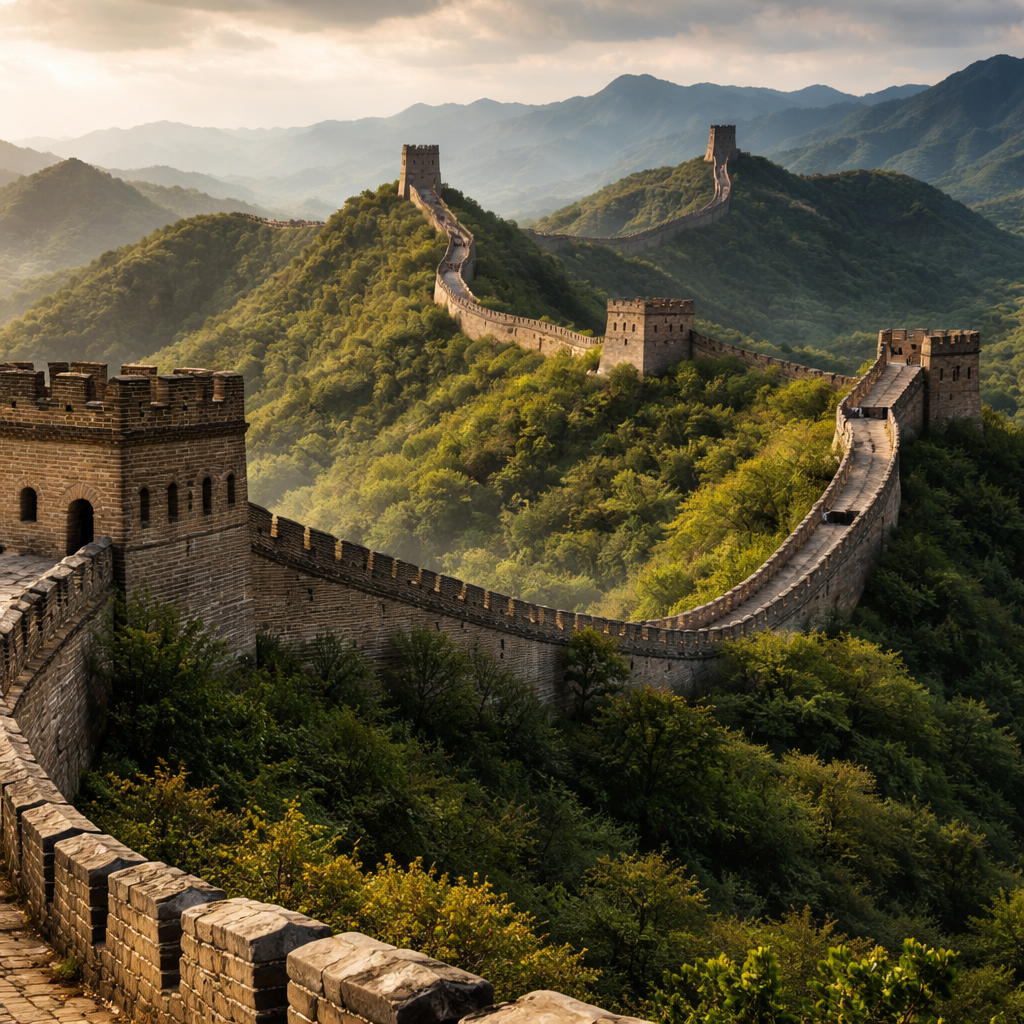
Most people picture a single continuous ribbon of stone stretching across China’s mountains when they think of this landmark — but the facts about the Great Wall of China tell a far more complex and surprising story than any postcard could suggest.
It Was Never One Wall
The Great Wall is not a single structure built in one era by one ruler. It is a collection of walls, fortifications, trenches, and natural barriers constructed over many centuries by different Chinese states and dynasties. The earliest sections date back to the 7th century BCE, while the most recognizable stone sections were built during the Ming Dynasty. What we see in photographs today is largely Ming-era construction — and even that is only a fraction of what once existed.
Different dynasties had different enemies, different resources, and different building techniques. Some used tamped earth, others used wood, and the Ming builders relied heavily on fired bricks and stone — a much more durable approach that explains why their sections survived better than earlier ones.
The Real Length Will Surprise You
Official surveys conducted by China’s State Administration of Cultural Heritage measured the total length of all wall sections — including those from every dynasty — at over 21,000 kilometers. That includes not just standing walls but also trenches, hillside ridges used as natural barriers, and ruins.
| Dynasty | Approximate Wall Length | Primary Material |
|---|---|---|
| Qin Dynasty | ~5,000 km | Tamped earth |
| Han Dynasty | ~6,000 km | Earth, wood, stone |
| Ming Dynasty | ~8,850 km | Brick, stone, lime mortar |
What makes these numbers even more striking is that a significant portion of the original wall has already been lost to erosion, agriculture, and human activity. Some estimates suggest that more than 30% of the Ming-era wall alone has disappeared over the centuries.
Building It Cost an Enormous Human Price
Construction of the Great Wall across different dynasties involved millions of workers — soldiers, peasants, and prisoners. Conditions were brutal, particularly during the Qin Dynasty under Emperor Qin Shi Huang, who unified China and ordered one of the earliest large-scale wall-building campaigns. Historical records and archaeological findings suggest that hundreds of thousands of workers died during construction, and some accounts claim that bodies were buried within the wall itself, though modern excavations have largely not confirmed this as a widespread practice.
The wall was not built in a generation. It absorbed the labor, lives, and resources of an entire civilization across more than two thousand years.
The human cost transformed the Great Wall into a deeply symbolic structure in Chinese culture — a representation not only of military power and strategic thinking, but also of collective sacrifice and state authority.
What the Wall Was Actually For
The common assumption is that the wall was purely a military barrier to stop invading armies from the north, particularly nomadic groups like the Xiongnu and, later, the Mongols. While defense was certainly a major purpose, the wall served several additional functions that are often overlooked.
- Controlling migration and movement of people across borders
- Regulating trade along Silk Road routes through designated gates and checkpoints
- Collecting tariffs and customs from merchants
- Allowing rapid communication via beacon towers — smoke signals by day, fire by night
- Projecting imperial power and marking territorial boundaries
The beacon tower system was particularly sophisticated. Towers were spaced so that a signal could travel hundreds of kilometers within hours, alerting military commanders to approaching threats long before an enemy could reach a garrison.
The Myth You Have Definitely Heard
Perhaps the most persistent myth about the Great Wall is that it is visible from space with the naked eye. This claim has been repeated for decades, but it is simply not true. The wall is extraordinarily long but also very narrow — averaging only 4 to 5 meters wide. From low Earth orbit, objects that thin are not distinguishable without optical aids. Several astronauts, including Chinese astronaut Yang Liwei, have confirmed they could not see the wall from space.
The myth likely originated from a misunderstanding of scale and was amplified through repetition rather than evidence. It is a good reminder that even the most famous “facts” deserve scrutiny.
UNESCO Recognition and the Preservation Challenge
The Great Wall was inscribed as a UNESCO World Heritage Site, a recognition of its outstanding universal value as a cultural and historical monument. However, preservation remains an ongoing and serious challenge. Tourists, local residents, industrial development, and natural erosion have all contributed to significant damage.
Some sections near Beijing, such as Badaling and Mutianyu, have been heavily restored and receive millions of visitors annually. Other sections far from major cities remain in a state of ruin — and in some cases, locals have removed bricks from the wall over generations to use in building homes and roads.
A Structure That Still Holds Mysteries
Researchers continue to make discoveries related to the wall. Archaeological surveys using drone technology and satellite imaging have identified previously unmapped sections in remote areas of Gansu and Inner Mongolia. Some of these sections were built using materials and techniques that differ from anything documented before, suggesting that local governors had more autonomy in construction than historians once assumed.
One ingredient that has fascinated engineers and historians alike is the mortar used in Ming-era construction. Analysis has shown it contained sticky rice flour mixed with slaked lime — a combination that produced unusually strong and water-resistant results. Modern testing has confirmed that this ancient mixture rivals the durability of many contemporary construction materials, which explains why Ming sections have withstood centuries of weather and seismic activity far better than expected.
The Great Wall is not a relic frozen in the past. It is a living subject of research, conservation debate, and cultural identity — a structure that continues to reveal new layers the more closely it is examined.
