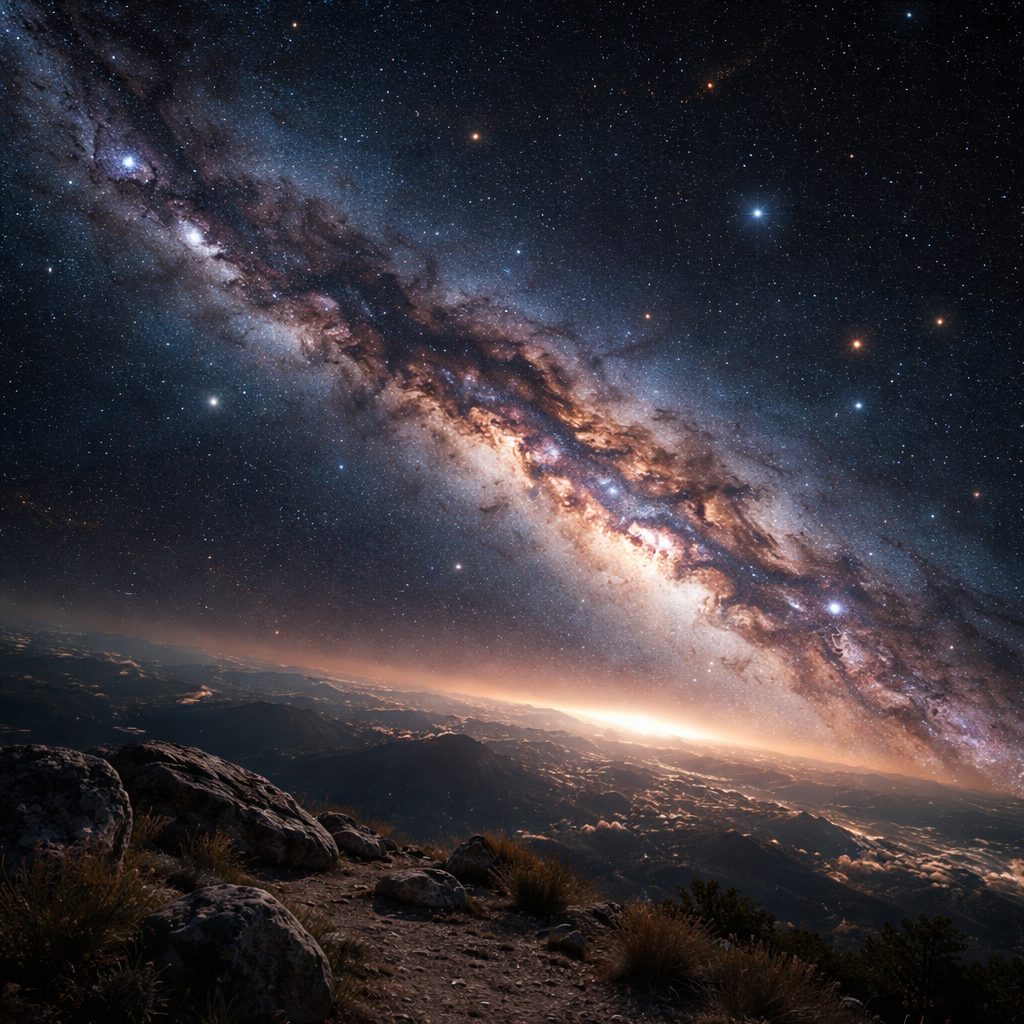
When you look up at the night sky and trace that faint band of light stretching from horizon to horizon, you’re actually looking at facts about the Milky Way galaxy from the inside — something very few people stop to consider. We live within this structure, orbit around its center, and yet we can never photograph it from the outside. That alone makes our galaxy one of the most fascinating objects in all of science.
A structure so large it bends the imagination
The Milky Way is a barred spiral galaxy — meaning it has a central bar-shaped region from which spiral arms extend outward. Scientists estimate its diameter at roughly 100,000 light-years, though more recent studies suggest the outer disk may stretch even further. Our solar system sits about 26,000 light-years from the galactic center, nestled in a minor arm called the Orion Arm.
To put that distance in perspective: even traveling at the speed of light, it would take 26,000 years just to reach the center of our own galaxy. These numbers stop feeling abstract the moment you realize we’re not observers of the Milky Way — we’re passengers inside it.
What the galaxy is actually made of
The Milky Way contains an estimated 100 to 400 billion stars. That’s not a typo. The challenge is that most of them are invisible to the naked eye — not because they’re too far away, but because vast clouds of interstellar dust block much of the visible light between us and the galactic core.
Beyond stars, the galaxy is filled with gas, dust, stellar remnants, and something we still don’t fully understand: dark matter. Current models suggest that ordinary matter — everything we can see and detect — makes up only a small fraction of the Milky Way’s total mass. The rest is composed of dark matter, which interacts with gravity but emits no detectable light or radiation.
The visible stars are, in a sense, just the tip of the iceberg. The Milky Way is mostly made of things we cannot yet directly observe.
The supermassive black hole at the center
At the very heart of the Milky Way lies Sagittarius A*, a supermassive black hole with a mass approximately 4 million times that of our Sun. It was long theorized based on the behavior of stars orbiting the galactic center, and its existence was confirmed through decades of observations by astronomers studying stellar motion in that region.
Remarkably, Sagittarius A* is currently in a relatively quiet state. It’s not actively consuming large amounts of material, which means it produces far less radiation than many other galactic cores. Some galaxies have what are called active galactic nuclei — their central black holes are feeding continuously and can outshine everything else. Ours, for now, is comparatively calm.
Key facts at a glance
| Feature | Detail |
|---|---|
| Galaxy type | Barred spiral |
| Estimated diameter | ~100,000 light-years |
| Number of stars | 100–400 billion (estimated) |
| Distance to galactic center | ~26,000 light-years |
| Central black hole mass | ~4 million solar masses |
| Number of known satellite galaxies | Over 50 |
| Galactic rotation speed (Sun’s orbit) | ~828,000 km/h |
How fast are we actually moving?
Here’s something that tends to surprise people: our solar system is not sitting still. It orbits the center of the Milky Way at approximately 828,000 kilometers per hour. At that speed, one complete orbit — called a galactic year or cosmic year — takes around 225 to 250 million Earth years.
The last time our solar system was in its current position relative to the galactic center, dinosaurs hadn’t yet appeared on Earth. That’s the scale of time we’re dealing with when we talk about galactic motion.
Satellite galaxies and the galactic neighborhood
The Milky Way has its own collection of smaller companion galaxies orbiting around it. The most well-known are the Large and Small Magellanic Clouds, which are visible to the naked eye from the Southern Hemisphere. Astronomers have identified over 50 satellite galaxies in total, though many are small, faint dwarf galaxies that are difficult to detect.
Some of these satellites are gradually being absorbed into the Milky Way through a process called galactic cannibalism — a natural part of how large galaxies grow over billions of years. The Sagittarius Dwarf Galaxy, for instance, is currently being torn apart and incorporated into our galaxy’s disk and halo.
Why we can’t photograph our own galaxy
One of the most common misconceptions is that images labeled “the Milky Way” actually show the entire galaxy from above. They don’t. Every photograph showing the full spiral structure is either an artist’s illustration, a composite model, or an image of a different galaxy that resembles what scientists believe ours looks like.
We are embedded inside the Milky Way’s disk, which makes getting an external view physically impossible with current technology. What we can photograph is the galactic plane — that glowing band of light — as seen from Earth. To map the galaxy’s structure, astronomers rely on radio telescopes, infrared imaging, and observations of star positions and velocities across the sky.
- Radio waves pass through dust clouds that block visible light, making them essential for studying the galactic core.
- Infrared telescopes like the James Webb Space Telescope can peer deeper into star-forming regions and the central bulge.
- Measuring the parallax and motion of stars across thousands of light-years helps astronomers build 3D maps of the galaxy’s spiral arms.
The Milky Way is older than most people realize
Based on the ages of the oldest stars found within it, the Milky Way is estimated to be around 13.6 billion years old — making it nearly as old as the universe itself, which formed approximately 13.8 billion years ago. The earliest stars in our galaxy formed when the universe was still very young, and their chemical signatures are dramatically different from stars like our Sun.
These ancient stars, sometimes called Population II stars, contain very little of the heavier elements that are forged in stellar explosions over time. Studying them gives astronomers a window into what conditions were like in the very early universe — a kind of cosmic archaeology carried out across billions of light-years.
The collision that’s already scheduled
In roughly 4.5 billion years, the Milky Way and Andromeda Galaxy are expected to collide and eventually merge into a single, larger elliptical galaxy. Despite how dramatic that sounds, the actual collision will unfold over hundreds of millions of years, and the vast distances between individual stars mean that stellar collisions will be extremely rare.
What will change dramatically is the structure of both galaxies — the spiral arms will distort, stars will be flung into new orbits, and the two central black holes will eventually merge. Our Sun will likely survive the event, though its position in the resulting galaxy will be very different from where it sits today.
The universe, it turns out, operates on timescales that make human history look like a single frame in a very long film. And the Milky Way — ancient, vast, and still full of unanswered questions — is one of the best reminders we have of just how extraordinary the cosmos truly is.
