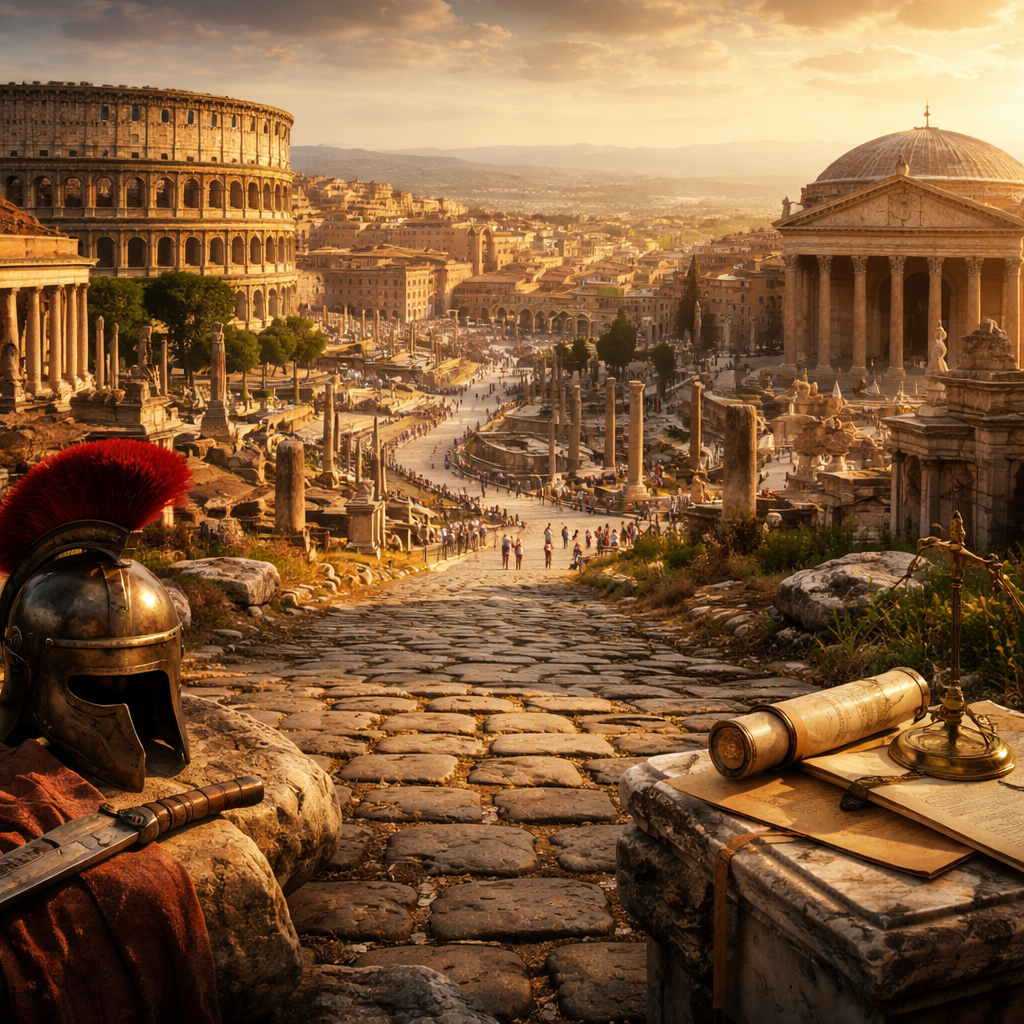
The Roman Empire stretched across three continents at its peak, governing over 70 million people — roughly one fifth of the entire world’s population at the time. These facts about the Roman Empire are not just numbers on a page; they reveal the mechanics of a civilization that shaped law, architecture, language, and governance in ways we still live with today.
Engineering that outlasted the engineers
Roman roads were built so precisely that many of their routes still underlie modern highways across Europe and the Middle East. The engineers used a layered method — gravel, sand, and large flat stones — that allowed proper drainage and load distribution. Some original road sections remain intact and walkable to this day.
The Pantheon in Rome, completed under Emperor Hadrian, features an unreinforced concrete dome that remains the largest of its kind in the world. The Romans used a volcanic aggregate called pozzolana in their concrete mix, which reacted with seawater and air to grow stronger over centuries rather than weaker. Modern engineers have studied this material specifically to improve contemporary construction.
“Roman concrete harbors a secret that modern science is only beginning to fully decode — it self-heals through a process of mineral crystallization that no synthetic material can replicate.”
— Findings from a study published in Science Advances by Marie Jackson et al.
A legal system that never really went away
Roman law introduced concepts that form the backbone of legal systems across Europe, Latin America, and beyond. The principle of “innocent until proven guilty,” the right to appeal a verdict, and the idea of legal personhood for organizations all trace back to Roman legal tradition. The Justinian Code, compiled in the 6th century CE, systematized Roman law and became the foundation for civil law systems used in dozens of countries.
What’s particularly striking is how practical Roman legal thinking was. Laws were not purely philosophical — they addressed property rights, commercial contracts, inheritance, and even noise complaints in urban areas. Roman cities were noisy, crowded places, and the law adapted accordingly.
Society, class, and daily life inside the empire
Roman society was deeply stratified, but surprisingly mobile by ancient standards. Freed slaves could become wealthy citizens, and some rose to positions of influence within the imperial household. The emperor Diocletian was born to a freed slave family. Military service was one of the most reliable paths to citizenship and land ownership for non-Romans living within the empire’s borders.
Daily life for ordinary Romans revolved around the insulae — multi-story apartment buildings that housed the urban poor. These buildings were fire hazards and frequently collapsed, prompting emperors like Augustus to establish one of history’s first professional fire brigades, the Vigiles.
| Aspect of Roman Life | Detail |
|---|---|
| Average working day | Started at dawn, most business done by midday |
| Public baths (thermae) | Used daily by most citizens, social and hygienic role |
| Diet of the poor | Primarily grain porridge, bread, olives, and legumes |
| Gladiatorial games | Funded by elites and emperors to gain public favor |
| Literacy rate | Estimated 10–30% depending on region and social class |
Military machine and the limits of empire
The Roman legion was one of the most effective military units in ancient history, not because of brute numbers, but because of discipline, logistics, and adaptability. Legions built their own roads, bridges, and fortified camps wherever they marched. A standard legion of roughly 5,000 soldiers could construct a fully defended camp in a single afternoon.
However, the empire’s enormous size eventually became its greatest vulnerability. Supplying and defending borders that stretched from Scotland to Mesopotamia required enormous resources. As the 3rd century CE brought wave after wave of internal political crisis — sometimes called the Crisis of the Third Century — maintaining frontier security became increasingly unsustainable.
- At its greatest extent, the Roman Empire covered approximately 5 million square kilometers
- The military consumed an estimated 50–70% of the imperial budget
- Rome had over 26 emperors in a 50-year period during the 3rd century CE
- The Eastern Roman Empire (Byzantine Empire) continued for nearly 1,000 years after the Western half fell
Language, culture, and the invisible inheritance
Latin did not simply disappear when the Western Empire collapsed — it fragmented and evolved into the Romance languages: Italian, Spanish, French, Portuguese, and Romanian. Even English, a Germanic language, absorbed Latin deeply through the Norman Conquest and the Catholic Church. Estimates suggest that over 60% of English vocabulary has Latin or Latin-derived roots.
Roman religious policy was notably pragmatic for most of the empire’s history. Rather than suppressing local religions, Rome typically incorporated foreign deities into its own pantheon. Temples to Egyptian Isis stood alongside temples to Jupiter in Roman cities. Christianity initially spread underground before eventually becoming the official state religion under Emperor Theodosius I.
A quick note on Roman numerals
Roman numerals are still actively used today — on clock faces, in film credits to indicate production years, in academic numbering of chapters and volumes, and in the names of monarchs. They represent one of the most visible daily reminders that ancient Roman culture never fully left us.
What Rome actually looked like
A common misconception is that ancient Rome was a city of white marble. In reality, Roman buildings and statues were painted in vivid colors — reds, blues, yellows, and greens. The paint has simply worn away over millennia, leaving behind the pale stone we now associate with antiquity. Modern archaeological analysis using ultraviolet light and chemical testing has confirmed this in numerous sites, including the Colosseum and the Forum of Trajan.
The city of Rome itself at its height housed somewhere between 1 and 1.5 million people — a population density comparable to modern urban centers. The infrastructure required to sustain that population, including 11 major aqueducts delivering up to one million cubic meters of water daily, remains one of the great achievements in urban planning history.
Rome did not fall in a single moment — and that matters
The narrative of Rome’s dramatic collapse is largely a simplification. The Western Roman Empire’s end was a slow transformation over more than a century, shaped by economic strain, migration of peoples, internal political fragmentation, and gradual shifts in trade networks. Many Roman institutions, including the Catholic Church and Roman municipal structures, continued without interruption.
Historian Edward Gibbon famously began analyzing Rome’s decline in the 18th century, and scholars have debated the causes ever since. What becomes clear from any serious study is that Rome did not simply collapse — it transformed. And much of what it transformed into is still with us, in our laws, our cities, our languages, and the very way we think about governance and civilization.
