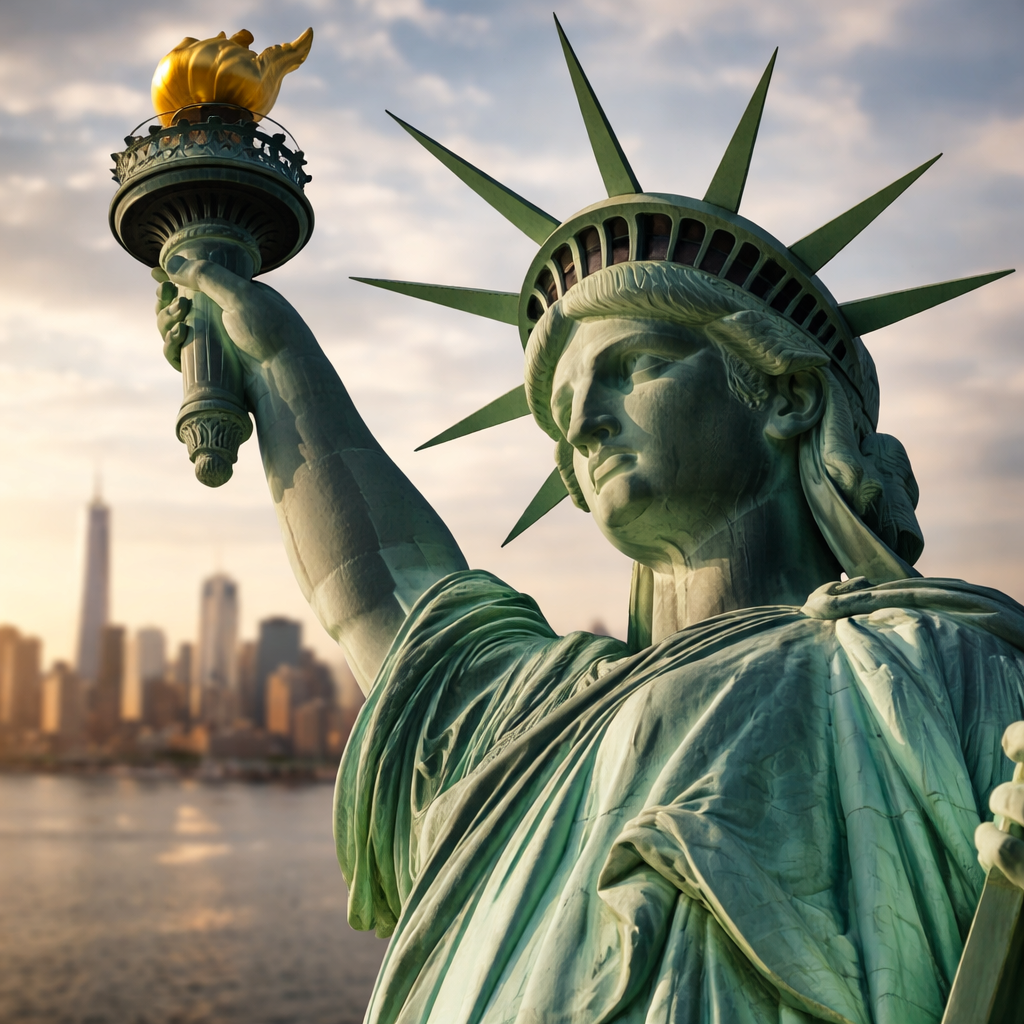
Most people can picture the Statue of Liberty instantly — the raised torch, the spiked crown, the green patina. But the facts about the Statue of Liberty go far deeper than its iconic silhouette, and many of them will genuinely surprise you, even if you’ve seen the monument in person.
She Was Never Meant to Be Green
When the statue was unveiled in 1886, Lady Liberty was a shining reddish-brown — the natural color of copper. The green color you see today is the result of oxidation, a slow chemical process that took roughly 20 to 30 years to complete. The technical term for this transformation is patina, and while many New Yorkers initially resented the color change, it eventually became inseparable from the monument’s identity.
The copper shell itself is surprisingly thin — about 2.4 millimeters, roughly the thickness of two pennies stacked together. Yet that thin layer has withstood Atlantic storms, salt air, and over a century of weathering without significant structural damage.
A French Engineer Built the Skeleton, Not the Sculptor
Frédéric Auguste Bartholdi designed the external form of the statue, but it was Gustave Eiffel — yes, the same engineer behind the Eiffel Tower — who designed the internal iron framework that holds everything together. This wasn’t a simple support structure. Eiffel created a flexible pylon and secondary framework system that allows the outer copper skin to move slightly in response to temperature changes and wind, preventing the metal from cracking over time.
Without that engineering insight, the statue likely wouldn’t have survived intact to the present day. It’s a collaboration that rarely gets the attention it deserves.
Numbers That Put the Scale Into Perspective
Reading about the statue’s size and actually internalizing it are two different things. These figures help bridge that gap:
| Feature | Measurement |
|---|---|
| Height from ground to torch tip | 93 meters (305 feet) |
| Height of the statue alone (pedestal excluded) | 46 meters (151 feet) |
| Weight of the copper structure | approximately 27 metric tons |
| Length of Lady Liberty’s index finger | 2.4 meters (8 feet) |
| Width of the mouth | about 91 centimeters (3 feet) |
| Number of rays on the crown | 7 |
| Number of windows in the crown | 25 |
The seven rays on the crown are often said to represent the seven seas and seven continents — a symbol of universal liberty rather than a specifically American one.
The Torch Has Been Closed to Visitors Since 1916
During World War I, a German sabotage operation known as the Black Tom explosion severely damaged the torch arm of the statue. The blast was one of the largest in pre-atomic history, and the structural damage to the torch was significant enough that the National Park Service has kept it closed to public access ever since. Today, visitors can climb to the crown — with advance reservations — but the torch remains off-limits.
“Give me your tired, your poor, your huddled masses yearning to breathe free.”
— Emma Lazarus, from the sonnet “The New Colossus,” inscribed on a bronze plaque inside the pedestal
These famous lines weren’t part of the original design. The poem was written in 1883 to raise funds for the pedestal’s construction, and the bronze plaque wasn’t installed until 1903 — seventeen years after the statue’s dedication. Over time, however, the poem became more closely associated with the statue’s meaning than the monument itself.
Details Most People Walk Past Without Noticing
There’s a lot happening at ground level that gets overlooked in favor of the view from above. Here are a few lesser-known details worth knowing before or after a visit:
- Lady Liberty’s right foot is raised mid-step, suggesting she is walking forward and breaking free from the broken chains at her feet — not standing still.
- The broken shackles around her ankles were a deliberate design choice by Bartholdi, symbolizing the end of oppression. They are most visible from above but easy to miss at ground level.
- The tablet she holds reads July IV MDCCCXXVI in Roman numerals — the date of American independence.
- The statue’s face is believed to have been modeled after Bartholdi’s mother, Charlotte, though this has never been officially confirmed.
- Liberty Island, where the statue stands, was originally called Bedloe’s Island. Its name was officially changed only in 1956.
The Gift That Came With Strings Attached
The popular narrative is that France gave the United States the Statue of Liberty as a gift. That’s true, but the full story is more complicated. The agreement between the two countries divided financial responsibility: France would fund the construction of the statue itself, while the United States was responsible for building the pedestal. Neither side found fundraising easy.
In the United States, Congress repeatedly refused to allocate federal funds for the pedestal. The project was saved largely by publisher Joseph Pulitzer, who used his newspaper — the New York World — to run an aggressive fundraising campaign, promising to print the name of every donor regardless of how small the contribution. More than 120,000 people responded, and the pedestal was completed in time for the statue’s 1886 dedication.
It’s a reminder that one of the most recognized structures on earth nearly didn’t happen for lack of money — and that public participation made the difference.
Still Standing, Still Relevant
The Statue of Liberty has been designated a UNESCO World Heritage Site and continues to draw millions of visitors annually from every corner of the world. Its meaning has shifted and expanded over time — from a symbol of the American-French alliance to a universal emblem of freedom and migration. What’s striking is how much of what makes it powerful lies not in the grand gesture of the torch, but in those smaller, often overlooked details: the broken chains, the mid-step posture, the poem on the wall inside.
The more closely you look, the more intentional it all becomes — and that’s true whether you’re visiting for the first time or simply seeing it through fresh eyes after reading something you didn’t know before.
