Most lawn owners underestimate how quickly weeds can take over — and by the time the problem is visible, the roots are already deep. Knowing how to get rid of weeds in the lawn effectively means understanding not just removal, but the conditions that allowed them to thrive in the first place. That’s where most generic advice falls short.
Why weeds keep coming back no matter what you do
Before pulling out a single dandelion, it helps to understand the root cause — literally. Weeds don’t appear randomly. They fill ecological gaps: compacted soil, bare patches, poor drainage, or low soil fertility. If your lawn has thin grass coverage, weeds will colonize those spaces because nature doesn’t tolerate empty ground.
Common culprits like dandelions, crabgrass, clover, and broadleaf plantain each signal something specific about your soil condition. Clover often appears in nitrogen-deficient lawns. Crabgrass loves compacted, dry soil and thrives in hot weather. Identifying your weed type isn’t just a curiosity — it directly informs the treatment you should use.
Manual removal: when it actually makes sense
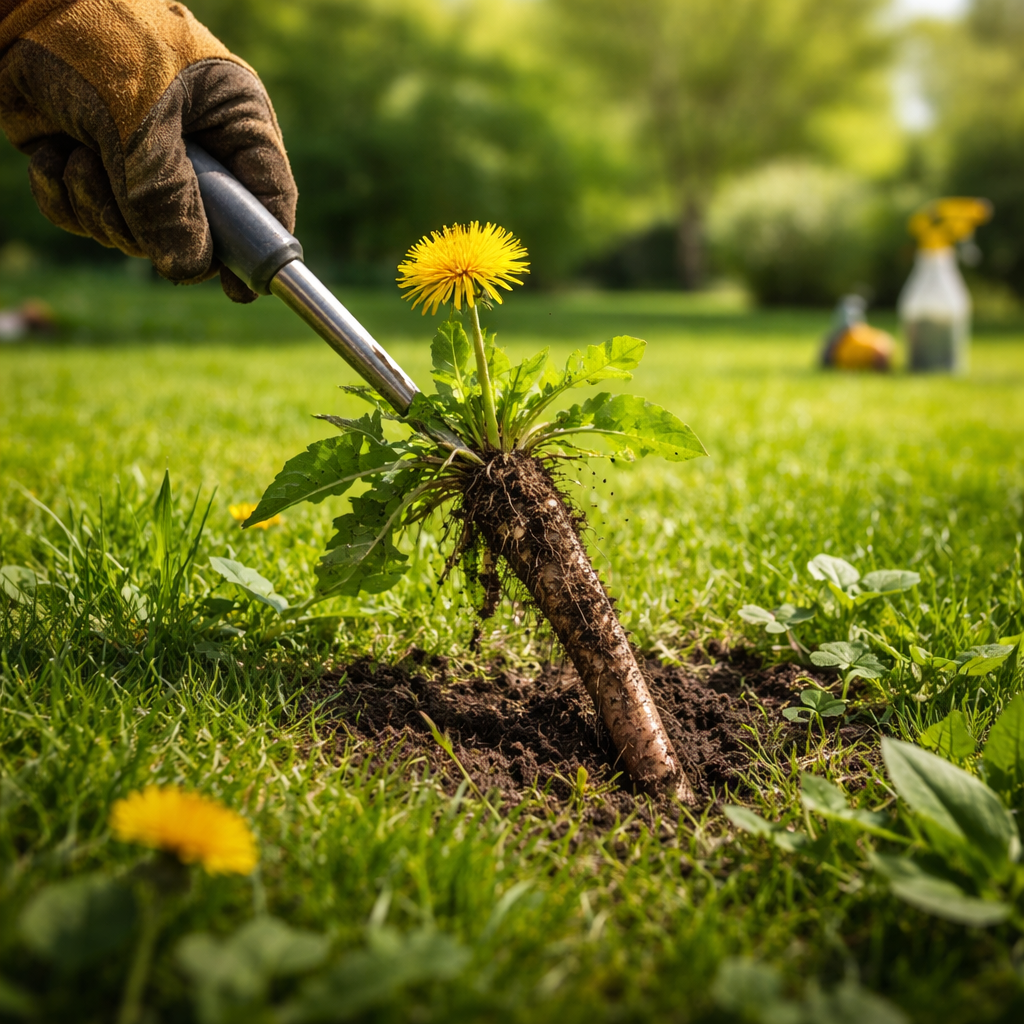
Hand-pulling works well when the infestation is limited and you’re dealing with deep-rooted weeds like dandelions. The key detail most people miss: you need to remove the entire taproot, not just the leafy top. A dandelion can regenerate from a root fragment left just a few centimeters underground.
The best time to pull weeds manually is after rain or watering, when soil is loose and roots release more easily without breaking.
A long-handled weeding tool or a narrow fishtail weeder gives you the leverage to extract the root cleanly. For larger areas, manual removal becomes impractical — and that’s when other methods deserve serious consideration.
Herbicides: choosing the right type for the right weed
Not all herbicides work the same way, and using the wrong one can damage your lawn grass alongside the weeds. There are two main categories to understand:
| Type | How it works | Best used for |
|---|---|---|
| Pre-emergent herbicide | Prevents weed seeds from germinating | Crabgrass, annual weeds — apply in early spring |
| Post-emergent herbicide | Kills existing, actively growing weeds | Dandelions, clover, broadleaf weeds |
| Selective herbicide | Targets specific weed types without harming grass | Broadleaf weeds in a grass lawn |
| Non-selective herbicide | Kills all plant growth it contacts | Spot treatments on paths, borders — use with caution on lawns |
Always read the label carefully. Many post-emergent selective herbicides are safe for common turf grasses like Kentucky bluegrass or tall fescue, but can damage fine fescue or bentgrass. Application timing also matters — most herbicides work best when weeds are young and actively growing, not during drought stress or extreme heat.
Natural and organic approaches that genuinely work
If you prefer to avoid synthetic chemicals, there are several organic weed control methods worth knowing — though they require more consistency to be effective.
- Corn gluten meal acts as a natural pre-emergent, reducing germination of weed seeds when applied at the right time in spring.
- Boiling water kills surface weeds on contact and is useful along edges and cracks — but avoid it on lawn areas since it kills grass too.
- Vinegar-based solutions with high acetic acid concentration can burn back young weeds, though they don’t affect the root system and regrowth often occurs.
- Overseeding bare patches with grass seed is one of the most underrated organic strategies — dense turf simply leaves no room for weeds to establish.
Organic methods rarely offer instant results, but paired with good lawn care habits, they can significantly reduce weed pressure over time without introducing chemicals into your yard.
Lawn care habits that prevent weeds better than any treatment
Here’s something the weed killer industry won’t emphasize: a healthy, dense lawn is your single most effective long-term defense. Weeds struggle to compete when turf grass is thick, well-fed, and properly maintained. That means a few non-negotiable habits.
Mowing too short is one of the leading causes of weed invasion. Scalped grass exposes soil to sunlight, which weed seeds need to germinate. Most lawn grasses perform best when kept at 7–9 cm in height.
- Mow at the correct height for your grass type and never remove more than one-third of the blade length at once.
- Water deeply but infrequently — shallow watering encourages shallow-rooted weeds more than deep-rooted grass.
- Aerate compacted soil annually to improve root depth and reduce conditions that favor weeds like crabgrass.
- Fertilize based on a soil test, not guesswork — over-fertilizing can favor weeds, while the right nutrients strengthen turf grass.
- Fill bare patches promptly with grass seed before weeds claim that space.
These practices work together rather than in isolation. A lawn that gets proper mowing, deep watering, and annual aeration is fundamentally harder for weeds to colonize — and that reduces the need for intervention later.
Timing your weed control for maximum impact
One of the most common mistakes is treating weeds reactively — only when they’re already visible and widespread. Effective lawn weed management follows a seasonal rhythm.
In early spring, apply pre-emergent herbicide before soil temperatures reach around 10°C — that’s typically the threshold when crabgrass and other annual weeds begin germinating. Missing this window means dealing with established plants, which are far harder to eliminate.
Late summer and early fall are actually ideal for treating perennial broadleaf weeds like dandelions with post-emergent herbicide. During this period, plants are actively moving nutrients down to their roots — which means herbicides travel deeper and are more effective. Fall is also the best time to overseed, giving new grass a head start before weeds re-emerge in spring.
A weed-free lawn is a process, not a one-time fix
Expecting to solve a weed problem in a single afternoon is the mindset that leads to repeated frustration. Lawn weed control works in layers — manual removal for immediate relief, herbicides for active infestations, and consistent lawn care to prevent the next wave. No single product or method covers all of that on its own.
The good news is that once you shift from reactive treatment to proactive lawn management, the amount of effort required drops considerably each season. A lawn that’s well-maintained simply doesn’t give weeds much opportunity to gain ground — and that’s the most satisfying result of all.
