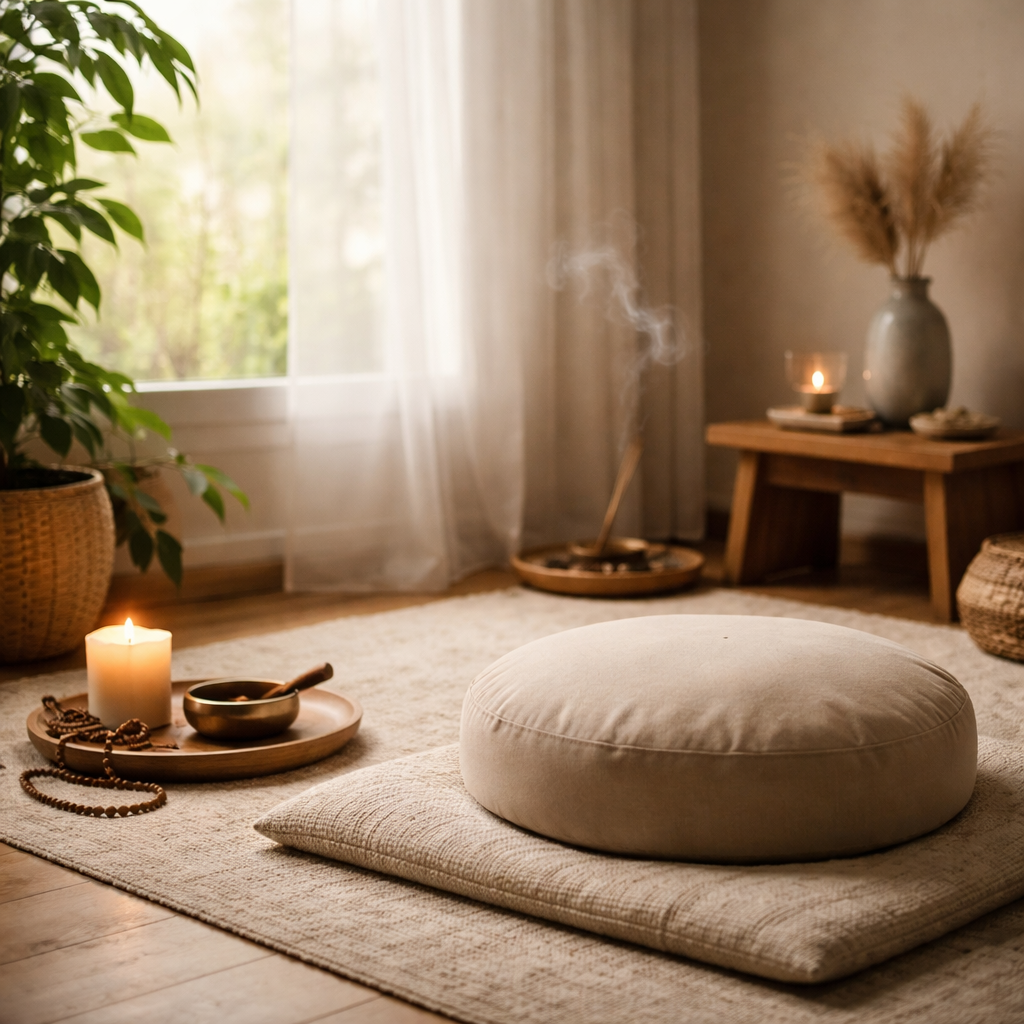
Finding ideas for a meditation corner at home often starts with one realization: you don’t need a spare room or a big budget to create a space that genuinely helps you decompress. What matters far more is intentionality — how you use the space and what you place within it to signal to your mind that it’s time to slow down.
Why a dedicated space changes the practice
There’s a well-documented psychological phenomenon called context-dependent memory: your brain associates behaviors with the environments where they happen. When you meditate in the same spot consistently, that corner gradually becomes a cue for calm. Sitting down there starts to feel different from sitting anywhere else in your home — even before you close your eyes or take a single conscious breath.
This is why creating even a small, defined area for mindfulness practice can strengthen the habit more effectively than meditating in a different location every day. The space does part of the work for you.
Choosing the right spot
Before thinking about cushions or candles, look around your home with fresh eyes. The ideal meditation nook doesn’t have to be a quiet bedroom corner — it could be a section of your living room, a spot near a window, or even a cleared area of a hallway alcove. What you’re looking for is a place that meets a few practical criteria:
- Low foot traffic — you’re less likely to be interrupted
- Some natural light, if possible — daylight helps regulate mood and alertness
- Distance from screens and work-related items — visual cues from your laptop or TV can keep the mind active
- A spot where you feel at ease, not exposed or uncomfortable
Even a corner of a shared bedroom can work beautifully if it’s set apart with intention. A small rug, a floor cushion, and a single plant can visually separate that area from the rest of the room.
Seating and comfort: more options than you think
The idea that you must sit cross-legged on the floor to meditate properly is one of the most persistent myths around mindfulness practice. Your posture matters, but comfort matters just as much — discomfort becomes a distraction.
| Seating option | Best for | Notes |
|---|---|---|
| Zafu cushion (round meditation pillow) | Floor sitters who want spine support | Often paired with a zabuton mat underneath |
| Meditation bench (seiza bench) | People who find cross-legged positions uncomfortable | Allows kneeling position with less strain |
| Yoga bolster | Those who practice body scan or lying meditations | Great for restorative or breathwork sessions |
| Upright chair | Anyone with back or knee issues | Keep feet flat on the floor, back away from the backrest |
If you’re just starting out, a folded blanket on the floor or a firm chair cushion is perfectly sufficient. Build toward more dedicated equipment once you know what your body actually needs during practice.
Elements that make the space feel intentional
Once seating is sorted, the surrounding environment plays a meaningful role in how easily you settle. This isn’t about decoration for its own sake — it’s about using sensory cues to help the nervous system downshift.
A meditation space doesn’t need to look like a wellness magazine spread. It needs to feel right to you — and that’s a deeply personal thing.
Here are some elements worth considering, along with what each actually contributes:
- Soft, warm lighting — harsh overhead lights can feel activating rather than calming; a small lamp or candle creates a gentler atmosphere
- Natural elements — a small plant, a stone, or a wooden object can add grounding texture to the space
- A scent anchor — using the same essential oil or incense each time you sit can become a powerful conditioning cue for the mind
- Minimal visual clutter — a cleared surface is easier to look at when you’re trying to let thoughts settle
- Something meaningful — a small object, a image, or a quote that holds personal significance can set an intentional tone
None of these are required. Some people meditate best in front of a completely blank wall. The point is to experiment and notice what genuinely helps you arrive in the present moment faster.
Sound and silence in small spaces
If you live in a noisy home or urban environment, silence may not be a realistic baseline. That’s where sound design becomes part of your corner setup. A small Bluetooth speaker placed nearby can play ambient sounds — rainfall, brown noise, or soft instrumental music — to create an acoustic boundary between your meditation space and the rest of your home.
Singing bowls are another option worth mentioning. Beyond aesthetics, striking a bowl at the beginning and end of a session creates a clear ritual boundary that trains the mind over time. Even a simple bell or chime can serve the same purpose.
Keeping the space alive and used
The most beautifully arranged meditation corner in the world won’t help if it turns into a decorative corner that you walk past every day without using. A few practical habits help keep the space functional:
- Keep it tidy but not precious — if straightening it up feels like a chore, you’ll avoid it
- Leave a visual reminder that invites you in — a lit candle, a turned cushion, a journal on the mat
- Avoid using the space for anything other than your practice — checking your phone there, for example, dilutes the conditioning effect
- Refresh it occasionally — changing a small element, like swapping out a plant or adding a new object, can reinvigorate interest in using the space
Small homes present real constraints, and that’s worth addressing honestly. If you share a bedroom or have limited square footage, your meditation corner might need to be collapsible — a cushion stored under the bed, a tray with your objects that slides out, a corner you return to by moving one chair. That’s completely valid. The ritual of setting it up can itself become part of the practice.
Making it yours, not someone else’s aesthetic
Social media has created a fairly uniform visual language around meditation spaces — white walls, dried botanicals, neutral linen, a specific style of cushion. That aesthetic works for many people, but it’s worth questioning whether it works for you specifically. A meditation nook in a home full of color and pattern doesn’t need to be stripped bare to be effective. Consistency and personal meaning matter far more than matching a particular look.
If the space feels genuinely yours — built around your sensory preferences, your schedule, your actual needs rather than an idealized version of mindfulness practice — you’ll return to it. And returning to it, day after day, is what the whole thing is really about.
