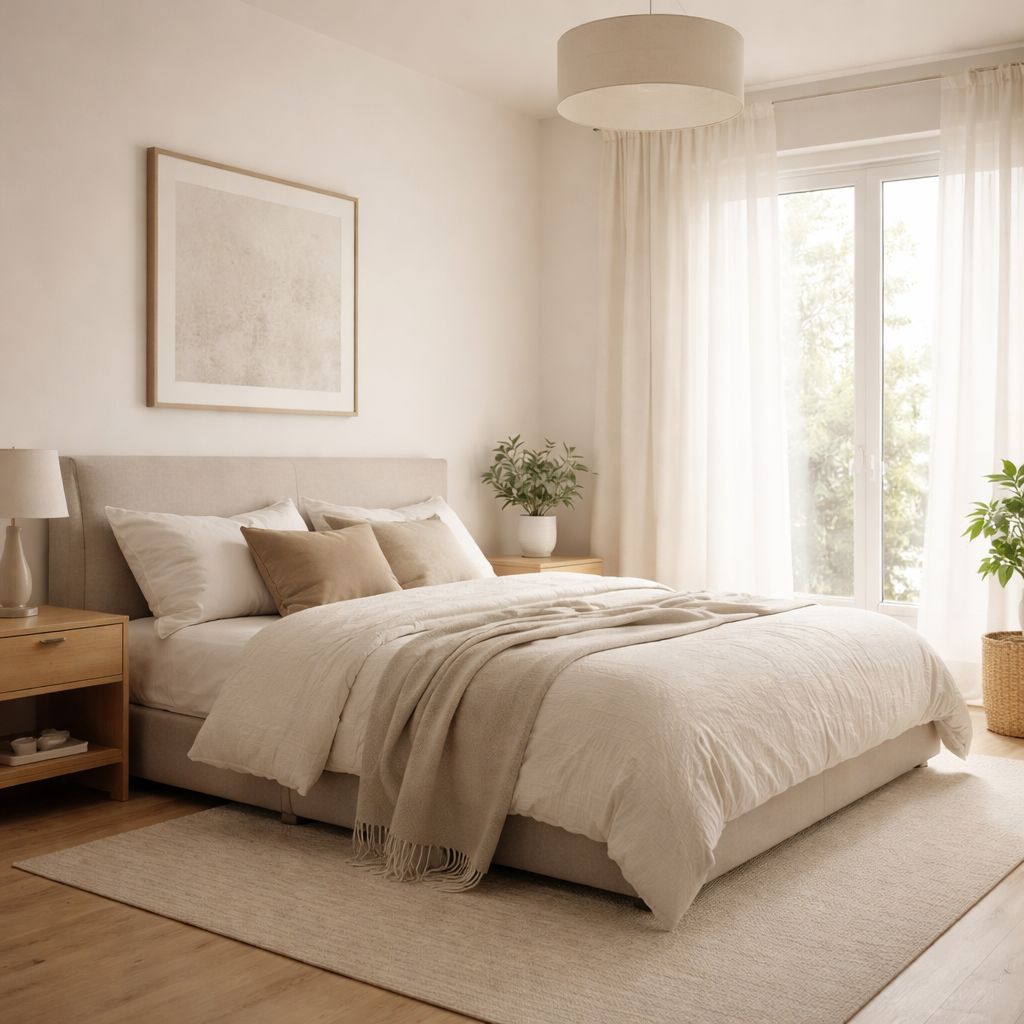
Most people underestimate how much the bedroom environment affects sleep quality, mental clarity, and daily mood — and ideas for a minimalist bedroom often offer the most effective solution, not because of aesthetics alone, but because of how intentional simplicity rewires how you feel in a space.
Why less actually works better in a bedroom
There’s a well-documented psychological effect tied to visual clutter: the more objects your eyes register before sleep, the harder it is for your brain to switch off. A minimalist bedroom isn’t about owning nothing — it’s about keeping only what earns its place. Every piece of furniture, every textile, every object on a surface should have a reason to be there. This approach shifts the room from a storage space into a genuine resting environment.
The good news is that minimalist design doesn’t require a complete renovation or a significant budget. It’s more about editing what you already have than buying anything new.
Start with the bed itself
The bed is the visual anchor of any bedroom, so it makes sense to start there. In minimalist interiors, bed frames tend to be low-profile — platform beds with clean lines work particularly well because they create a sense of groundedness without dominating the space. Upholstered headboards in neutral tones add softness without visual noise.
Bedding matters just as much as the frame. Stick to a limited color palette — whites, warm grays, soft beiges, or muted earth tones. Layering two or three textures (a linen duvet, a cotton throw, simple pillowcases) adds warmth without making the bed look like a display window at a home goods store.
A well-made bed with quality, simple bedding does more for a bedroom’s atmosphere than any decorative item placed on a shelf.
Furniture: how to choose and how much
One of the core principles of minimalist bedroom furniture is multifunctionality. A bedside table with a drawer replaces the need for a separate shelf. A storage ottoman at the foot of the bed eliminates a dresser. A floating shelf installed at the right height doubles as a nightstand and frees up floor space — which visually expands even a small room.
Here’s a simple framework to audit your current furniture situation:
| Item | Keep if… | Remove if… |
|---|---|---|
| Dresser | You lack built-in storage | A wardrobe already covers it |
| Bench or ottoman | It serves storage or daily use | It’s purely decorative |
| Armchair | You genuinely sit in it daily | It only collects clothes |
| Second nightstand | Two people share the space | You sleep alone and space is tight |
Color, light, and how they shape perception
Minimalist bedrooms tend to rely on a restrained color palette, but that doesn’t mean the space has to feel cold or sterile. Warm neutrals — think off-white, warm taupe, soft sage — create a calm atmosphere that feels intentional rather than empty. If you want one accent color, keep it grounded: a dusty terracotta pillow or a deep olive throw can add character without breaking the visual calm.
Natural light is the most powerful free tool available. Keep window treatments simple — sheer linen curtains or light-filtering roller blinds allow daylight in while maintaining privacy. Heavy drapes with elaborate patterns are the quickest way to undo a minimalist aesthetic.
For artificial lighting, layering works well: a ceiling fixture for general light, a bedside lamp for reading, and optionally a small floor lamp if the room allows. Warm-toned bulbs (around 2700K) create a relaxing glow that’s much more conducive to winding down than cool white light.
What to do with storage — practically
The most common struggle with minimalist bedroom design isn’t visual — it’s practical. Where does everything go? The answer usually involves a combination of built-in solutions and smart use of existing space.
- Use under-bed storage boxes for seasonal items like extra blankets or off-season clothing — flat, lidded containers keep things organized and invisible.
- If your wardrobe has a mixed interior, invest in matching hangers and simple organizers. Uniform hangers alone reduce visual chaos significantly when doors are open.
- Keep surfaces deliberately spare — a bedside surface ideally holds only what you use nightly: a lamp, a book, a glass of water.
- Hooks on the back of the bedroom door or inside the wardrobe door handle everyday items like bags or tomorrow’s outfit without cluttering the room.
Decor that doesn’t compete with calm
Minimalism doesn’t mean bare walls and zero personality. It means being selective. One larger piece of art creates more visual impact than a gallery wall of smaller prints — and it’s considerably easier to live with long-term. Choose something you genuinely respond to rather than something that matches the duvet.
Plants are a natural fit for minimalist bedrooms because they add life and texture without manufactured clutter. A single pothos on a shelf or a small snake plant on the floor near the window is enough. You don’t need a botanical collection to feel the benefit.
Mirrors are another underused tool. A full-length mirror leaning against the wall or hung on the back of a door serves a practical function while also reflecting light and making the room feel larger — two benefits from one object, which is very much in the minimalist spirit.
Where to begin if the room feels overwhelming right now
If your bedroom currently feels far from any of this, the most useful thing to do is start with one surface. Clear it completely, then return only what you actually use in that spot. That single action builds momentum and makes the whole project feel achievable rather than abstract.
Minimalist bedroom design is not a destination you arrive at and stay. It’s an ongoing practice of choosing what belongs. The more deliberate that practice becomes, the more naturally the space starts to reflect the kind of rest and calm you were looking for in the first place.
