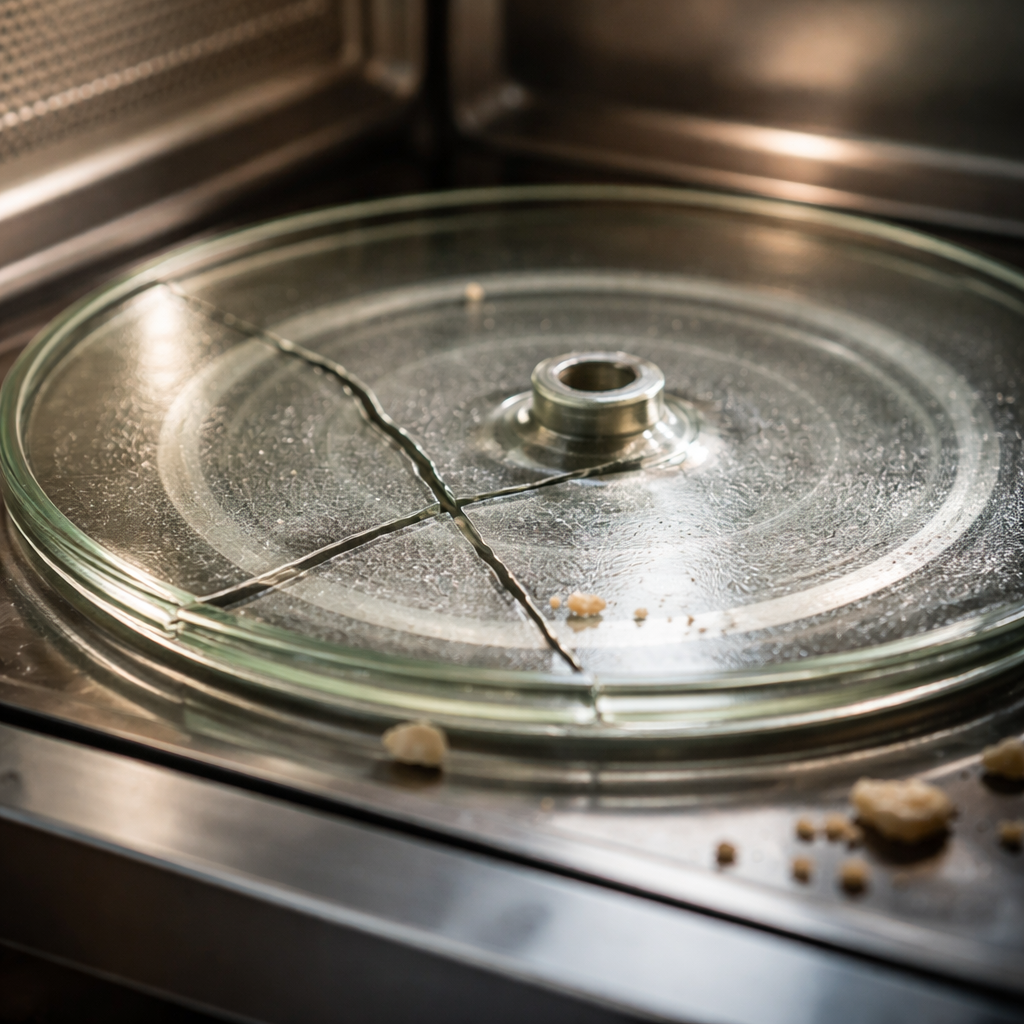
A hairline crack on the glass plate might seem like a minor cosmetic issue, but the question of whether is it safe to use a cracked microwave turntable is one that deserves a straight, well-informed answer — not a dismissive “it’s probably fine.” The short version: it depends on the crack, but the risks are real enough to take seriously.
What the turntable actually does — and why its condition matters
The rotating glass plate inside your microwave is not just there to spin food around for even heating. It also acts as a physical barrier that keeps food, moisture, and debris away from the cavity floor and the drive mechanism beneath. When that plate is damaged, even partially, its ability to perform both functions is compromised.
Glass used in microwave turntables is specifically designed to withstand repeated thermal cycling — the constant shift between cold and hot that happens every time you use the appliance. Standard glass is not built for this. A crack, no matter how small, creates a structural weak point that grows over time as thermal stress accumulates.
The real risks behind a damaged microwave plate
People tend to underestimate what a cracked turntable can lead to. Here is what can realistically happen:
- The plate can shatter mid-cycle, sending fragments into the food and potentially damaging the interior of the microwave.
- Cracks collect food residue and grease that cannot be properly cleaned, creating a hygiene problem and a fire risk.
- An uneven or wobbling plate causes inconsistent food rotation, leading to cold spots — which matters especially when reheating meat or poultry.
- Broken edges can scratch the microwave cavity floor, exposing the metal and interfering with microwave energy distribution.
Thermal shock is the leading cause of microwave glass plate failure. A crack that looks stable at room temperature can propagate rapidly when exposed to steam or sudden temperature changes.
It is also worth noting that not all cracks behave the same way. A superficial surface scratch is different from a crack that runs through the full thickness of the glass. The latter is a clear signal to stop using the plate immediately.
How to assess the damage before making a decision
Before you decide to replace or continue using the plate, take a moment to actually look at it carefully — under good lighting, ideally holding it up to check both surfaces.
| Type of damage | Risk level | Recommended action |
|---|---|---|
| Fine surface scratch (no depth) | Low | Monitor closely, clean regularly |
| Crack through full thickness | High | Replace immediately |
| Chipped edge | Medium to high | Replace as soon as possible |
| Multiple hairline cracks | High | Do not use — replace now |
| Crack near the center hole | Very high | Stop using immediately |
A crack near the center of the plate — where the drive coupler connects — is especially dangerous because that area bears the most mechanical stress during rotation. Even a small fracture in that zone can cause sudden breakage.
Can you run a microwave without the turntable at all?
Some people remove the damaged plate and simply run the microwave without it while waiting for a replacement. This is generally not recommended for regular use. Without the rotating plate, microwave energy distribution becomes highly uneven. Certain areas of your food will be overheated while others remain cold, which is more than just inconvenient — it is a food safety concern when dealing with proteins.
That said, some modern microwaves use an inverter system or a rotating antenna instead of a turntable, and are designed to work without a glass plate. Check your appliance’s manual to know which category yours falls into.
Finding a replacement and what to look for
Replacement microwave turntable plates are widely available and typically inexpensive. You can find them through the appliance manufacturer directly, through authorized parts retailers, or via general appliance parts marketplaces. When choosing a replacement, keep the following in mind:
- Use the model number printed inside the microwave door frame or on the back panel to find a compatible part.
- Opt for OEM (original equipment manufacturer) parts when possible — they are built to the same specifications as the original.
- If buying a third-party plate, verify that it is rated for microwave use and made from borosilicate or equivalent thermal-resistant glass.
- Check that the turntable ring (the plastic or roller ring the plate rests on) is also in good condition — a worn ring causes the plate to wobble even if the glass itself is new.
Replacing a turntable plate takes about two minutes and requires no tools. It is one of the simplest appliance repairs you can make, and the cost is almost always under the price of a single takeout meal.
The bottom line your microwave manual won’t tell you
Appliance manuals rarely address cracked components in plain language, which leaves most people guessing. The practical answer is this: surface-level scratches with no structural depth are low risk if monitored, but any crack that goes through the glass — regardless of size — means the plate’s structural integrity is already gone. Continued use adds heat stress with every cycle, and there is no way to predict when the plate will finally give way.
The cost of a replacement plate is negligible compared to the hassle of cleaning shattered glass out of a microwave, or worse, having to replace the entire appliance because the cavity floor was damaged. It is one of those small maintenance decisions that takes almost no effort but protects both your equipment and your daily routine from an avoidable interruption.
