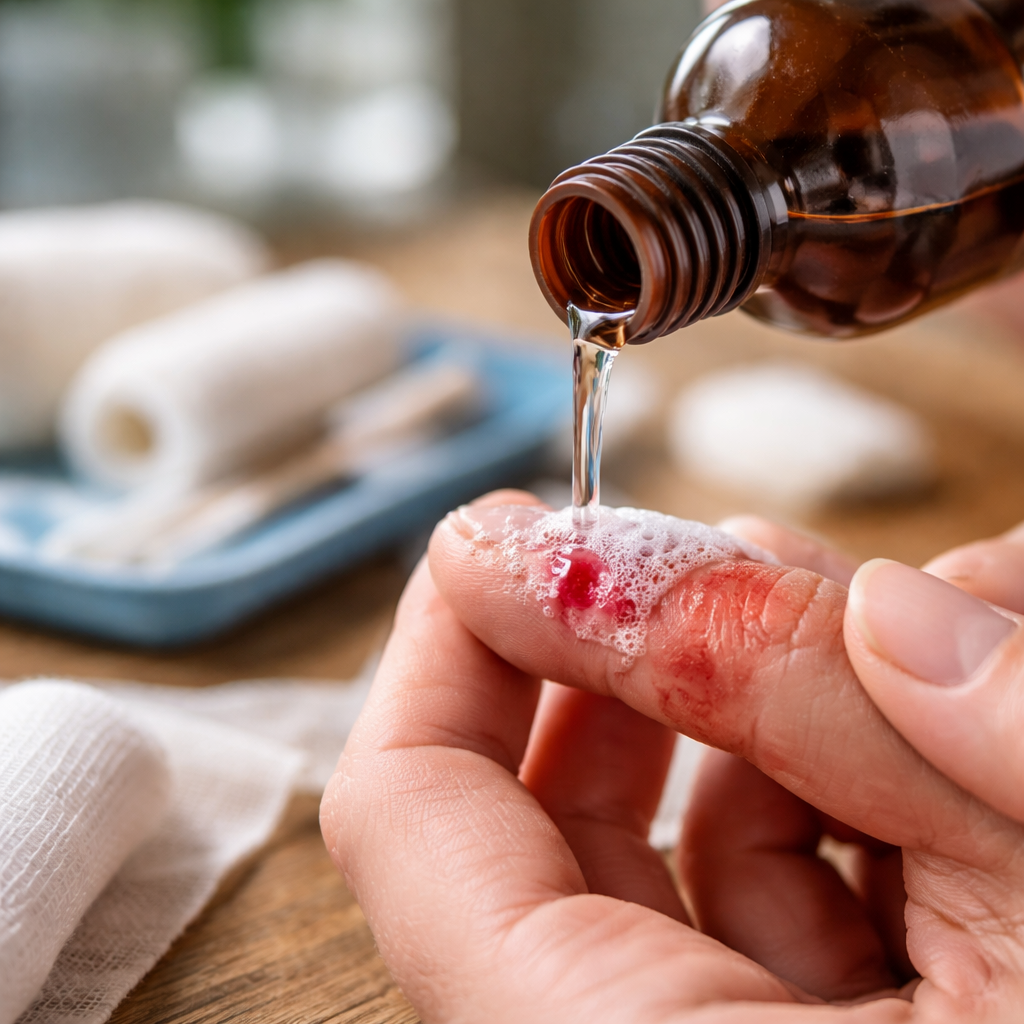
For decades, hydrogen peroxide sat in medicine cabinets as the go-to solution for cleaning cuts and scrapes — but is it safe to use hydrogen peroxide on wounds, or has that habit been quietly doing more harm than good? The answer might genuinely surprise you, and it’s worth knowing before you reach for that brown bottle next time.
What hydrogen peroxide actually does when it touches a wound
When you pour hydrogen peroxide (H₂O₂) onto broken skin, you see that familiar fizzing reaction. It feels satisfying — like something is actively fighting bacteria. And chemically speaking, something is happening: the compound breaks down into water and oxygen, and that release of oxygen creates a bubbling effect that can help dislodge debris from shallow wounds.
The problem is that hydrogen peroxide doesn’t discriminate. Along with bacteria, it also destroys fibroblasts — the cells your body relies on to build new tissue and close the wound. In other words, it’s effective at killing things, including the very cells that are trying to heal you.
“Hydrogen peroxide is cytotoxic, meaning it kills cells. It impairs healing rather than supporting it.” — a position consistently supported by wound care specialists and dermatologists in clinical literature.
The science behind why it fell out of favor
Medical guidance on wound care has shifted significantly over the past few decades. Major health organizations, including the American Academy of Dermatology and various wound care associations, have moved away from recommending hydrogen peroxide for routine wound treatment. The reason is straightforward: research consistently shows that moist wound healing — keeping a wound clean and covered, not doused in antiseptics — leads to faster recovery with less scarring.
Studies comparing standard antiseptic treatment with simple saline irrigation found that wounds treated with saline alone often healed more efficiently. The body’s immune system, when not disrupted by chemical agents, handles minor contamination remarkably well on its own.
| Treatment Method | Effect on Healing Cells | Recommended for Minor Wounds? |
|---|---|---|
| Hydrogen peroxide (3%) | Destroys fibroblasts and healthy tissue | No — not recommended by most clinicians |
| Sterile saline solution | Neutral — supports natural healing | Yes |
| Mild soap and water | Gentle cleansing without cell damage | Yes — first choice for most minor cuts |
| Povidone-iodine (diluted) | Less damaging than H₂O₂, still use cautiously | Situational — consult a professional |
When it might still have a role — and when it clearly doesn’t
To be fair, hydrogen peroxide isn’t universally harmful in all contexts. There are specific situations where a healthcare provider might use it or recommend it — for example, to loosen dried blood or crust from a wound that cannot otherwise be cleaned. But this is done carefully, in a clinical setting, and not as a regular practice.
What it’s clearly not suited for is everyday wound care at home. If you’ve just cut your finger chopping vegetables or scraped your knee, reaching for hydrogen peroxide is more likely to delay healing than to help. The same applies to deeper lacerations, puncture wounds, or any injury where tissue repair is critical.
Situations where hydrogen peroxide should be avoided entirely
- Deep or puncture wounds — it can damage internal tissue and interfere with clotting
- Burns — further irritates already compromised skin
- Chronic wounds or ulcers — significantly delays healing in vulnerable tissue
- Wounds in elderly patients or people with diabetes — healing capacity is already reduced
- Animal bites — these require professional medical evaluation, not home antiseptics
What to actually use instead
The good news is that proper wound care doesn’t require a cabinet full of products. For most minor cuts, abrasions, and scrapes, a simple and effective routine works well.
Start by rinsing the wound under clean running water for at least one to two minutes. This mechanical action is surprisingly effective at removing bacteria and debris. Then, if needed, gently clean around the wound with mild soap — not inside it. Pat dry, apply a thin layer of petroleum jelly or an appropriate antibiotic ointment if recommended by your doctor, and cover with a sterile bandage. Change the dressing daily or when it becomes wet or dirty.
Signs a wound needs more than home care
No home treatment — whether it’s hydrogen peroxide, saline, or any antiseptic — replaces professional medical attention when it’s genuinely needed. Knowing when to seek help is just as important as knowing how to clean a wound properly.
- The wound is deep, wide, or won’t stop bleeding after 10–15 minutes of steady pressure
- The edges of the wound gape and likely need stitches
- You notice increasing redness, warmth, swelling, or pus forming after a day or two
- The wound came from a rusty object and your tetanus vaccination isn’t current
- You have a fever in combination with a worsening wound
Wound infection is a real risk, and the early signs are easy to miss if you’re not watching for them. Skin that feels increasingly hot around a healing cut, red streaks extending outward, or any discharge that isn’t clear are all reasons to get a professional opinion without delay.
Rethinking what “clean” actually means for wound healing
One of the most persistent myths in home first aid is that a wound needs to be visibly foaming or stinging to be properly treated. That idea is largely rooted in older medical habits, not in how wound physiology actually works. The skin has a sophisticated repair process, and the best thing most people can do is support it rather than aggressively interfere with it.
Clean running water, gentle drying, appropriate covering — these might feel almost too simple, but they align with how professional wound care has evolved. The body doesn’t need harsh chemistry to heal a minor cut. It needs a clean environment, adequate moisture, and time. Letting go of the hydrogen peroxide habit might feel counterintuitive at first, but it’s one of those small changes that genuinely makes a difference in how quickly and cleanly you heal.
