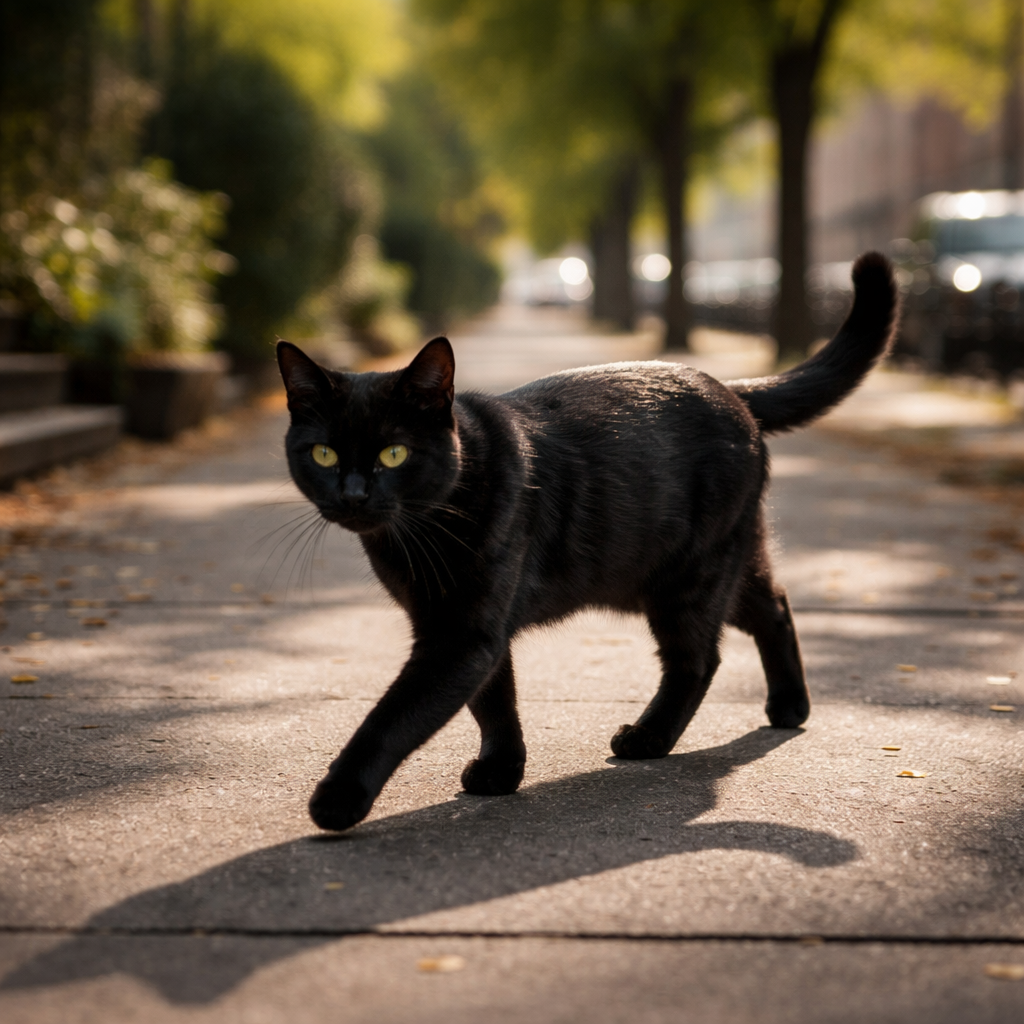
Few moments in daily life spark as much instant curiosity as the meaning of black cat crossing your path — whether you freeze on the sidewalk, laugh it off, or quietly wonder what just happened. That split-second reaction says a lot about how deeply rooted these cultural associations really are, even among people who consider themselves entirely rational.
Why the same animal means opposite things in different cultures
Here is where things get genuinely interesting. In Western European tradition — particularly in parts of Germany, Spain, and early American colonial culture — a black cat walking across your path was considered a warning, a signal to pause or change direction. Yet travel to the United Kingdom or Japan, and the exact same encounter flips entirely: black cats crossing your path are seen as a sign of incoming good fortune, financial luck, or positive change on the horizon.
This contradiction is not a mistake in cultural transmission. It reflects how local folklore developed independently in isolated communities, each layering meaning onto an animal that was highly visible, behaviorally unpredictable, and associated with night. The black coat made the cat especially striking — and in pre-modern settings, anything that stood out visually tended to collect symbolic weight quickly.
The historical roots behind the superstition
Much of the negative symbolism in Western culture traces back to medieval Europe, when black cats became associated with witchcraft and dark omens during periods of religious tension. Church authorities in several regions actively discouraged keeping black cats, and folklore spread that witches could transform into cats — particularly black ones — to move unseen. This association stuck culturally for centuries, long after its original religious context faded.
Ancient Egypt, by contrast, revered all cats without distinction of color. The goddess Bastet — depicted as a cat or a woman with a cat’s head — was a protector of home and family. Black cats in this context carried divine energy rather than dark omens. Egyptian sailors were known to bring cats on ships specifically to attract good luck during voyages, and a black cat aboard was considered particularly auspicious.
“In Scotland, a strange black cat arriving at your home was historically interpreted as a sign of prosperity coming your way — a belief so widespread it influenced everyday decisions about welcoming or turning away stray animals.”
What different traditions actually say — a clear comparison
| Region / Culture | Interpretation of a black cat crossing your path |
|---|---|
| United Kingdom | Good luck, positive omen |
| Japan | Good fortune, especially for single women |
| Germany (historically) | Depends on direction — left to right was seen as bad luck |
| Italy | Illness or misfortune if cat crossed from right to left |
| Ancient Egypt | Divine protection, sacred animal |
| Early American folklore | Bad omen, linked to witchcraft superstitions |
The directional element in German and Italian traditions is particularly telling — it shows how granular these belief systems became over time. It was not simply about the animal itself, but about the geometry of the encounter: which way was the cat moving relative to your own direction of travel?
The psychology behind why we still react
Even people who openly dismiss superstitions often notice a flicker of something when a black cat crosses their path unexpectedly. This is not irrational weakness — it is pattern recognition doing exactly what it evolved to do. The human brain is wired to assign meaning to coincidences, especially when the timing feels significant or the moment is unusual.
Psychologists refer to this tendency as apophenia — the experience of seeing meaningful connections between unrelated events. Combine that with culturally absorbed associations from childhood stories, films, and seasonal imagery (think Halloween), and you have a very efficient system for keeping old symbolism alive without anyone consciously deciding to preserve it.
Black cats in modern symbolism and popular culture
Contemporary culture has done something interesting with the black cat image — it has reclaimed it. Rather than pure superstition or fear, black cats now appear widely as symbols of mystery, independence, and counterculture confidence. They show up in fashion, tattoo art, branding, and internet culture in ways that lean into the mystique without taking the omen seriously.
Animal welfare organizations have actively worked to counteract negative black cat superstitions, since these beliefs historically contributed to lower adoption rates at shelters. Campaigns in multiple countries have highlighted that black cats make equally affectionate and healthy companions — and some shelters report that reframing the “lucky black cat” narrative from British and Japanese traditions actually improves adoption outcomes.
- In Japan, black cat imagery is used on good luck charms and business mascots
- Sailors in 18th and 19th century Britain paid high prices for black cats to keep aboard ships
- The Maneki-neko (beckoning cat) figure sometimes appears in black to ward off evil rather than attract wealth
- Several European football clubs and sports teams have adopted black cat mascots specifically for their luck associations
So what does the encounter actually mean for you?
The honest answer is: exactly what your cultural background, personal beliefs, and current emotional state make of it. There is no universal meaning embedded in the moment itself. What the encounter does offer — regardless of superstition — is a rare pause in the day. A moment where you stop, notice something unexpected, and briefly step out of autopilot.
If you come from a tradition that frames it as lucky, lean into that. If your background leans toward caution, acknowledge the feeling and move on. And if you have no inherited belief either way, you are actually in an interesting position — free to notice that humans across centuries have looked at the exact same moment and seen radically different things, which tells you far more about human nature than it does about cats.
Black cats, for their part, are simply doing what cats do: moving exactly where they want, entirely indifferent to what it means to anyone watching.
