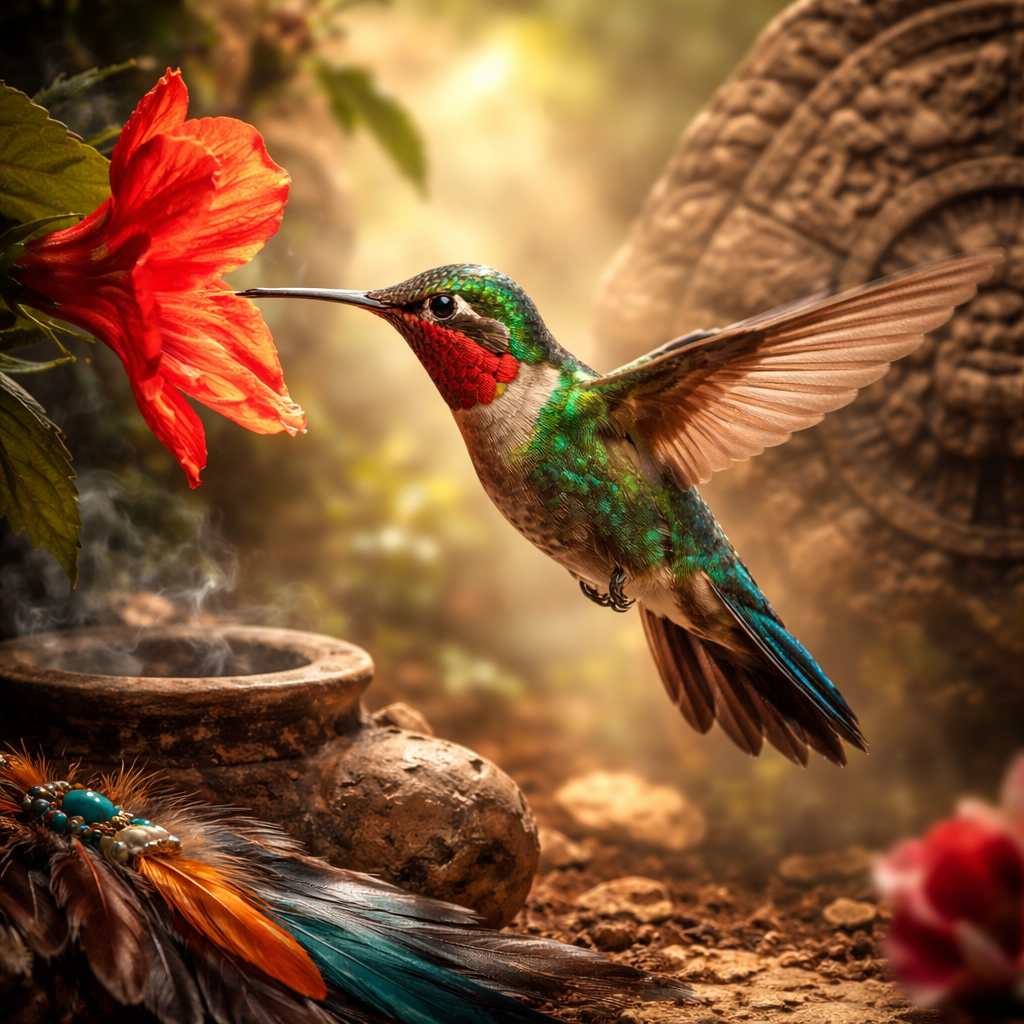
Few creatures have captured human imagination across such distant cultures as the hummingbird — and the meaning of hummingbirds in mythology turns out to be far richer and more layered than most people expect. From ancient Mesoamerican warriors to Celtic-adjacent folk traditions, this tiny bird carried enormous symbolic weight long before it became a popular tattoo motif or garden visitor.
Why such a small bird became a powerful symbol
There is something almost physically impossible about a hummingbird. It hovers in place, flies backwards, beats its wings up to 80 times per second, and survives on pure nectar. Ancient peoples who observed these birds had no framework of biology to explain them — so they turned to the sacred. The hummingbird became a living symbol of energy, resilience, and the bridge between the visible and invisible worlds.
This pattern appears independently across cultures that had no contact with each other, which is what makes the mythology so compelling. The symbolic meanings don’t copy one another — they arrive at similar conclusions from completely different starting points.
Aztec mythology: the warrior reborn
Perhaps the most well-documented mythological role of the hummingbird belongs to the Aztec tradition. Huitzilopochtli — whose name literally translates as “Hummingbird of the South” or “Left-handed Hummingbird” — was one of the most important deities in the Aztec pantheon, associated with the sun, warfare, and the continuation of the world itself.
According to Aztec belief, warriors who died in battle or were sacrificed did not simply vanish. They spent four years accompanying the sun across the sky, and after that transformation, they returned to earth as hummingbirds and butterflies. This made every hummingbird a potential ancestor — a fallen warrior visiting the living world in a new form.
In Aztec cosmology, the hummingbird was not a decoration of nature — it was proof that death was not an ending. Every hovering bird near a flower was, in some sense, a soul in motion.
This belief shaped how Aztec warriors prepared for battle. Wearing hummingbird talismans was considered protective, a way of invoking the spirit of Huitzilopochtli and the courage of those who had already crossed over.
Native American traditions: messengers and healers
Across various Native American nations, the hummingbird held different but consistently elevated roles. The symbolic meanings varied by region, but certain threads ran through many of them.
- Among the Cherokee, hummingbirds were associated with healing. One traditional story describes a hummingbird retrieving a lost tobacco plant — a plant considered sacred and medicinally essential — by flying to the top of the world to bring it back for the people.
- In the traditions of some Pueblo peoples, hummingbirds were seen as intermediaries between humans and the rain gods, capable of interceding during drought.
- The Navajo connected hummingbirds with beauty and blessing — their presence near a person was interpreted as a sign of good things approaching.
- In certain Pacific Coast traditions, the hummingbird was credited with helping to separate earth from sky at the beginning of time.
What unites these stories is the idea of the hummingbird as an agent — not a passive symbol, but a creature that does something on behalf of the human world. It moves between realms, carries messages, restores what was lost.
South American and Caribbean beliefs
In parts of South America and the Caribbean, hummingbird symbolism took on a more intimate, personal dimension. In Trinidad, the hummingbird holds the status of national bird and features in local folklore as a symbol of energy and industriousness — the connection between the natural world and human vitality.
Among some indigenous groups in the Amazon basin, hummingbirds were considered spirit guides capable of helping shamans navigate between the physical and spiritual planes during ritual practices. Their speed and their ability to move in all directions — including backward — made them natural symbols of freedom from ordinary limitations.
| Culture | Primary symbolic role | Associated qualities |
|---|---|---|
| Aztec | Warrior deity, reincarnated souls | Courage, solar energy, sacrifice |
| Cherokee | Healer, sacred messenger | Restoration, medicine, service |
| Navajo | Symbol of blessing | Beauty, good fortune |
| Amazonian traditions | Spirit guide | Freedom, boundary-crossing |
| Trinidad folklore | National spirit, vitality symbol | Energy, industry, life force |
What these stories still mean today
It would be easy to treat these mythologies as historical curiosities — interesting, but disconnected from daily life. In practice, though, many people still draw on hummingbird symbolism in meaningful ways, whether or not they identify with any specific cultural tradition.
The recurring themes across cultures point to something that resonates beyond any single belief system: the hummingbird represents the possibility of lightness in the face of enormous effort. It moves faster than almost anything its size, sustains itself on something as delicate as flower nectar, and appears suddenly, unexpectedly — which is perhaps why so many people report feeling something when one hovers nearby.
Across mythologies, the hummingbird never symbolizes rest or stillness. It symbolizes sustained, purposeful motion — which might be exactly why it resonates with people navigating demanding lives.
In spiritual and personal development contexts, hummingbird symbolism is often invoked around themes of adaptability, joy in small things, and the ability to find nourishment even in difficult circumstances. These aren’t arbitrary interpretations — they grow directly from the mythological roots described above.
A bird that keeps arriving
What the mythology of the hummingbird ultimately shows is that certain creatures manage to speak to something consistent in human experience across geography and time. The Aztec warrior-god, the Cherokee healer’s helper, the Amazonian spirit guide — these are not the same story, but they circle the same truth: that something so small, moving so fast, sustained by so little, somehow endures.
If you’re drawn to hummingbird symbolism, it’s worth exploring the specific tradition it comes from rather than treating it as a generic “good omen.” The depth of meaning is considerably greater — and considerably more interesting — than the simplified versions that circulate in popular culture. Understanding where these beliefs actually come from only adds to the experience of encountering one of these birds in the wild.
