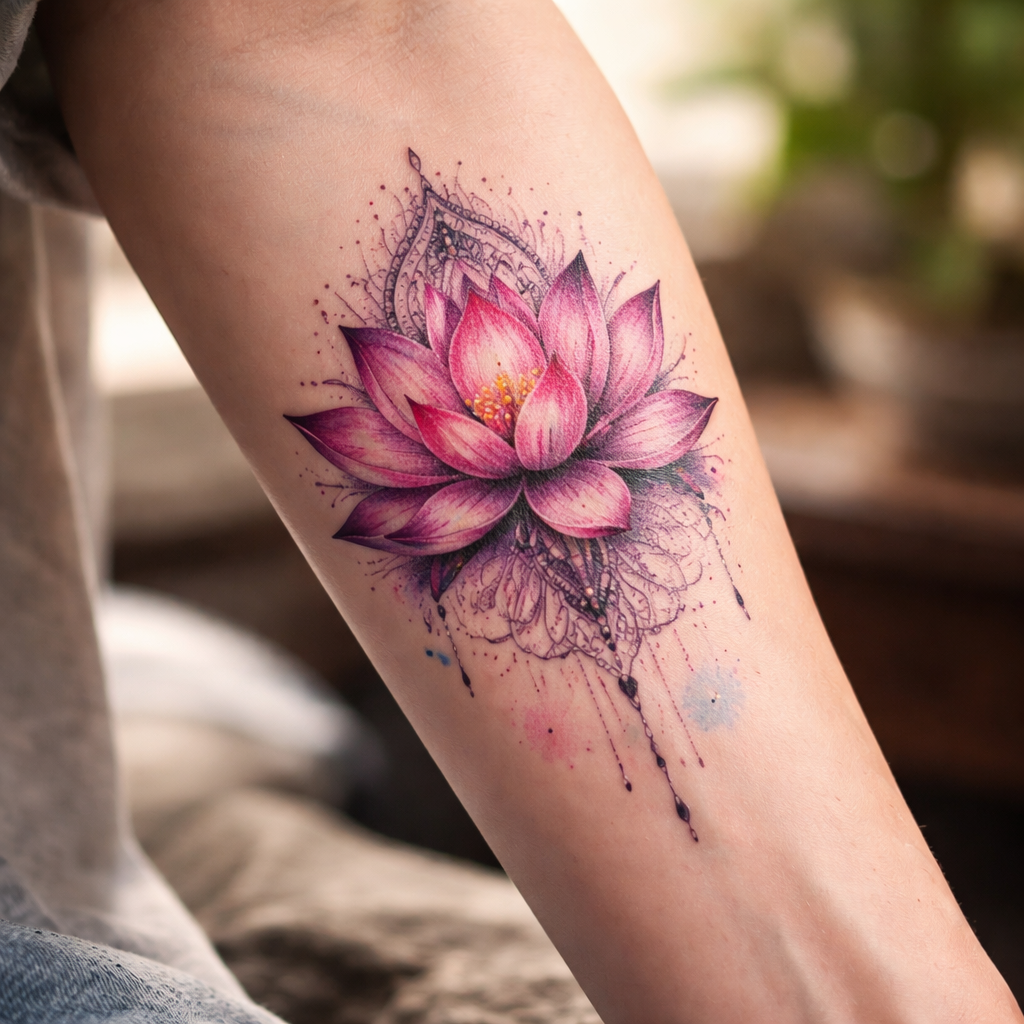
Few tattoo designs carry as much layered significance as the lotus — and understanding the meaning of lotus flower tattoos goes far beyond “beauty” or “zen aesthetics.” This symbol has traveled across centuries, continents, and spiritual traditions, and yet it still feels deeply personal to every person who wears it.
Where this symbol actually comes from
The lotus grows in muddy, murky water — and that’s not a metaphor someone invented later. Ancient Egyptians observed this plant closing at night and sinking beneath the surface, then rising again each morning in full bloom. To them, it represented creation and the cycle of the sun. In Hindu and Buddhist traditions, the lotus carried its own distinct weight: it became associated with divine beings, enlightenment, and the capacity to remain untouched by the impurity surrounding it.
These aren’t interchangeable meanings. The cultural origin of a lotus tattoo genuinely shapes what it communicates — which is why it’s worth knowing the differences before committing to one.
Color changes everything
Most people don’t realize how dramatically the color of a lotus tattoo shifts its symbolic meaning. A pink lotus and a black lotus worn by two different people might represent almost opposite ideas.
| Color | Associated meaning | Common context |
|---|---|---|
| White | Purity, mental clarity, spiritual awakening | Buddhist symbolism |
| Pink | Devotion, the Buddha, divine beauty | Hindu and Buddhist traditions |
| Red | Love, passion, compassion, the heart | Romantic or emotional contexts |
| Blue | Wisdom, knowledge, victory over the senses | Esoteric Buddhist teachings |
| Purple | Mysticism, spiritual journey, transformation | General spiritual symbolism |
| Black | Rebellion, independence, power, the unknown | Contemporary tattoo culture |
If you’re working with a tattoo artist on a design, this is one of the first conversations worth having — not just about what looks good, but what you actually want the piece to say.
What the bloom stage represents
It’s not only the color that carries meaning — the stage of the bloom does too. This is something many people overlook when choosing a design.
- A closed bud often symbolizes potential, the period before transformation, or a journey that’s still unfolding.
- A partially open flower suggests growth in progress — a life actively changing or healing.
- A fully open bloom represents enlightenment, arrival, or a state of peace that has been earned.
Some people choose a bud deliberately because their story isn’t finished yet. Others choose a fully open lotus to mark a turning point — the end of a difficult chapter. Neither choice is more meaningful than the other; they just say different things.
The personal dimension: why people actually get this tattoo
Beyond spiritual traditions and color theory, lotus tattoos resonate with people for very concrete, personal reasons. The most common thread is the idea of rising through difficulty — not despite hardship, but because of it.
“The lotus is the only flower that blooms from the mud. That’s the whole point — it’s not asking to be placed somewhere clean.”
People who’ve come through addiction, grief, trauma, or long periods of depression frequently describe the lotus as the design that captured something they couldn’t put into words. It holds the tension between where you were and where you are — without erasing either part.
This is also why lotus tattoos appear frequently in mental health awareness contexts and recovery communities. The symbol doesn’t promise a clean, painless journey. It just says: growth is still possible from here.
Placement and what it quietly signals
Placement is part of the language too. A lotus on the wrist or inner forearm is often chosen for its visibility — a daily reminder the wearer can see. The back, chest, or sternum placements tend to be more private, something worn close rather than displayed.
- Discuss the cultural tradition your design draws from — it helps your artist get the visual language right.
- Decide on the bloom stage intentionally, not just aesthetically.
- If color is part of the design, ask your artist how different inks age on your skin tone.
- Research artists who have a portfolio in botanical or fine-line tattoo styles — lotus designs vary enormously in execution.
When a lotus tattoo carries spiritual weight
In Buddhism, the lotus is directly connected to the concept of non-attachment — the idea that one can exist in the world without being consumed by it. The flower touches the water but isn’t defined by it. In yoga and Hindu philosophy, the lotus chakra symbol (particularly the crown chakra, Sahasrara) represents the highest state of consciousness.
Some people who get lotus tattoos are practicing Buddhists or Hindus, for whom the design holds explicit religious meaning. Others are drawn to the same imagery for secular reasons — a reminder of mindfulness, of not letting external chaos define internal state. Both are valid, and neither cancels out the other.
What matters is knowing which category you’re in, so the design you choose reflects something real rather than something borrowed without context.
A symbol that keeps finding new people
The staying power of the lotus in tattoo culture isn’t accidental. It works across minimalist fine-line styles, traditional Japanese irezumi, watercolor techniques, and geometric designs — which means it adapts without losing its core identity. That visual flexibility, combined with a meaning that resonates across cultures and personal stories, keeps it one of the most requested tattoo motifs among artists worldwide.
If you’re considering one, the most useful thing you can do is sit with the specific meaning that draws you to it. Not the general idea — the specific one. That clarity will shape every decision that follows: the color, the bloom stage, the placement, the style. And it’s what will make the tattoo feel genuinely yours, rather than just beautiful on the surface.
