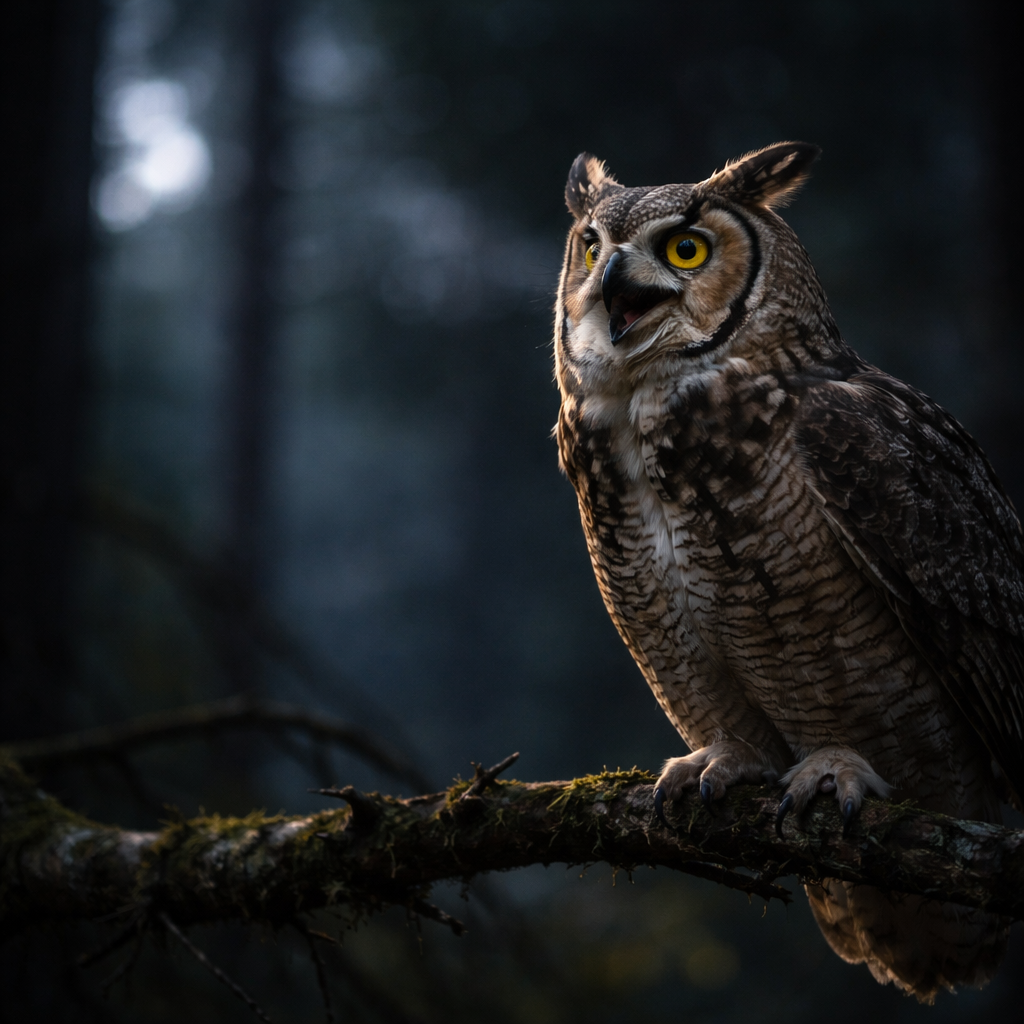
Few nighttime sounds are as striking as an owl’s call cutting through the darkness — and the meaning of owl hooting at night has fascinated humans across cultures and centuries, long before modern ornithology gave us scientific explanations. Whether you heard it outside your window or deep in the woods, that haunting sound is rarely random, and understanding it opens up a genuinely interesting window into owl behavior, ecology, and folklore.
What owls are actually doing when they hoot
Contrary to what many people assume, hooting isn’t simply owls “talking” into the night. Vocalization in owls serves highly specific biological purposes, and different call types carry very different messages. The classic deep hoot associated with great horned owls, for example, is primarily a territorial signal — a way of broadcasting ownership of a particular patch of habitat to other owls of the same species.
Owls are also famously active at night because most species are nocturnal hunters. Darkness gives them a significant advantage: exceptional low-light vision, silent flight due to specialized feather structure, and acute directional hearing. Hooting at night fits naturally into this lifestyle because sound travels differently in cool, still nighttime air, making calls more effective over distance.
The main reasons owls hoot after dark
Ornithologists have identified several distinct motivations behind nocturnal owl calls, and they vary depending on the season, the individual bird, and even the time of night.
- Territory defense: Males use repetitive hooting to warn rival owls away from their established range. This is especially prominent during late autumn and winter, when owls begin claiming nesting territories.
- Mate attraction: During breeding season, hooting patterns become more elaborate. Males may call persistently for hours, and females often respond with their own calls, creating the duets that many people hear on quiet nights.
- Communication between bonded pairs: Mated owls frequently exchange calls to maintain contact, especially when one bird is hunting and the other is at the nest.
- Juvenile calls: Young owls that have recently left the nest produce persistent, raspy begging calls at night — a sound that is often mistaken for something else entirely by people who hear it for the first time.
- Alarm signals: Some species give sharp, rapid hoots or barks in response to perceived threats, including humans moving through their territory at night.
“The great horned owl’s territorial hoot can be heard up to a kilometer away on a calm night — making it one of the most effective long-distance communication tools in the bird world.”
Does owl hooting near your house mean anything specific?
If you’re regularly hearing owl calls near your home, it almost certainly means an owl has established territory in your area — which is genuinely good news from an ecological standpoint. Owls are highly effective natural pest controllers, with a single barn owl family capable of consuming hundreds of rodents over the course of a nesting season.
The time of night can also offer clues. Calls heard shortly after sunset often indicate a bird beginning its hunting patrol. Persistent calling in the hours before dawn, on the other hand, is more commonly associated with territorial or mating behavior, particularly in late winter and early spring when breeding activity peaks.
| Time of hooting | Most likely meaning |
|---|---|
| Just after sunset | Beginning of nightly hunting activity, territory patrol |
| Midnight to 2 AM | Active territorial signaling, mate communication |
| Pre-dawn hours | Breeding calls, duets between paired birds |
| Any time of night (repetitive rasping) | Juvenile begging calls from recently fledged owls |
Owl hooting in cultural and symbolic traditions
Beyond biology, nocturnal owl calls carry deep symbolic weight in human culture. Different traditions have interpreted the sound in remarkably varied — and often contradictory — ways, which tells us more about human psychology than about owls themselves.
In ancient Greek tradition, the owl was associated with Athena, goddess of wisdom, and its call was considered a positive omen. Roman culture, however, often viewed owls as harbingers of death — Julius Caesar’s assassination was reportedly preceded by owl calls, at least according to later accounts. Many Indigenous North American traditions regard the owl as a messenger connected to the spirit world, though interpretations vary significantly between specific nations and communities.
In parts of South Asia and the Middle East, owl calls heard near a home are traditionally associated with incoming change or spiritual messages. Meanwhile, in British folklore, an owl hooting near a pregnant woman was thought to predict the child’s gender. These interpretations share no scientific basis, but they reflect how powerfully the sound affects the human imagination, especially in darkness.
Which owl species are most commonly heard at night
Not every hoot sounds the same, and knowing a few species-specific calls can make nighttime listening far more rewarding. The great horned owl produces the deep, resonant “hoo-hoo-hoooo” most people associate with owls in general. The barred owl, by contrast, calls in a phrase that sounds remarkably like “who cooks for you, who cooks for you-all” — a distinctive pattern that makes it easy to identify.
The barn owl doesn’t hoot at all in the traditional sense; it produces a long, eerie screech that startles people unfamiliar with it. The eastern screech-owl uses a descending whinny or a long tremolo call. The burrowing owl, active in open grasslands, gives a soft two-note coo. Each of these species uses its calls in the same fundamental ways — territory, mating, contact — but the acoustic signatures are genuinely distinct once you’ve had a chance to learn them.
How to respond if owls are calling near your home regularly
Regular owl presence is typically something to welcome rather than worry about. If hooting is disrupting your sleep, it helps to remember that calling activity is usually most intense during a defined breeding window — often six to eight weeks — after which it decreases significantly as the pair settles into nesting and chick-rearing.
- Avoid disturbing known roosting or nesting sites — owls are protected under migratory bird laws in most countries.
- Keep outdoor lighting minimal where possible, as bright lights can affect owl hunting patterns and cause stress.
- If you have a large yard or garden, consider installing an owl nesting box — great horned owls and screech-owls readily adopt them.
- Reduce rodent attractants (uncovered compost, bird seed on the ground) if you’d prefer owls to hunt elsewhere on your property rather than right outside a bedroom window.
When the night speaks back
The next time you hear an owl calling in the dark, you’re listening to one of nature’s most refined communication systems — a sound shaped by millions of years of evolution to carry specific information across terrain and darkness. Whether you choose to interpret it through a biological lens, a cultural one, or simply as one of the more striking sounds the natural world produces at night, that call is doing something purposeful and real. The bird is not performing for you, but that doesn’t make the experience any less worth stopping to hear.
