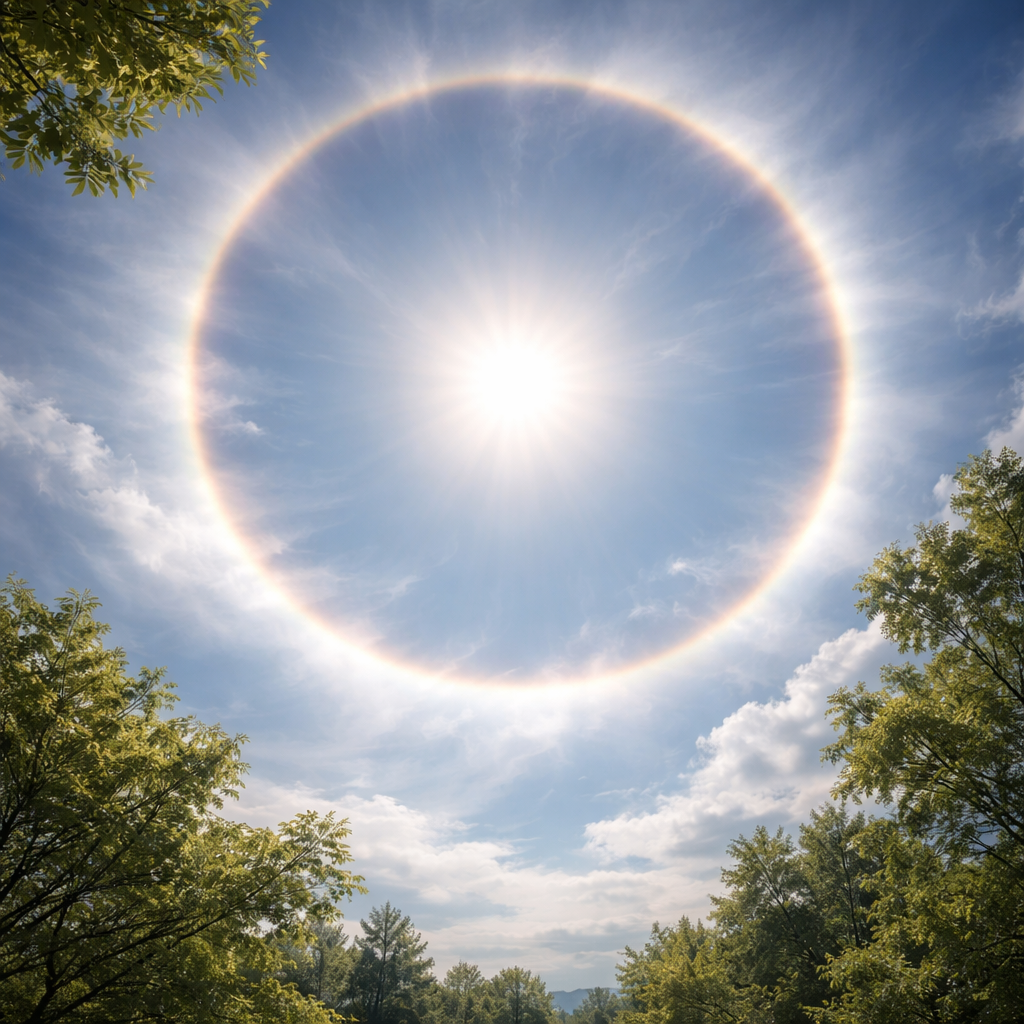
Look up on a clear day and you might catch a glowing ring circling the sun — not a rainbow arching across the sky after rain, but something far less understood. The meaning of rainbow around the sun has puzzled skywatchers, scientists, and curious minds for centuries, and it turns out the explanation is both elegant and rooted in real atmospheric physics.
What You’re Actually Seeing Up There
That luminous halo around the sun is not a true rainbow. Rainbows form when sunlight refracts through water droplets. What creates a ring around the sun is an entirely different optical phenomenon — it forms when sunlight passes through ice crystals suspended high in the atmosphere, typically in cirrus or cirrostratus clouds at altitudes of 20,000 feet or more.
The most common version is called the 22-degree halo, named for the angle at which light bends as it travels through hexagonal ice crystals. This bending — technically called refraction — separates the light into its spectral components, which is why the halo often appears with a faint reddish tint on the inner edge and a bluish or whitish glow on the outer edge.
The 22-degree halo is one of the most frequently observed atmospheric optical phenomena in the world — more common than actual rainbows, yet far fewer people know what it is.
The Science Behind the Ring
Ice crystals in the upper troposphere act as tiny prisms. When sunlight enters one face of a hexagonal crystal and exits through another face at a specific angle, the light bends by a minimum of about 22 degrees. Because millions of randomly oriented crystals are present across the sky, the refracted light forms a complete circle around the sun at that fixed angular radius.
The brightness and clarity of the halo depend on several factors:
- The density and uniformity of the ice crystal layer in the cloud
- The size and shape of the crystals — plate-shaped vs. column-shaped crystals produce slightly different effects
- The position of the sun in the sky — halos are most visible when the sun is at a moderate elevation
- Atmospheric moisture and temperature at high altitude
Sometimes you’ll also notice a brighter spot on the halo at the same height as the sun on either side — these are called sun dogs or parhelia, another related ice-crystal phenomenon that often appears alongside the main ring.
Halo vs. Rainbow: Key Differences at a Glance
| Feature | Sun Halo | Rainbow |
|---|---|---|
| Cause | Ice crystals in high clouds | Water droplets in lower atmosphere |
| Position | Around the sun | Opposite the sun |
| Shape | Full circle or arc | Arc (rarely full circle) |
| Color order | Red on inside, blue outside | Red on outside, violet inside |
| Typical altitude | Above 20,000 ft | Below 6,500 ft |
Can It Predict the Weather?
There is genuine science behind the old folk saying “ring around the sun, rain before done.” Cirrus and cirrostratus clouds — the very clouds that produce sun halos — often precede a warm front. As a warm front approaches, high-altitude ice clouds typically arrive 12 to 24 hours ahead of the accompanying precipitation.
This doesn’t mean a halo guarantees rain every time. The atmosphere is complex, and frontal systems don’t always behave predictably. But statistically, a visible sun halo in a milky, thin overcast sky is a legitimate early indicator that weather may be changing within the next day or so.
Other Types of Solar Halos Worth Knowing
The 22-degree halo is the most recognizable, but it belongs to a broader family of atmospheric optics events. Depending on the type, orientation, and size of ice crystals present, different structures can appear in the sky:
- 46-degree halo — a larger, fainter ring that forms at twice the angular distance, much rarer than its 22-degree counterpart
- Circumzenithal arc — a colorful upside-down arc near the zenith, sometimes called an “upside-down rainbow,” caused by plate-shaped crystals
- Infralateral arcs — curved arcs below the sun that extend from the 46-degree halo
- Light pillars — vertical columns of light above or below the sun, visible mostly in cold climates near sunrise or sunset
Each of these phenomena has its own specific geometry and set of crystal conditions. Atmospheric optics is a genuinely rich field, and amateur observers around the world document these events regularly through photography and citizen science platforms.
Is It Safe to Look at a Sun Halo?
This is one of the most commonly asked questions — and it deserves a direct answer. No, you should never look directly at the sun, even when a halo is visible. The halo itself forms around the sun at a 22-degree distance, so the ring can often be observed by blocking the sun with your hand or using a physical object for shade.
Photographers typically use a building edge, a tree branch, or a lens hood to block the solar disk and capture the full circle without damaging their eyes or sensors. Sunglasses can help reduce glare when looking near — but not at — the solar disk to observe the halo’s structure and color gradient.
Something Worth Pausing For
There’s something quietly remarkable about the fact that thin, invisible clouds made of microscopic ice crystals — floating miles above your head — can project a perfect geometric ring of color around the sun. No special conditions required, no storm needed. It happens on ordinary days, often going unnoticed because most people aren’t in the habit of looking up.
Once you understand what produces a sun halo, you start seeing connections: the thin veil of cloud, the slight milky quality of the sky, the faint colored ring. These aren’t random — they’re the atmosphere speaking in a language that atmospheric optics helps decode. And knowing how to read it makes an ordinary afternoon sky considerably more interesting.
