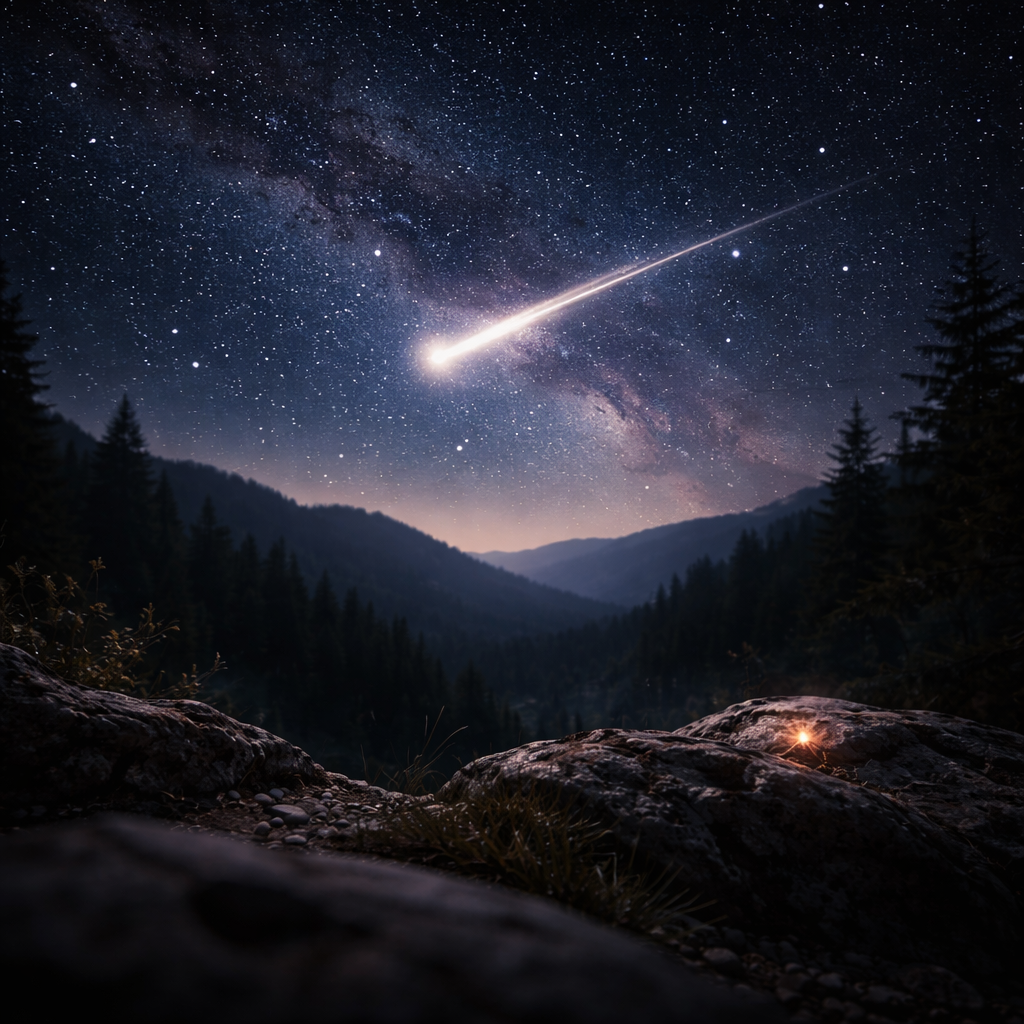
Every year, millions of people look up and catch a brief streak of light crossing the night sky — and almost instinctively make a wish. But the meaning of shooting stars goes far deeper than folklore and childhood wishes. These fleeting phenomena carry both rich cultural history and fascinating scientific explanations that are worth exploring properly.
What shooting stars actually are (and what they are not)
Despite the romantic name, shooting stars have nothing to do with actual stars. They are meteors — small fragments of rock, dust, or metallic material that enter Earth’s atmosphere at high speed. The intense friction between these particles and atmospheric gases causes them to heat up and glow, producing the bright trail we see from the ground. Most meteors are no bigger than a grain of sand or a small pebble.
If a meteoroid survives the journey through the atmosphere and lands on Earth’s surface, it becomes a meteorite. This distinction matters, because it means what you witnessed in the sky may have physically reached the ground somewhere — though this is rare for smaller particles.
Where do they come from?
Shooting stars originate from several sources. Most of the material floating through our solar system comes from asteroid belts or cometary debris. When Earth passes through the trail of dust left behind by a comet, we experience a meteor shower — a predictable, repeating event that amateur astronomers plan for every season.
| Meteor Shower | Peak Period | Parent Comet or Asteroid |
|---|---|---|
| Perseids | Mid-August | Comet Swift-Tuttle |
| Leonids | Mid-November | Comet Tempel-Tuttle |
| Geminids | Mid-December | Asteroid 3200 Phaethon |
| Eta Aquariids | Early May | Comet Halley |
The Geminids are particularly interesting because they come from an asteroid rather than a comet — a relatively unusual source that scientists are still studying closely.
The cultural and spiritual meaning across different traditions
Long before telescopes and astrophysics, people across the world looked at falling stars and tried to make sense of them. The interpretations varied enormously depending on geography, religion, and era — but nearly every culture assigned significance to these lights in the sky.
- In ancient Greece, shooting stars were believed to be souls descending from the heavens or ascending toward them.
- Many Native American traditions viewed them as messages from ancestors or signals from the spirit world.
- In parts of East Asia, meteors were historically interpreted as omens — sometimes positive, sometimes warning of change.
- European folklore widely associated a falling star with a wish being granted, a tradition that persists globally to this day.
- In some African traditions, shooting stars were connected to the movement of divine beings through the sky.
What is striking about these varied traditions is that almost none of them interpreted shooting stars as ordinary or meaningless. The human instinct to find symbolism in sudden, brief events is well-documented in psychology — and a meteor is about as sudden and brief as natural phenomena get.
“Meteors have fascinated humanity not because they are powerful, but because they are fleeting. They appear without warning and vanish just as quickly — making them feel personal, even intimate.”
The wish-making tradition — where did it come from?
The specific practice of wishing on a shooting star is most commonly traced to ancient Greek and Roman beliefs. The astronomer Ptolemy wrote that the gods occasionally peered down at the Earth, and when they lifted the celestial sphere slightly to look, stars would slip through and fall. Since the gods were already paying attention at that moment, it was the ideal time to make a request.
Over centuries, this idea blended with various European folk customs and eventually became the universalized tradition we know today. The wish must be made quickly — before the streak disappears — which adds a psychological urgency that makes the ritual feel charged and meaningful.
Fireballs, bolides, and other dramatic visitors
Not all meteors are equal. While most produce only a faint streak lasting a second or two, some create exceptionally bright displays called fireballs. A fireball is defined as a meteor brighter than Venus in the night sky. An even more intense version, called a bolide, may produce an audible sonic boom and can be seen in daylight.
Fireball events are reported regularly around the world and are tracked by meteor observation networks in the United States, Europe, and Australia. When a fireball is detected by multiple sensors, scientists can calculate its trajectory and potentially locate where fragments may have landed.
Why people still feel something when they see one
There is something psychologically compelling about shooting stars that goes beyond superstition. Researchers in positive psychology have noted that awe-inducing natural events — those that feel vast, rare, or unexplained — have a measurable effect on human wellbeing. They can shift perspective, reduce stress, and increase a sense of connection to something larger than daily routine.
A shooting star fits that description almost perfectly. It is real and natural, yet it appears unexpectedly, lasts only a moment, and leaves no trace. Whether you interpret it scientifically or symbolically — or both — the experience tends to stay with people in a way that a clear night sky alone does not.
So the next time you catch that streak of light overhead, you are simultaneously witnessing a piece of ancient solar system debris burning up in the atmosphere and participating in one of the most enduring traditions in human history. Both things are true at once — and that combination is what makes shooting stars genuinely worth looking up for.
